
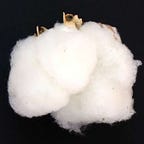
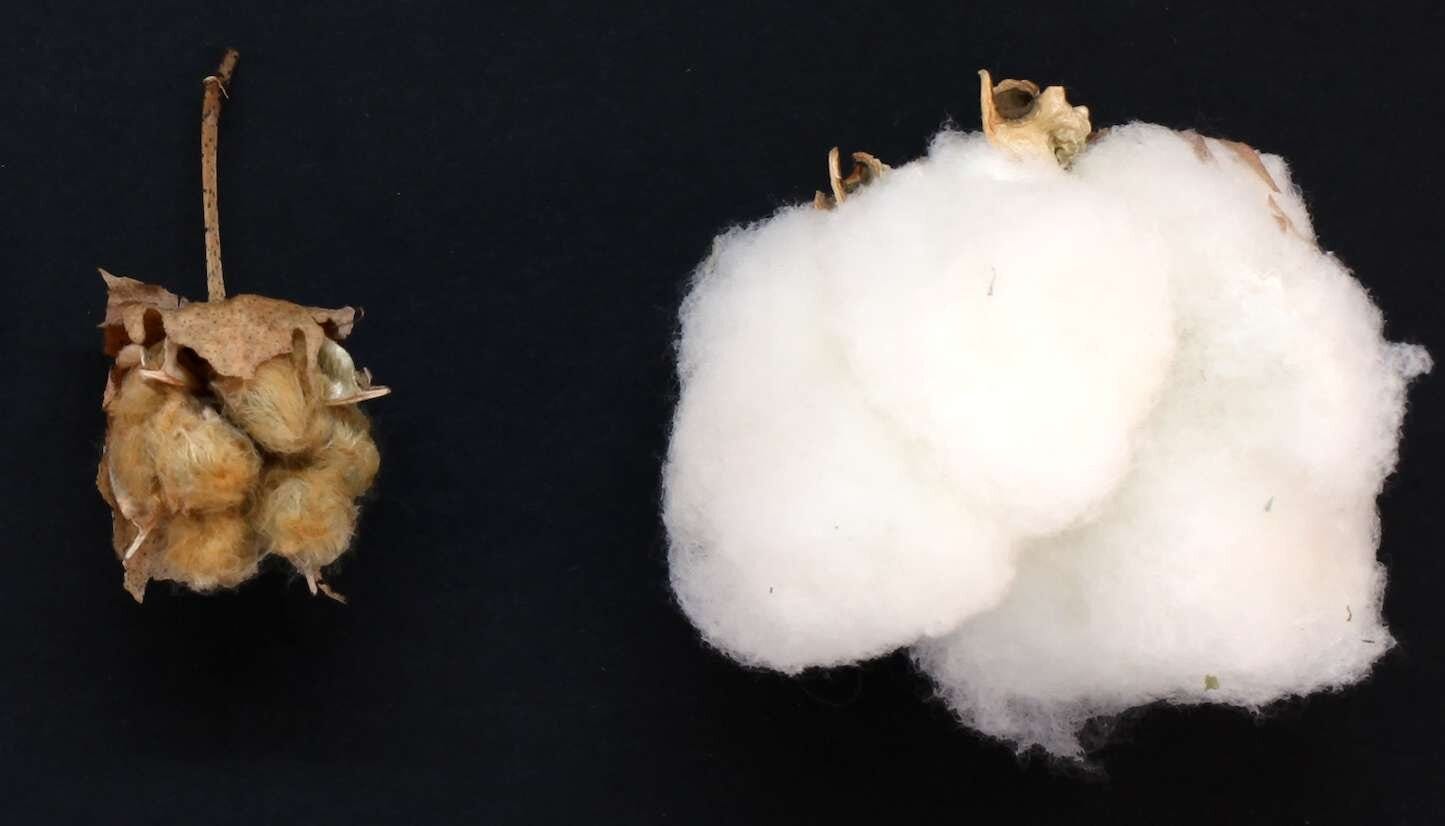
Jonathan Wendel keeps a cotton boll in his office at Iowa State, the kind that comes off a commercial field: a soft white burst of fiber exploding out of a capsule about the size of a golf ball. Next to it he sometimes sets a wild boll, and the contrast is almost comic. The wild capsule is smaller, harder, and the fiber inside is short, coarse, and the color of weak tea. Nobody looking at one would guess it’s related to the other. Wendel has spent forty years trying to explain how it happened anyway.
He now has an answer1 with the genomic resolution his earlier career lacked. A team led by Weixuan Ning and Corrinne Grover, with Wendel as senior author, sequenced 299 newly collected wild cotton plants from the Yucatán Peninsula and the coast of southwestern Florida and compared them against existing genomic data from domesticated cultivars, early landraces, and two related wild species. What they found does more than confirm a decades-old hypothesis. It sharpens it considerably. Upland cotton, Gossypium hirsutum, the species that accounts for roughly 90 percent of cotton grown today, traces its domestic lineage to one specific patch of coastal scrubland in northwestern Yucatán, a region that still carries more genetic diversity than anywhere else the species exists in the wild.
The hypothesis itself isn’t new. Wendel and colleagues proposed a Yucatán origin more than thirty years ago, using allozyme markers and RFLP data that, by today’s standards, amounted to squinting at the problem through a keyhole. The basic geography held up, but the methods couldn’t distinguish a broad regional origin from a precise one, and they couldn’t rule out the possibility that the “wild” cotton being sampled wasn’t actually feral, escaped cultivars gone rogue and readopting wild traits while still carrying the genomic fingerprints of domestication underneath. Telling truly wild cotton apart from feral cotton turns out to be one of the harder problems in this field, since a domesticated plant can drift back toward wild-looking morphology within a few generations while its genome quietly remembers where it came from.
Sorting that out required two things the earlier studies didn’t have: cheap whole-genome sequencing and an enormous number of plants collected in the right places. The team built a new reference genome from a Yucatán accession, assembled from PacBio and Hi-C data into 26 chromosomes, and used it as the scaffold for comparing 392 cotton genomes total, spanning Florida, Puerto Rico, Guadeloupe, the Yucatán, modern cultivars, two early landrace groups, and the related species Gossypium barbadense and Gossypium mustelinum as outgroups.


