

Every pediatrician has a name for it now: flat head syndrome, or deformational plagiocephaly, if you want the clinical term. It’s the mild, usually harmless flattening that shows up on the back or side of a baby’s skull after months of lying on a soft flat surface, unable to turn its own head against gravity. Parents worry about it, then mostly forget about it once their kid starts walking around with a full head of hair. It seems like exactly the kind of thing that has nothing to do with deep time.
It turns out to be exactly the kind of thing that has everything to do with deep time.
A team led by Yousuke Kaifu at the University of Tokyo has just published a study in Proceedings of the Royal Society B1 arguing that skull flattening is not just a modern parenting footnote. It is a physical signature of a trait so central to being human that its absence or presence in a fossil skull can tell you something about how that individual’s infancy went, and by extension, whether someone had to take care of it.
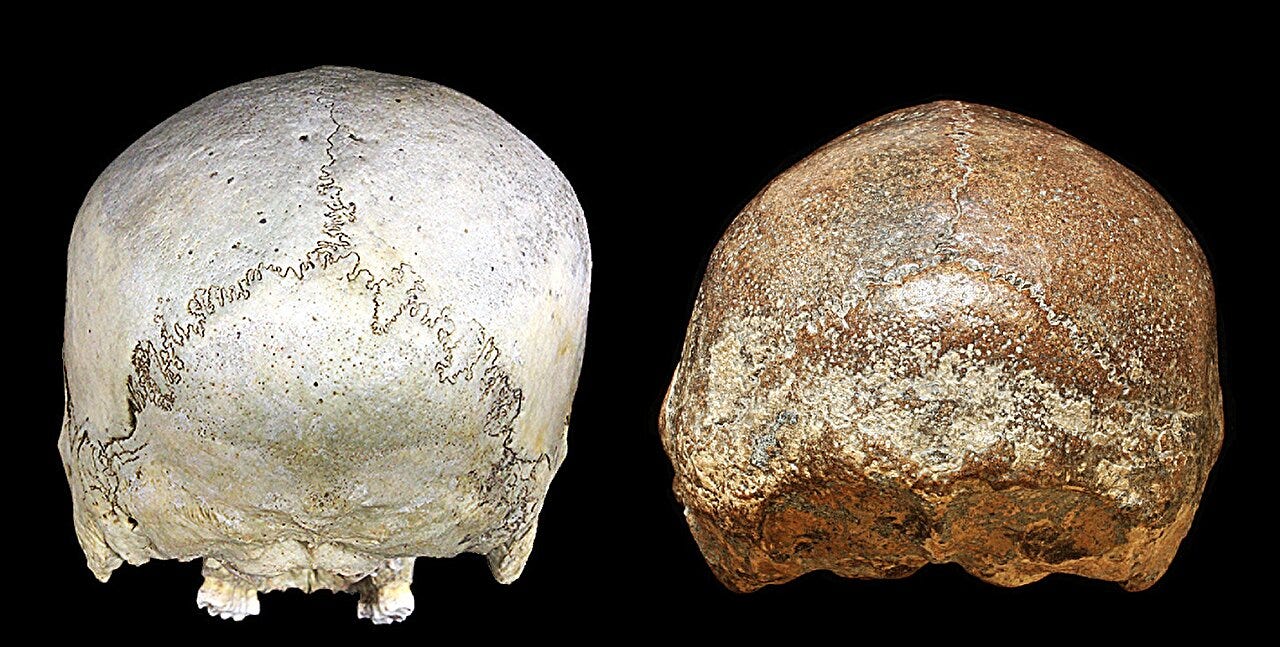
Start with the strange fact this whole study is built on. Human babies are almost comically underdeveloped compared to other great apes. A newborn chimpanzee can lift its head within weeks and cling unaided to its mother’s fur by two months old, freeing her to move through the forest without using her hands to hold the infant in place. A newborn human can do neither. Our necks are weak, our skull bones are thin and mobile, held together by soft fontanelles that won’t fully close for well over a year, and our brains are still doing roughly three quarters of their total postnatal growing after we’re already out in the world. Chimp and macaque brains, by contrast, do most of their growing before birth, arriving already past the steepest part of the growth curve.
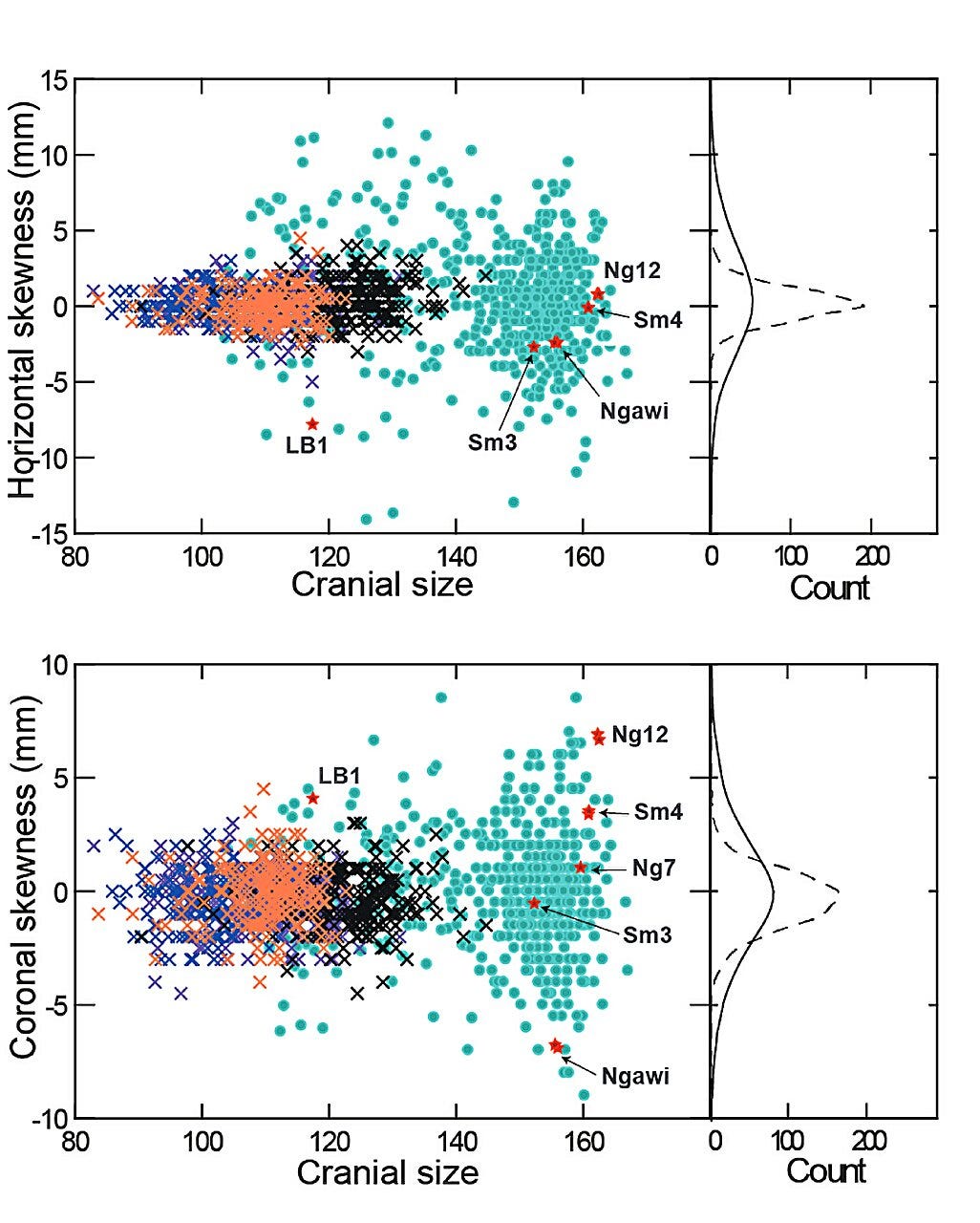
The going explanation for this has long been the obstetrical dilemma: bipedalism narrowed the pelvis, big brains demanded a wide birth canal, and something had to give. Babies got evicted early, before their skulls and nervous systems caught up, because keeping them in utero any longer risked a birth canal that couldn’t accommodate a bigger head. It’s a tidy story. The problem has always been figuring out when in the hominin lineage this trade-off actually kicked in, since infant fossils are vanishingly rare and the skeletal evidence that does survive is fragmentary.


