
Fly a laser over enough rainforest and the forest starts to admit things. Not all at once. The canopy has to be pierced pulse by pulse, from a plane running long straight lines a few hundred meters up, and even then the ground only shows itself in fragments, wherever enough light manages to slip through gaps in the leaves and bounce back. It is a slow, expensive, unglamorous way to look at the earth. It is also, as of this year, how a team led by Martti Pärssinen has forced1 a rewrite of what people are willing to say about the precolonial Amazon.
The rewrite is this: between roughly 600 BCE and 850 CE, a network of interconnected societies in what is now the Brazilian state of Acre and neighboring Amazonas built somewhere between 24,000 and 30,000 earthworks across an area of about 183,000 square kilometers, roughly the size of Syria. At its peak, around 100 to 300 CE, this civilization may have supported somewhere between 1.25 and 3 million people. Pärssinen and his colleagues call them the Aquiry, after the Indigenous name for the Acre River, and their paper, published in Nature, reads like a demolition of the polite skepticism that has followed Amazonian archaeology for decades.
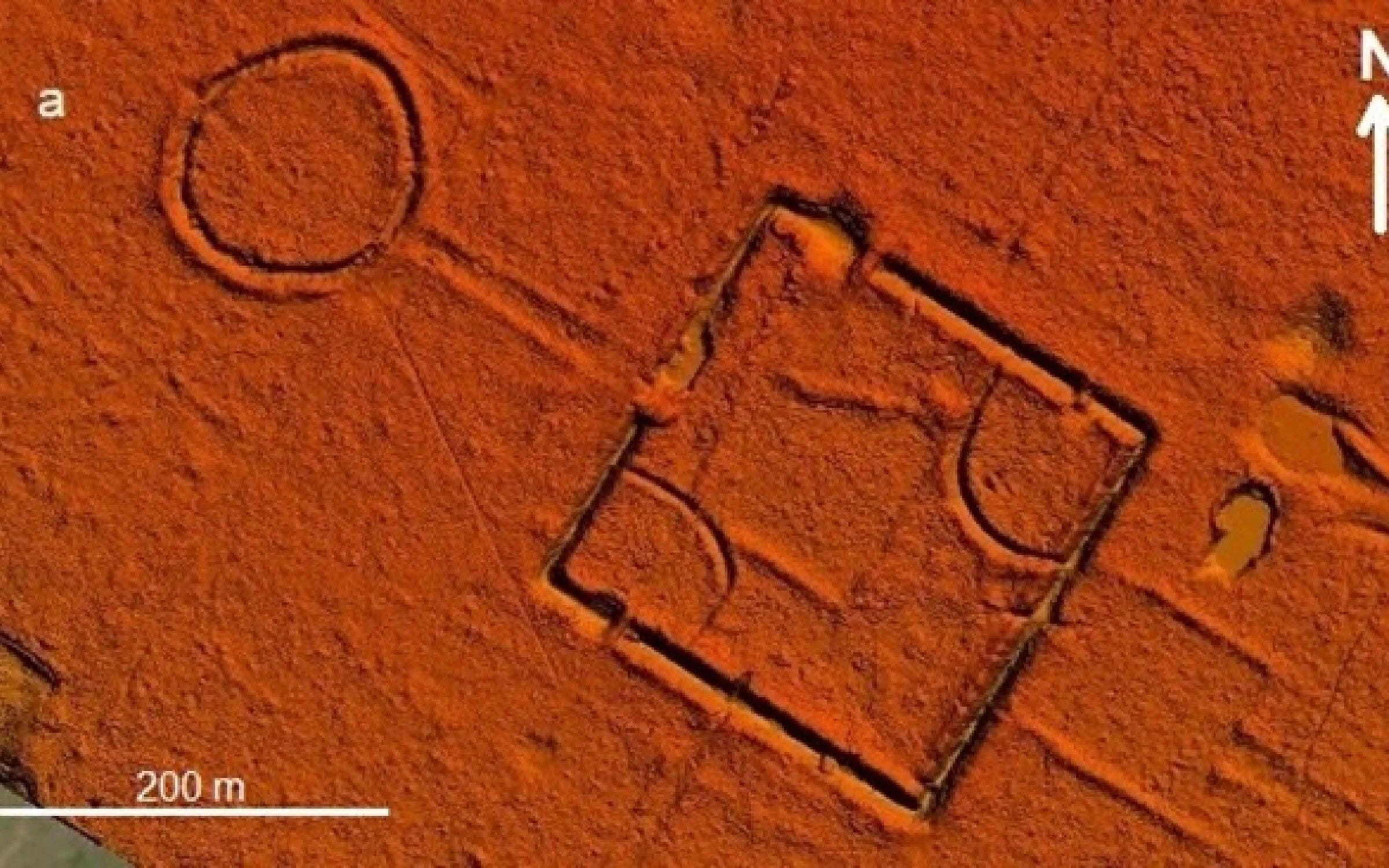
The number that ought to stop you is the multiplier. When the researchers flew LiDAR over ground they had already surveyed using satellite imagery, they found five times more earthworks than the satellite data had shown. Where visible-light imagery from a deforested patch had picked out 30 structures, the laser found 156, at the exact same site. Extend that correction across the whole known extent of Aquiry territory and you get a civilization roughly ten times larger than anyone had previously proposed.
None of this comes from grand stone monuments, because there is no stone. Southwestern Amazonia sits on a landscape without the raw material that let other precolonial societies build cities that read as cities to modern eyes. What the Aquiry left instead are earthworks: ditches cut nine to thirteen meters wide and up to five meters deep, banked with the excavated soil, laid out in squares, rectangles, and circles that sometimes cluster into complexes of six or eight enclosures joined by wide roads. The largest known example covers fifty hectares. Most are smaller, under a hectare and a half on average, but there are thousands of them, and until this survey most sat buried under forest that satellite cameras simply could not see through.


