
The scissors are 123mm long. So are the tweezers. Both are iron, nearly pure iron, the kind that only a mature smelting industry can reliably produce. They were buried sometime around the early fifteenth century with a man named Xia Quan, who died in 1411, in Jiangyin County in what is now Jiangsu Province, China. When archaeologists excavated the tomb in 1974, the instruments went to the Jiangyin Museum. Decades passed.
Then someone looked more carefully at the rust.
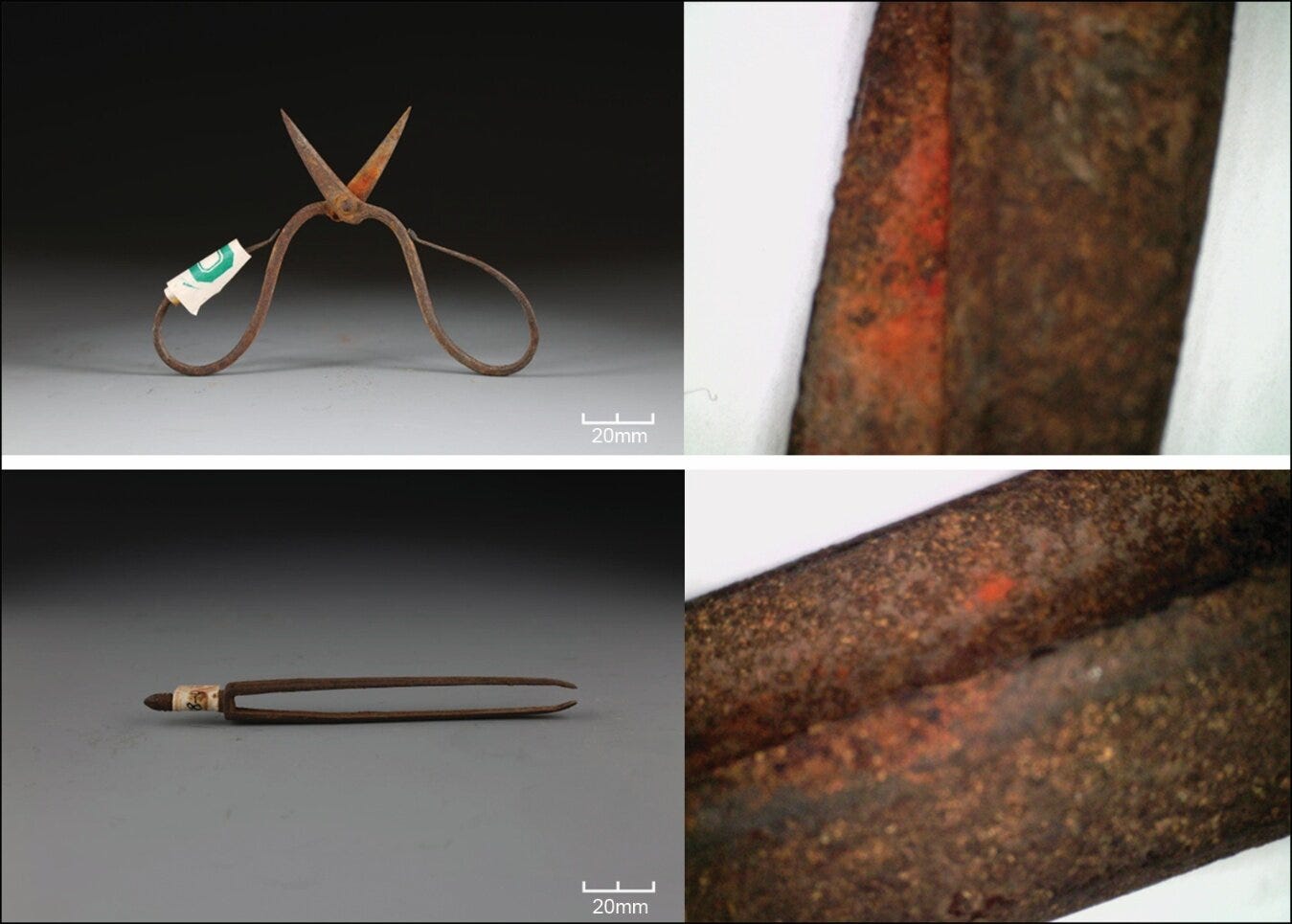
It wasn’t ordinary rust — or rather, it wasn’t only ordinary rust. In the places hardest to clean, the overlapping joints of the scissor blades, the recessed body of the tweezers near the handle, there were small deposits of bright red micro-residue. A team led by researchers from Northwest University in Xi’an collected just two milligrams from each instrument, a barely visible trace of red in a collection tube, and subjected them to a suite of analytical techniques. Their findings, published in Antiquity1 in 2026, suggest those red specks are the physical remnants of an anaesthetic applied during surgery more than six centuries ago.
The substance in question is aconitine. It comes from plants of the Aconitum genus, a group that includes Aconitum carmichaelii and Aconitum kusnezoffii, both widely cultivated and collected across China. The alkaloid is extremely toxic. It is also, at controlled doses and in prepared form, a potent analgesic.
Reading the residue
Identifying organic compounds on corroded medieval iron is not straightforward. Conventional residue analysis techniques, including gas chromatography mass spectrometry, typically require larger samples and frequently fail when material is poorly preserved or quantities are minute. Early excavations in China compounded the problem by paying little attention to residue analysis at all, meaning that potential chemical evidence was often lost.
The team addressed this by applying stimulated Raman scattering microscopy, an advanced optical technique that integrates spectroscopy and chemical imaging, and crucially, avoids the fluorescence interference that disrupts conventional Raman analysis. SRS works by detecting molecular vibrations at specific wavenumber ranges without needing to destroy the sample or extract more material than a microscope can accommodate.
What they found in the residue particles was a characteristic cyano group (-CN) peak at around 2101–2105 cm⁻¹, alongside methylene (-CH₂-) stretching vibrations near 2848 cm⁻¹. The cyano absorption band is the telling signal: blood lacks cyano-compounds, so an organic residue containing a -CN group points away from biological contamination and toward a medicinal source. To confirm the identification, the team ran SRS analysis on a commercially prepared thin-tissue section of Aconitum carmichaelii as a reference. The reference spectrum showed a clear peak at 2103 cm⁻¹ in the cyano-stretching region, matching the residue exactly, and characteristic peaks at 2834, 2864, and 2882 cm⁻¹ in the C-H stretching region, closely mirroring the residue signals from both instruments.
The ester group characteristic of intact aconitine (which would show up around 1700–1740 cm⁻¹) is absent from the spectra, which the team attributes to partial hydrolysis over six centuries. But the core chemical fingerprint, the cyano group and the methylene pattern, remained intact and detectable. The residues were also concentrated in the functional parts of the instruments, consistent with deposition during use rather than later contamination.
The plant, the poison, and how to work around it
Aconitum has a long history in Chinese medicine. The character for aconite appears in oracle bone script from around 1250–1046 BCE, making it one of the earliest documented plant drugs in the archaeological record. Shen Nong’s Materia Medica, compiled during the Han dynasty, records it formally. By the Song Dynasty, practitioners had begun distinguishing between the cultivated form (A. carmichaelii) and the wild form (A. kusnezoffii), noting that the latter was the more toxic of the two.
Toxicity was understood explicitly, not as a side effect in the modern pharmacological sense, but as an inherent property of the plant that had to be actively managed. By the Ming period, a body of processing knowledge had developed around making Aconitum preparations safe enough to administer. Methods included boiling in vinegar, soaking in black soybean decoctions, treating with boys’ urine, detoxifying with mung beans, and removing the outer skin of the tuber. These preparations produced what texts refer to as Caowu San (草乌散), anaesthetic powder, documented in at least four Ming medical compilations including Shiyi’s Formulary of Tested Efficacy and the Compendium of Medicine. The primary function was to render patients insensitive to pain during surgery.
Nineteen historical Chinese anaesthetic formulae survive in textual records. Most include A. carmichaelii or A. kusnezoffii or both, often in combination with other plants including Datura, Ligusticum chuanxiong, and Pinellia ternata. Wang Kentang’s Standards for Diagnosis and Treatment: Ulcer Treatment (1602) describes direct clinical procedure: before using scissors in surgery, one would first apply a numbing agent to the area, then cut. In dental procedures recorded in Miscellaneous Sayings from the Upper Pool, tweezers were used after applying a small amount of glutinous rice paste. The instruments, in other words, routinely came into direct or indirect contact with medicinal preparations.
The concentration of residue on the Xia Quan tweezers, near the handle, covering an area of about 1.5mm, is consistent with a medicinal liquid having splashed onto this concealed area during topical application and escaped cleaning. This is exactly what Ming surgical texts prescribe: applying the numbing compound to the patient’s skin before cutting. The residue is not on the working tips of the instruments but in the recessed areas near the handles, where a liquid applied from a container during use would naturally accumulate and persist.
What makes this find distinctive is precisely that gap between textual and physical evidence. Ming medical texts have long described anaesthetic preparations and their use in surgery. But describing a practice and demonstrating it materially are different things. The Xia Quan instruments now provide the latter: direct chemical evidence, on actual surgical tools from a datable tomb, for the presence of Aconitum alkaloids.
Whether this constitutes incontrovertible proof is worth being clear about. The SRS identification rests on spectral pattern-matching rather than full molecular characterisation, and the constraints imposed by the Jiangyin Museum on destructive sampling meant the analytical scope was limited. The authors are appropriately measured in framing the result as “probable” traces of aconitine. But the convergence of chemical signature, instrument type, residue location, and textual record makes the interpretation coherent and well-supported.
The instruments themselves are telling too. At around 97% iron each, both tools reflect what was achievable through Ming smelting technology at its height. Jiangsu Province was a thriving centre for medical practice during the Ming and Qing dynasties, and the iron industry of the period, transitioning from state-run to private operations through the early 1400s, was producing tools of sufficient purity and precision for surgical use. The scissors closely resemble what modern practitioners would recognise as straight operating scissors. The tweezers, with their inward-curved tips, bear a functional resemblance to Allis tissue forceps. These are not rough approximations. They are purpose-built instruments.
That a physician practising surgery in fourteenth-century Jiangyin would apply a processed Aconitum preparation to a patient’s skin, pick up iron scissors and tweezers, and cut — and that those instruments would eventually carry molecular traces of the preparation into a tomb, through six hundred years of corrosion and storage, and into a spectrometer — is, to put it plainly, remarkable. Not because it requires us to revise what we knew about Ming medicine. The textual record already pointed here. But because the chemistry now agrees.
Further Reading
Cheng, J.X. & Xie, X.S. (2015). Vibrational spectroscopic imaging of living systems: an emerging platform for biology and medicine. Science 350. https://doi.org/10.1126/science.aaa8870
Rageot, M. et al. (2023). Biomolecular analyses enable new insights into ancient Egyptian embalming. Nature 614: 287–93. https://doi.org/10.1038/s41586-022-05663-4
Giachi, G. et al. (2013). Ingredients of a 2,000-y-old medicine revealed by chemical, mineralogical, and botanical investigations. Proceedings of the National Academy of Sciences USA 110: 1193–96. https://doi.org/10.1073/pnas.1216776110
Czamara, K. et al. (2014). Raman spectroscopy of lipids: a review. Journal of Raman Spectroscopy 46: 4–20. https://doi.org/10.1002/jrs.4607
Müller, B. et al. (1992). Raman studies of solid hydrogen cyanide (HCN, DCN) and of HCN argon matrices. Spectrochimica Acta Part A: Molecular Spectroscopy 49: 191–97. https://doi.org/10.1016/0584-8539(93)80174-9
Ling, X., Li, J., Zhao, G., Cao, X., Weng, X., Zhang, H., Li, Z., & Zhao, C. (2026). Surgical anaesthesia in Ming China: scientific analysis of aconitine residues on medical instruments. Antiquity. https://doi.org/10.15184/aqy.2026.10347


