

The bronze rack was in pieces before anyone had a chance to loot it.
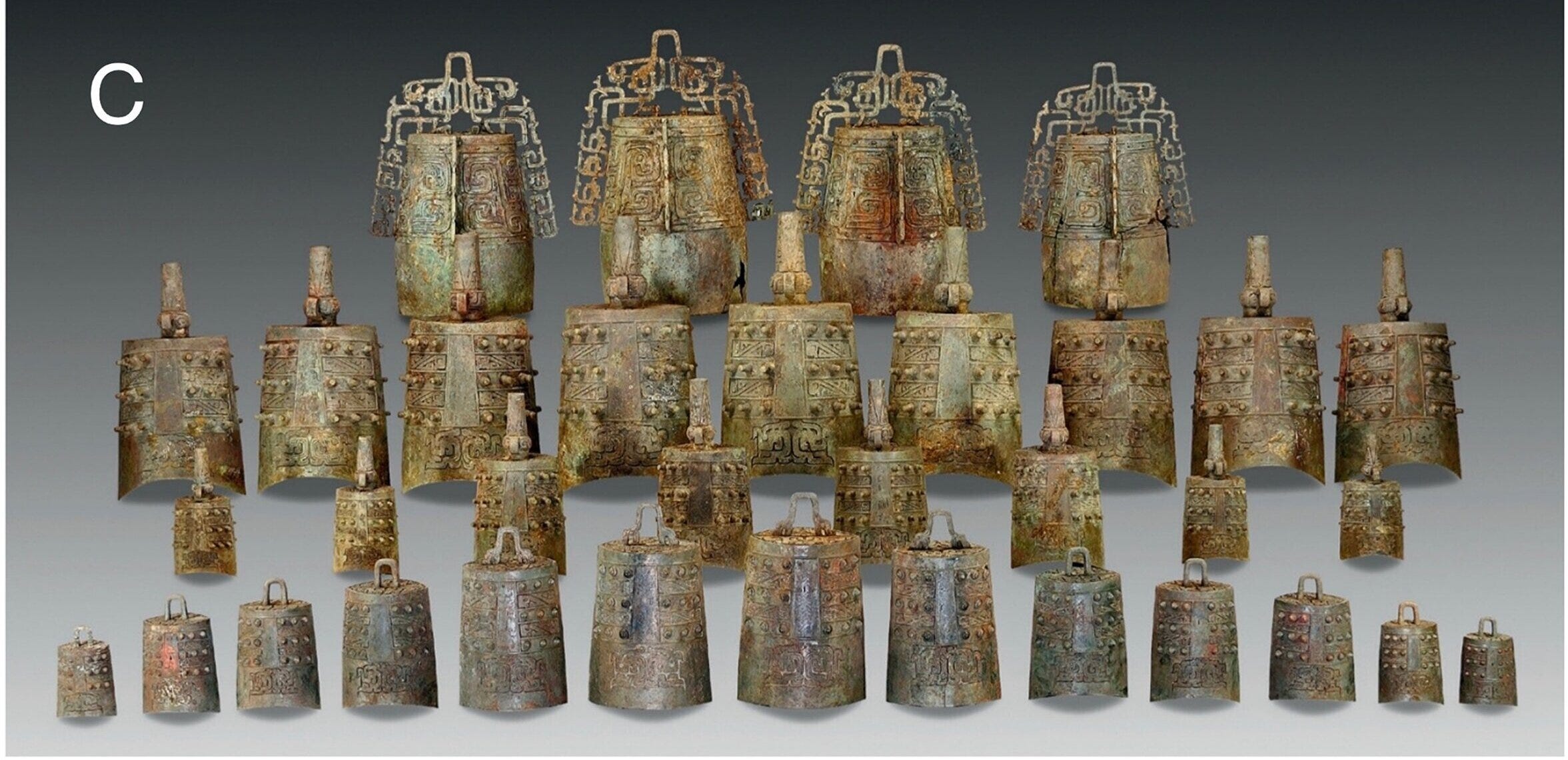
In the northwestern corner of tomb M190, someone had dismantled a musical instrument on purpose. Not casually. Not as an accident of collapse or centuries of settling earth. The rack that once held twenty-one bronze bells in a graduated line, largest to smallest, had been broken into pieces and scattered across the chamber floor, its fragments lying nowhere near the bells they were built to hold. The bells themselves lay in a jumble, facing every direction of the compass, stacked haphazardly on top of one another. Two bell-shaped bozhong sat upright on other bells like paperweights.
This is not what a Zhou-dynasty burial usually looks like. Bronze bells were expensive, difficult to cast, and central to the ritual life of the aristocratic families who owned them. When they went into the ground with their owners, they normally went in the way they were meant to be played: hung on their racks, arranged by size, oriented consistently, ready in principle to be struck again. Archaeologist Chinglong Tse, whose analysis of the tomb appears in the Cambridge Archaeological Journal,1 argues that the disorder in M190 was not decay. It was a decision.
The man in the tomb was Lord Qiu of Zeng, who ruled a small but strategically placed state in what is now Hubei province sometime in the seventh century BCE, during the fractious Spring and Autumn period. Zeng sat in a river corridor linking the Yangtze basin to the old Zhou heartland, a position that made it useful to everyone and safe from no one. Its rulers claimed a mandate from Heaven itself to govern and protect the south. Its most serious rival for that role was Chu, an expanding regional power that would eventually swallow Zeng whole, though not before an unusual detour.


