

Three helmets have sat in the British Museum collection for more than a century, catalogued as copper alloy. The description is technically accurate. It is also, a new study argues, seriously incomplete.
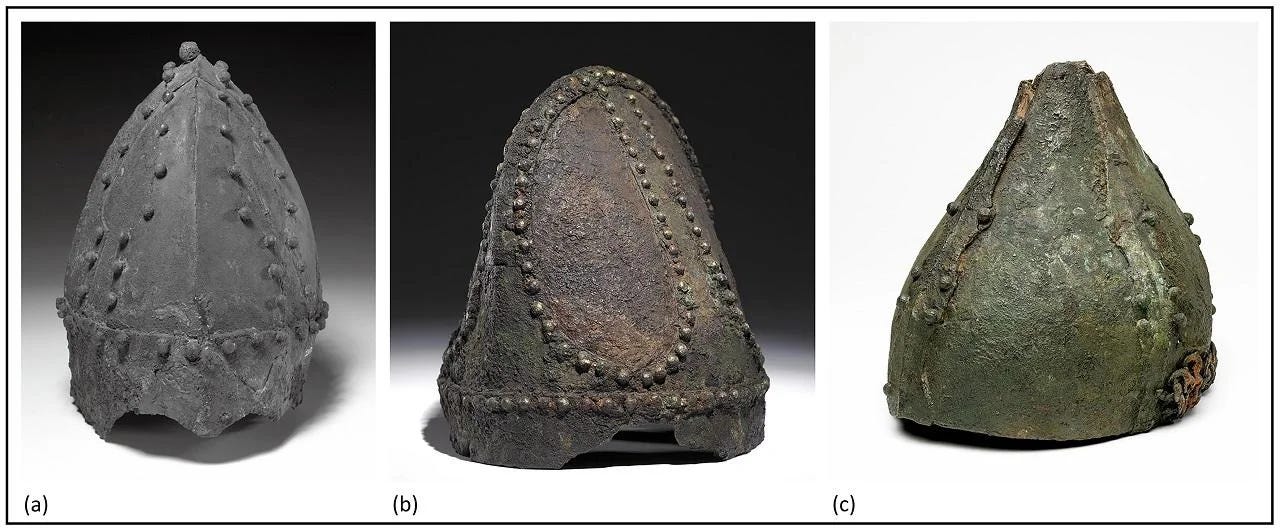
The helmets came from Nineveh, excavated in the nineteenth century. They date to the late Sasanian period, probably the sixth or seventh century CE. Multi-part segmented designs assembled from iron plates, copper alloy strips, and rivets, they are among the very few intact examples of Sasanian military headgear known to survive. A team of researchers from the British Museum and the University of Cambridge recently subjected1 these helmets, along with a collection of excavated metal fragments from Merv in present-day Turkmenistan, to X-ray fluorescence analysis, scanning electron microscopy, and radiographic imaging. What they found changes the way these objects need to be read.
Many of the copper alloy components in the helmets are brass. Not bronze. Brass. The difference is not pedantic.
Bronze is an alloy of copper and tin. Brass substitutes zinc for tin. They can look similar, and for routine archaeological cataloguing they have often been treated as interchangeable. But they have distinct chemistries, distinct physical properties, distinct supply chains, and distinct histories in the archaeological record. Calling a brass object “copper alloy” tells you almost nothing useful about where the material came from or why it was chosen.
Producing brass in antiquity was not simple. Zinc boils at a lower temperature than copper melts, which means you cannot alloy them by adding zinc metal to molten copper. Instead, early metalworkers used a technique called cementation: copper was packed with zinc ore and charcoal, then heated. Zinc vapor diffused directly into the copper. The process worked, but it imposed a ceiling on zinc concentration, usually around 30 percent by weight. It also required specific knowledge and a reliable supply of zinc ores.
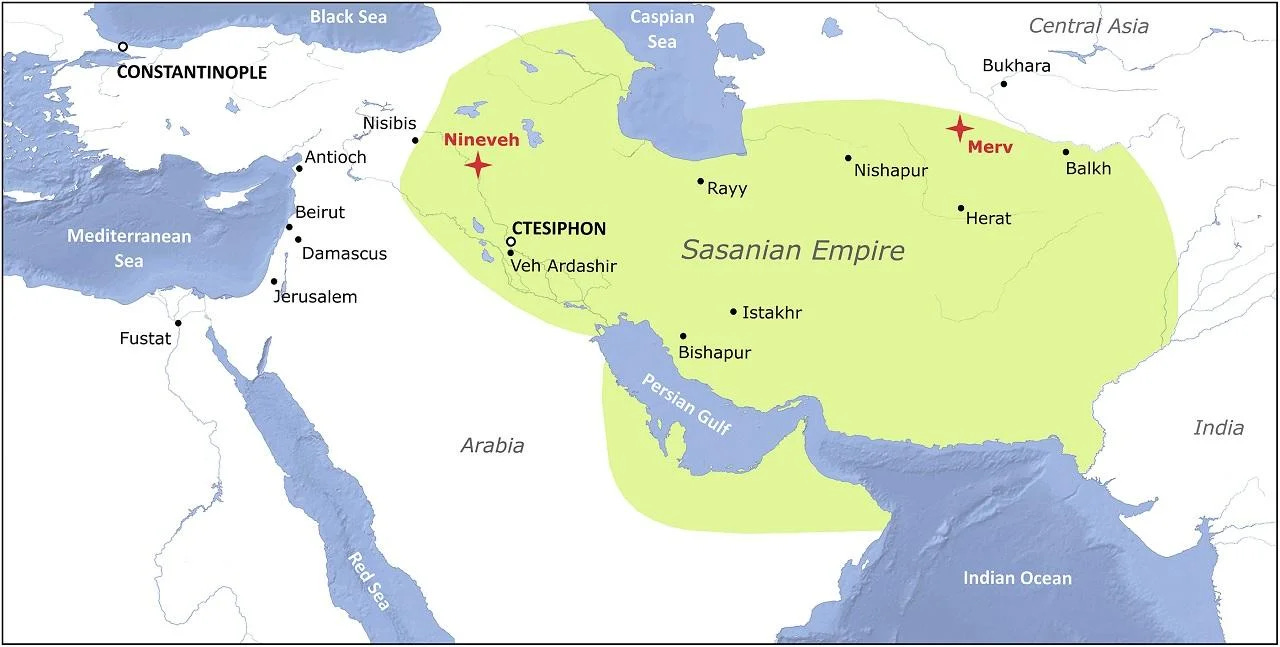
The Sasanian Empire (224 to 651 CE) sits at an interesting position in the longer history of this metal. Roman and Byzantine brass use is well documented, and by the early Islamic period brass had become the dominant copper alloy across much of Western Asia. The Sasanian period occupies the gap between those two moments, geographically and chronologically, yet it had received almost no archaeometallurgical attention. Davis, Mongiatti, Simpson, and Martinón-Torres set out to fill that gap.
The Merv excavations, carried out by the International Merv Project between 1992 and 2000, produced copper alloy fragments from several centuries of Sasanian occupation. The overall volume is not large. Metalworking scraps are precisely the kind of material that gets recycled, and the site’s preservation history reflects careful scavenging. But the fragments that survived are informative.
The earliest brass from Merv, dating to the fourth and fifth centuries CE, is found in cast objects. A bangle fragment, a hairpin inlaid with lapis lazuli and colored glass, a fitting, a hook or ring. The zinc content in these pieces ranges widely, from around 2 to 27 percent by weight. That scatter is characteristic of metalworkers dealing with inconsistent material: primary cementation brass of variable quality mixed with recycled stock, possibly imported objects melted and recast alongside locally produced bronze. The presence of lead in most of these pieces confirms the casting interpretation. Lead was deliberately added to improve fluidity during the pour. You add it when you’re filling a mold, not when you’re hammering sheets flat.
In this early phase, the researchers argue, brass was valued for its color. It looks like gold. Not as a forgery but as a deliberate reference to gold’s prestige. For people below the tier who dressed in actual gold and silver, a brass hairpin or bangle likely occupied a mid-level status role. The material itself was where the value lived.


