

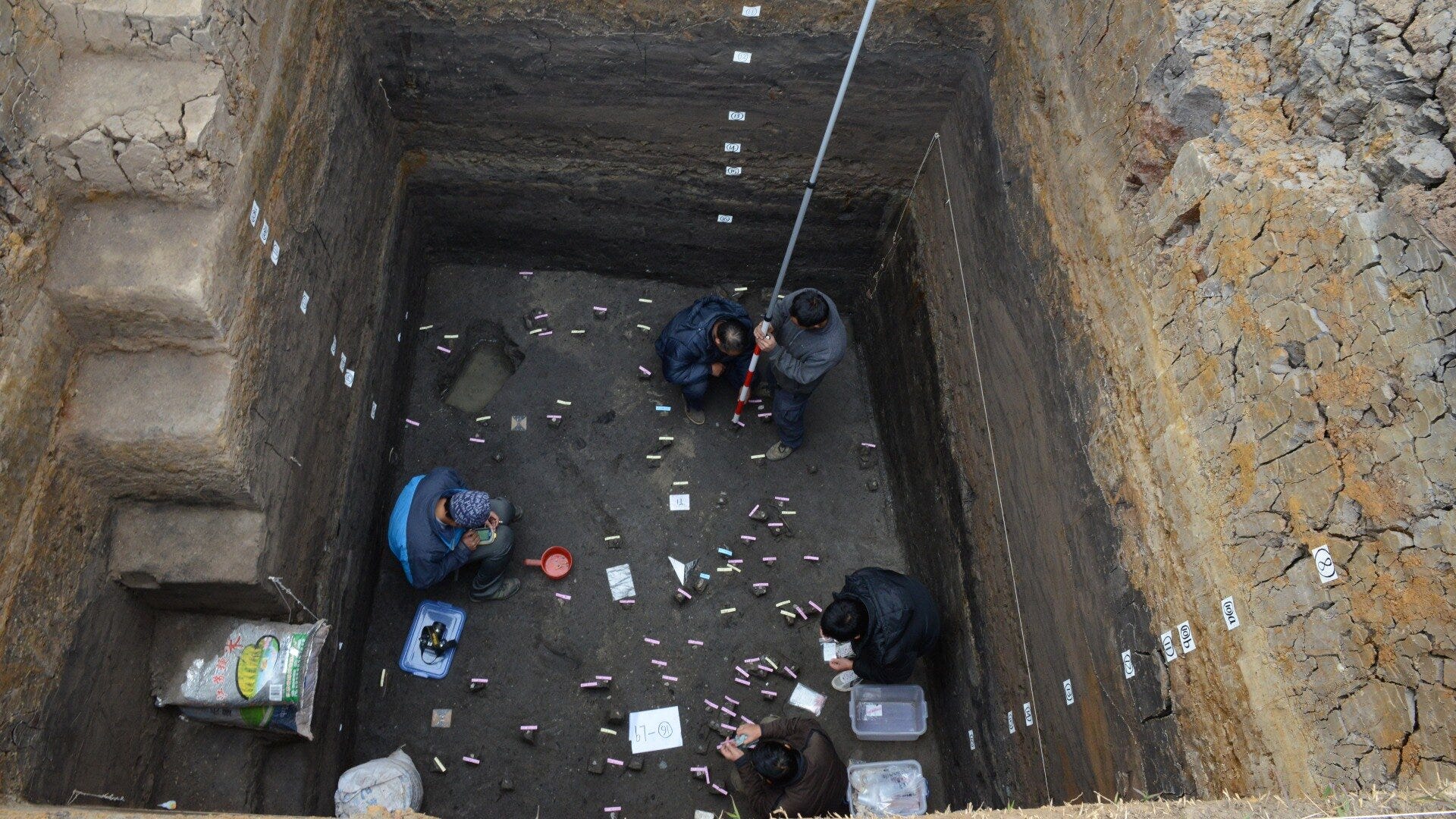
In Heqing County, in the mountains of western Yunnan Province, workers restoring an abandoned quarry in 2019 uncovered a limestone cave packed with bone. Archaeologists who later excavated the site, named Bianfu Cave, screened more than 60,000 fragments of that bone by hand. Three of them turned out to belong to something other than the deer, bovids, and hyenas that made up the rest of the deposit: two curved slivers of skull and part of a forearm. Researchers tried to pull ancient DNA from all three. Every attempt failed.
That should have ended the story. Since 2010, when a sliver of DNA from a finger bone in a Siberian cave revealed an entirely new kind of ancient human, genome sequencing has been the default way to confirm a Denisovan identity, the kind of evidence that settles an argument. What settled this one instead was protein: the two skull fragments and the forearm piece were confirmed as Denisovan through molecules built from the same genetic code as DNA but far more stubborn about surviving, and in this cave, they had outlasted DNA completely.
The stakes reach beyond one cave. Denisovans are known mostly through their genes: people living today across Southeast Asia and Oceania, in Papua New Guinea, the Philippines, and Australia among other places, carry some of the highest percentages of Denisovan ancestry found anywhere. But the physical evidence of that population, actual bone and tooth, has been almost entirely missing from the region where the genetic signal runs strongest. Southwestern China has sat inside that gap since Denisovans were first identified. Bianfu Cave closes part of it, with more confirmed Denisovan material than any site outside Siberia.
Of the sixty thousand-odd fragments screened, twenty-two looked, by eye, like they might be hominin. Three were.
How Do You Identify a Fossil Without DNA?
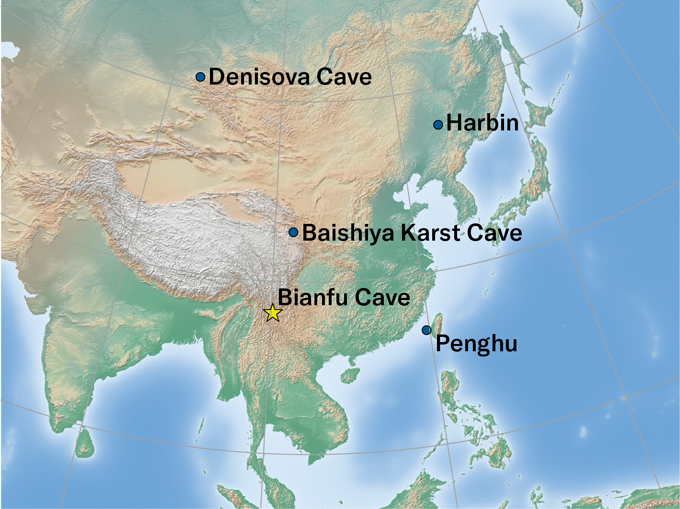
Screening tens of thousands of unidentifiable bone splinters for the rare one or two that might be human is normally done with a technique called ZooMS, zooarchaeology by mass spectrometry, which reads short fragments of collagen protein well enough to sort a bone by animal family without a full genetic workup. It is fast and cheap compared with genome sequencing, but even ZooMS has limits: at Denisova Cave and at Baishiya Karst Cave on the Tibetan Plateau, running it blind across the whole assemblage turned up hominin bone at a rate of about one fragment in a thousand. Running that same approach across all 60,000 Bianfu Cave fragments would have meant processing thousands of bones for a chance at one or two hominin fragments, a slow, expensive proposition no lab budget was built for.
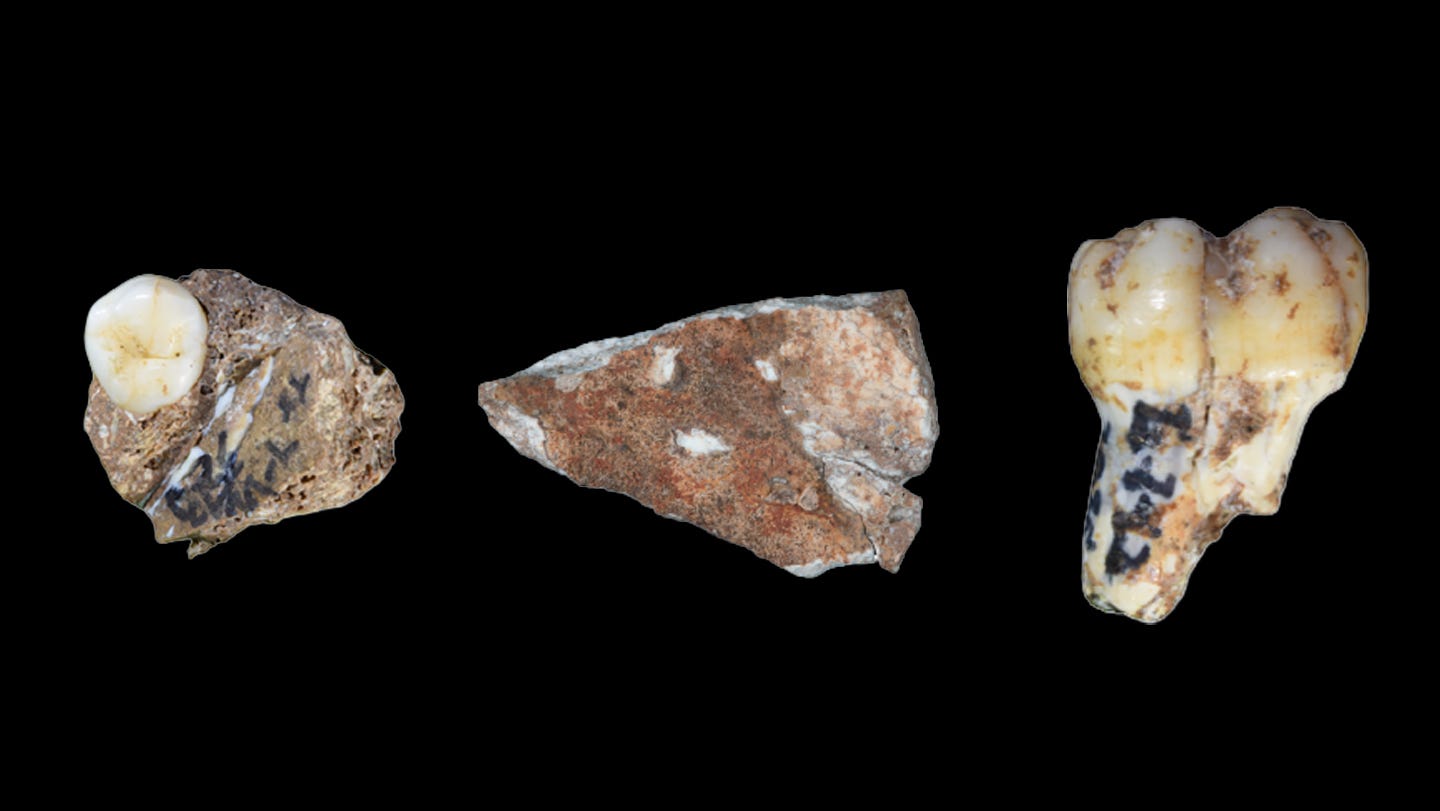
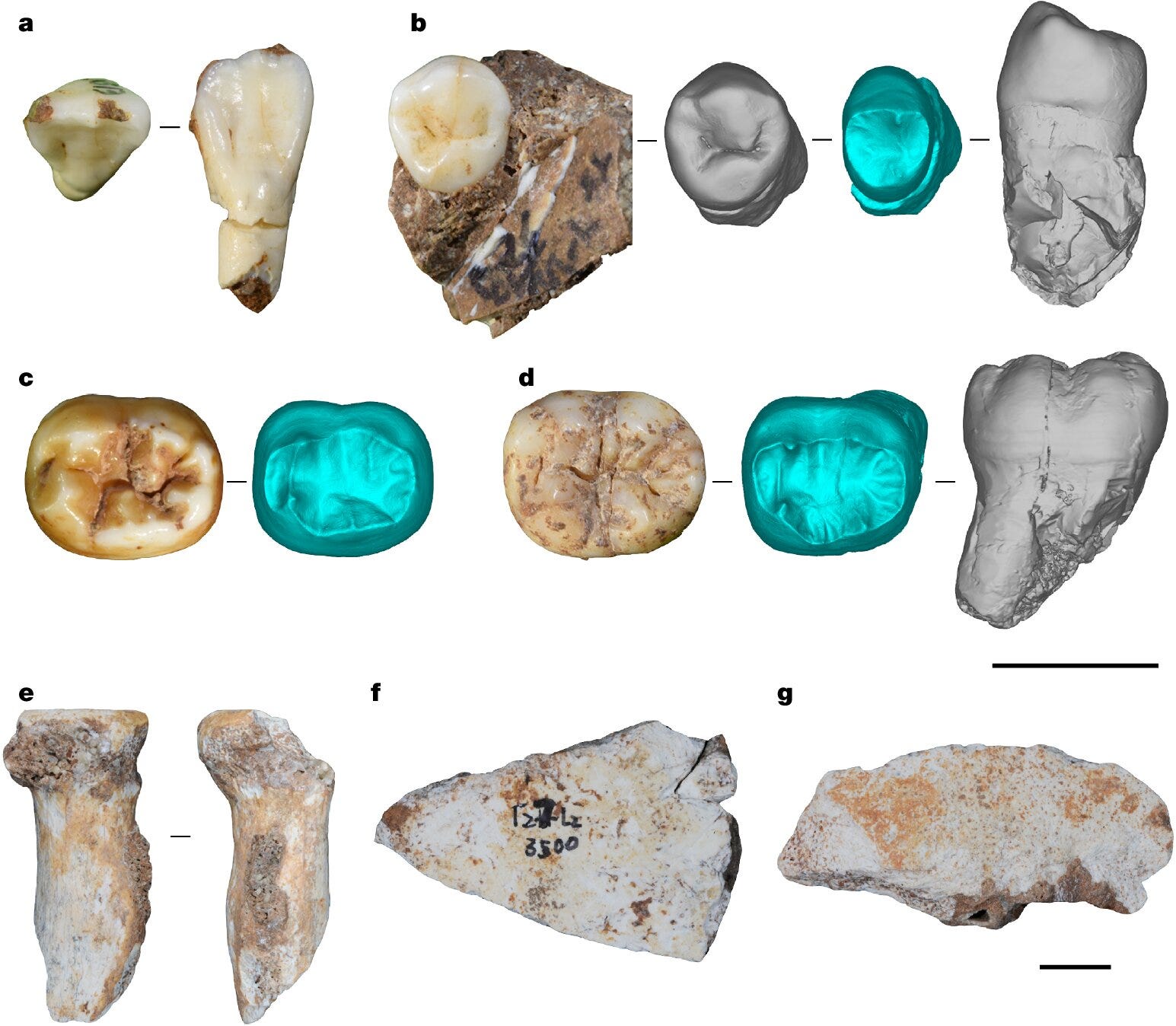
So the team looked first, by hand, at bone size, cortical thickness, and surface texture, the kind of read a trained osteologist does before any lab work begins, and narrowed 60,000 fragments down to 22 candidates worth testing. Of those 22, three came back with collagen markers specific to the genus Homo: two curved pieces of parietal bone, the plates that form the side and roof of the skull, one from a layer dated to roughly 148,000 to 134,000 years ago and cataloged as BFD767, the other from an older layer near 167,000 to 150,000 years ago and cataloged as BFD769; and a partial radius, one of the two forearm bones, cataloged as BFD771 and pulled from the same younger layer as BFD767. Two teeth from that younger layer, a lower premolar and a lower molar, went through the same analysis and came back Denisovan as well.
DNA is a fragile molecule, two strands loosely paired and easy to break apart with heat, water, and time. Collagen, the structural protein that makes up most of bone, is built differently: three long chains wound into a tight triple helix, chemically tough enough to survive well past the point where DNA has fallen apart into unreadable fragments. That toughness is why protein has become the main way of confirming Denisovan identity outside the cold, dry conditions of Siberia. The mandible from Xiahe on the Tibetan Plateau, the mandible dredged from the Taiwan Strait near Penghu, and now the bones from Bianfu Cave were all identified this way, with no DNA recovered from any of them. Even the most complete Denisovan skull ever found, the cranium from Harbin in northeastern China, gave up its species identity through protein first; a trace of Denisovan DNA eventually turned up, but only in the calculus built up on its teeth, not in the bone itself.
Proteins carry genetic information too, just written a step removed from DNA. A change in a single DNA letter can change a single amino acid in the protein that DNA codes for, and researchers can read that change directly in a protein sequence even after the DNA that produced it is long gone. In the Bianfu Cave specimens, that readout came from a collagen chain called COL1A2, at one specific position out of more than a thousand. More than 99.999 percent of a large modern human reference database carries the amino acid arginine there. Every confirmed Denisovan tested so far, from Siberia to Tibet to Taiwan, carries lysine instead.
Every one of the five Bianfu Cave specimens carries it too.
A few other variants added detail rather than proof. Peptides from the enamel of both teeth carried an abundance of a protein called amelogenin Y, present only in male individuals, so at least two of the Bianfu Cave Denisovans were men. Another enamel variant, in a protein called ameloblastin, is shared with East Asian Homo erectus, with the Harbin and Penghu fossils, and with a scatter of living people who carry the derived form today, most of them from Southeast Asia and Oceania, the same populations whose genomes point back toward exactly this part of the map.
Dating the bones directly turned out to be its own small puzzle. Uranium-series measurements on the three hominin bones and the carbonate crusted onto them gave minimum ages of around 102,000 years for the two specimens from the younger layer and about 143,000 years for the parietal from the older one, younger in both cases than the layer they came from. Bone keeps absorbing uranium from groundwater long after an animal dies, so a bone’s own uranium clock only ever proves a minimum age, never the true one. The more reliable numbers come from the sediment around the bones, dated by luminescence, and from the layered mineral crusts nearby, dated independently by the same uranium method applied to a substance that behaves as a closed system. Those put the younger layer at roughly 148,000 to 134,000 years old and the older one at 167,000 to 150,000, the figures the excavation team treats as accurate. The radius raises a different kind of question, less about when than about what kind of arm it was attached to.


