

Eleven skulls from two cemeteries at Matelica, a town in the Marche region of central Italy, are flatter at the back than they should be, and on one side more than the other. Most are flattened on the right. The people who owned them were buried in the mid-ninth to eighth century BCE, in deep rectangular pits at the necropolises of Crocifisso and Brecce, and the shape of their heads is the same one pediatricians now measure with calipers and 3D imaging in infants who sleep in the wrong position. The condition is deformational plagiocephaly, or flat head syndrome, and the team led by Michael Allen Beck De Lotto of the University of Padua found1 it in 11 of the 26 crania preserved well enough to assess, or 42.3%.
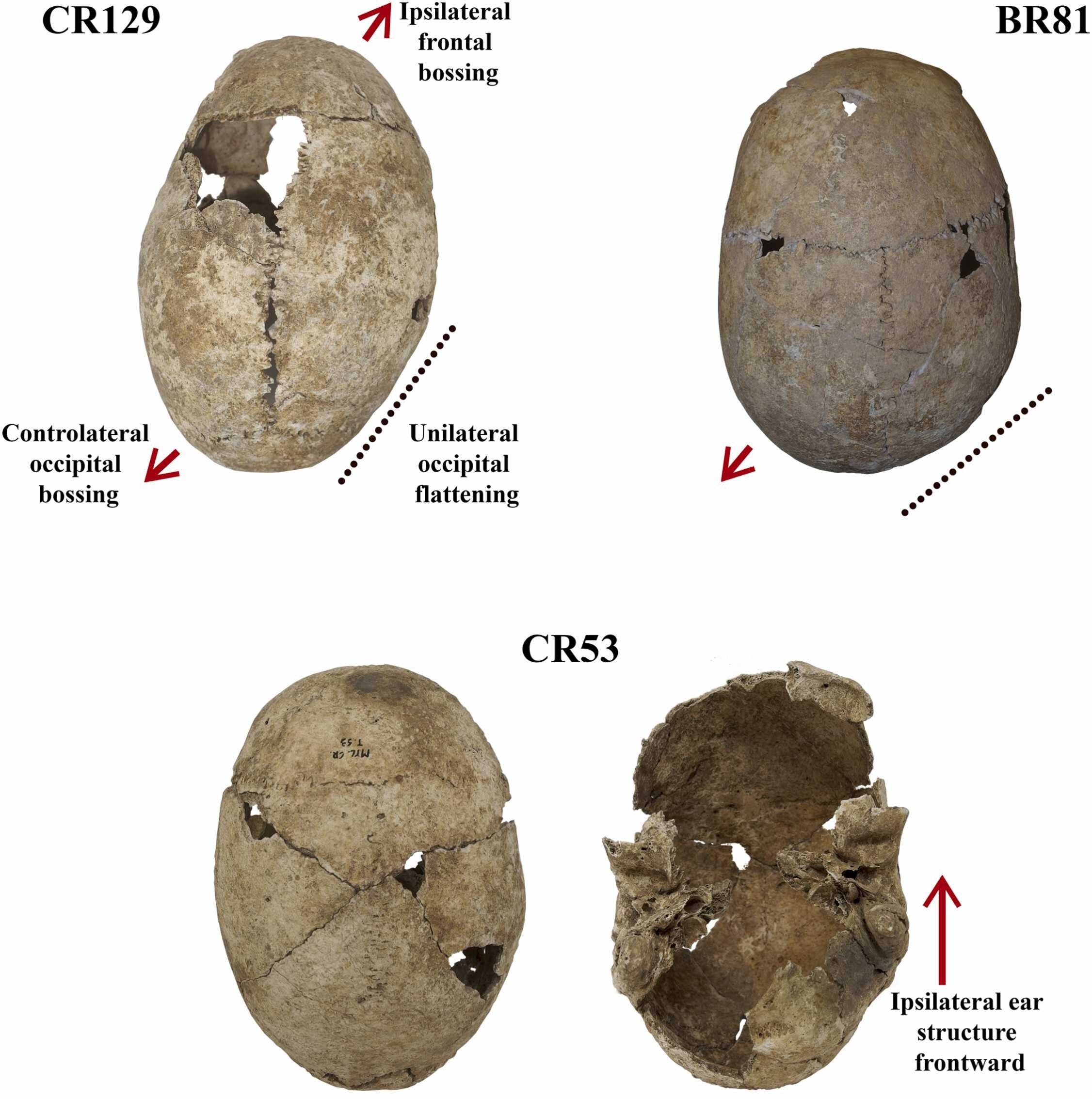
That figure sits almost exactly on top of what clinicians report today. Studies of infants seven to twelve weeks old put modern prevalence between 37.8%and 46.6%. The comparison is imperfect, since the Matelica sample is adults and the clinical figures are babies, and I will come back to why that matters, but the coincidence is hard to ignore.
The belief it disturbs is a tidy one. In 1992 the American Academy of Pediatrics began advising parents to lay infants on their backs to reduce sudden infant death syndrome, and in the years that followed, pediatric clinics saw more flattened heads. The sequence is easy to read as cause and effect, and a good deal of popular and some clinical writing treats flat head syndrome as the price of a lifesaving policy, or more broadly as a problem of strollers, car seats and bouncers. The paper’s own introduction is more careful than that: the post-campaign rise coincided with growing clinical attention, and the pre-campaign estimates, drawn mostly from British clinical observation with varying case definitions, ran from 0.3% to 48%. Nobody had a clean baseline.


