

On 27 April 2024, a 60-year-old female chimpanzee died of natural causes at the zoological center in Ramat Gan, Israel, and her hands were frozen at minus 80 degrees Celsius; they ended up in a study of cartilage, human evolution and osteoarthritis now published in Nature.1 Once the hands were thawed, squares of cartilage up to a centimeter across were cut from her knuckles and the joints beyond them, full thickness, down to the bone. Hers were the only ape fingers in the study. The rest of the ape tissue came from six animals that had died in European zoos, and the human tissue from 42 people who had given their bodies to the Technion’s medical faculty in Haifa.
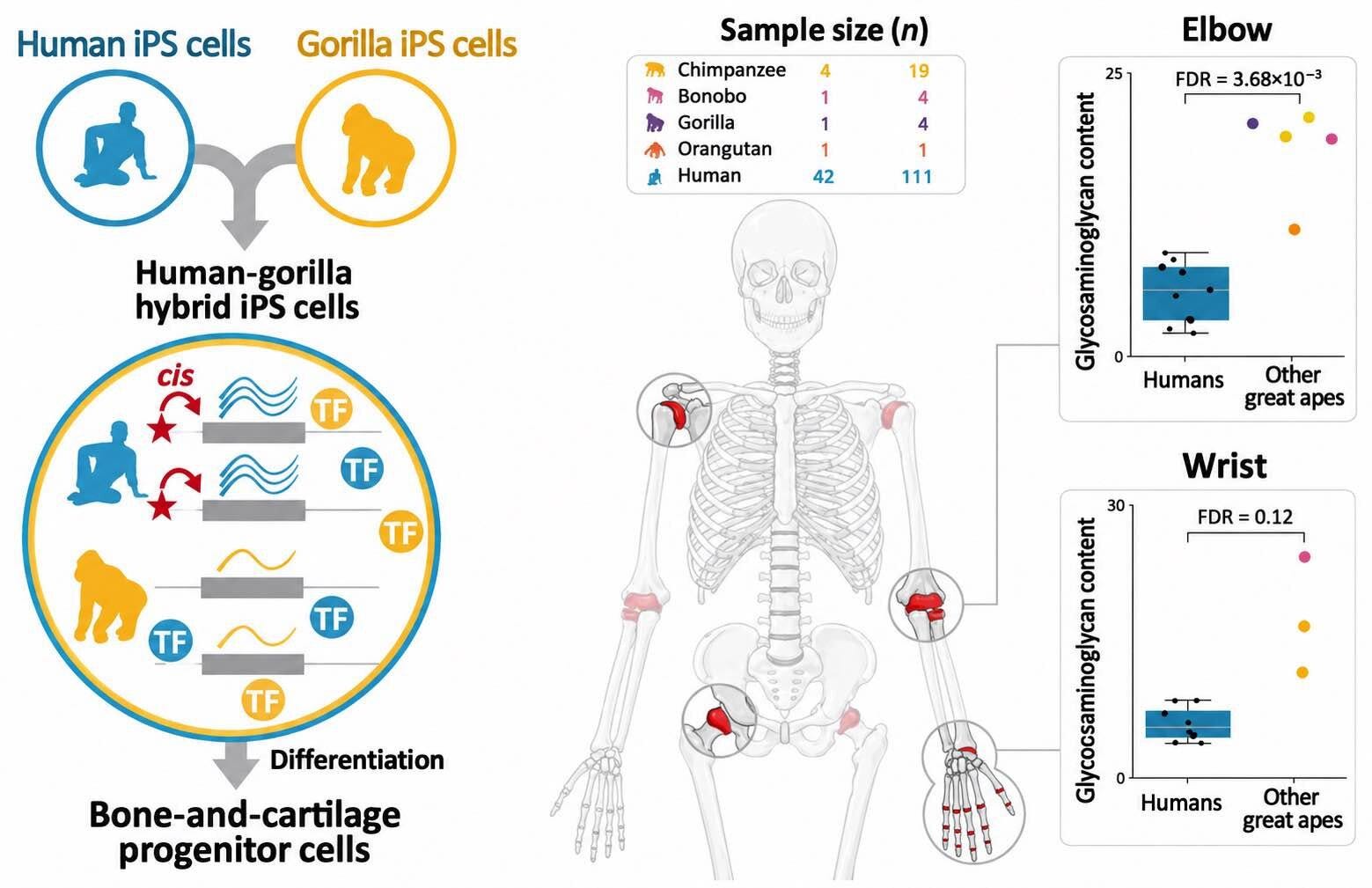
The explanation most of us carry for failing joints is mechanical, and it is old. Wilton Krogman, a physical anthropologist at the University of Pennsylvania, gave it its most durable name in a 1951 Scientific American essay, “The Scars of Human Evolution,” whose summary line noted that although man stands on two legs, “his skeleton was originally designed for four.” In the popular version, hips, knees and lower backs carry weight that four limbs once shared, they wear down under it, and osteoarthritis is the bill that comes due late in life. The cartilage from her hands and from the 48 other bodies fits that story poorly. Human cartilage held roughly a third as much of the water-binding sugar chains called glycosaminoglycans, or GAGs, as ape cartilage did, and the shortfall was plain in the elbow, a joint that carries less weight in a person than in a chimpanzee walking on its knuckles.
Earlier measurements cited in the paper put the GAG loss in osteoarthritic human cartilage at 25 to 38 percent below healthy human cartilage, and the gap the team found between human and ape cartilage is about twice that. The authors suggest the shift may have pushed human cartilage “towards a threshold of vulnerability,” such that “all humans carry a baseline GAG deficit that primes the joint for degeneration.”
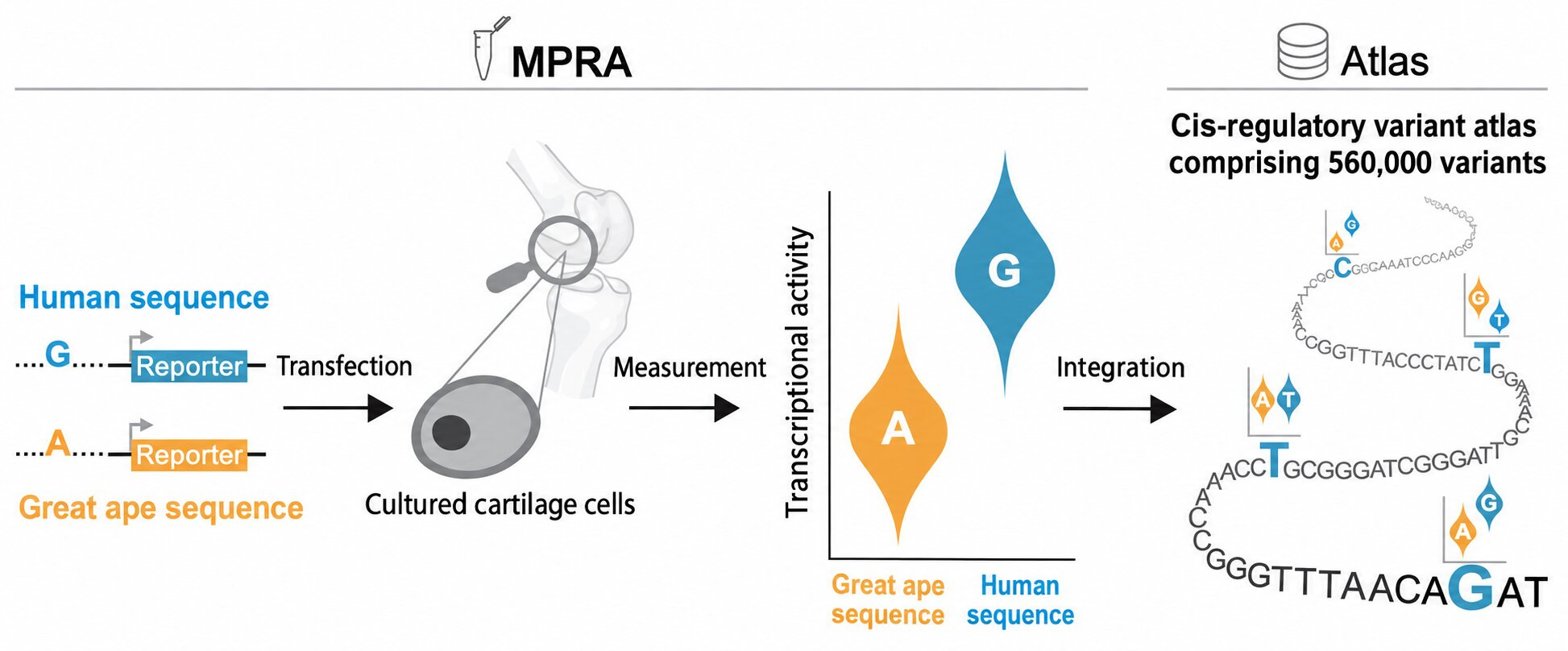
A joint whose chemistry tracked only its workload would not look like that elbow, and the likelier culprit is heredity, in particular the stretches of DNA that set how strongly genes are switched on. Those switches are what the study’s leaders, Fumitaka Inoue, an associate professor at Kyoto University’s Institute for the Advanced Study of Human Biology (WPI-ASHBi), and David Gokhman, a principal investigator at the Weizmann Institute of Science in Rehovot, Israel, had set out to map across the human skeleton. Their strongest pathway signal pointed at the machinery for making GAGs. The paper cannot close the question an anthropologist asks first: why a lineage would turn down its supply of the molecules that keep joints hydrated and springy, and whether that was a price paid for something else or a loss that selection simply stopped guarding against.


