
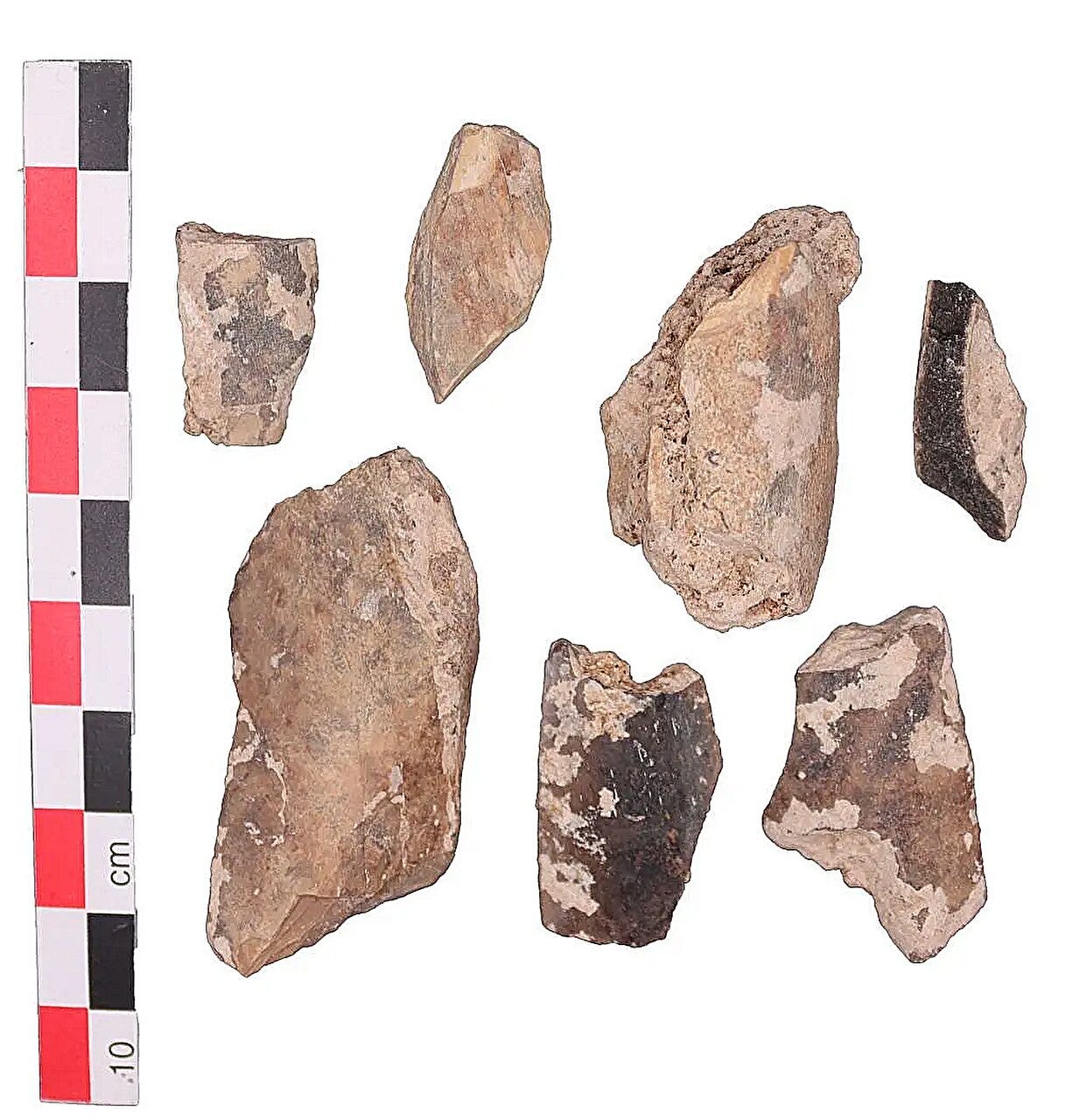
On the headland at Ras el-Kelb, just north of Beirut, a Jesuit priest named Godefroy Zumoffen spent part of the late nineteenth century prying bones and teeth out of cemented breccia, and a surprising share of what he kept came from rhinoceroses. The narrow-nosed rhinoceros, Stephanorhinus hemitoechus, accounts for 27.3 percent of the individuals in his Ras el-Kelb collection, all of them known only from teeth, the conspicuous pieces early collectors favored, though rhinos also turn up in numbers in the cave later dug on the same headland, and the restudy team thinks they really were common in that estuary. His finds now sit in the Museum of Lebanese Prehistory at Saint Joseph University. In two1 papers2 published this week, researchers report that one of his Ras el-Kelb teeth, dated by combined uranium-series and electron spin resonance methods, is 402,000 years old, give or take 46,000, far older than the deposits in the cave below, which Dorothy Garrod excavated in 1959 and which had long been assigned to Marine Isotope Stage 5, roughly 130,000 to 71,000 years ago.
Surveys through the early 1970s turned up hundreds of Paleolithic sites in Lebanon, then the civil war that began in 1975 ended plans for further work, and instability has limited fieldwork since. In the southern Levant, meanwhile, a century of digging at Tabun, Skhul, Qafzeh, Amud, Misliya, Nesher Ramla and Qesem built the reference record, and its patterns have often been read as the whole region’s. So the corridor most readers picture, the land bridge that Homo sapiens and Neanderthals crossed between Africa and Eurasia, is a southern one, fringed by steppe and desert and hostage to every swing of the ice ages. The two studies, both in Communications Earth & Environment, argue that the central Lebanese coast was more wooded than that picture allows, and that it changed far less.
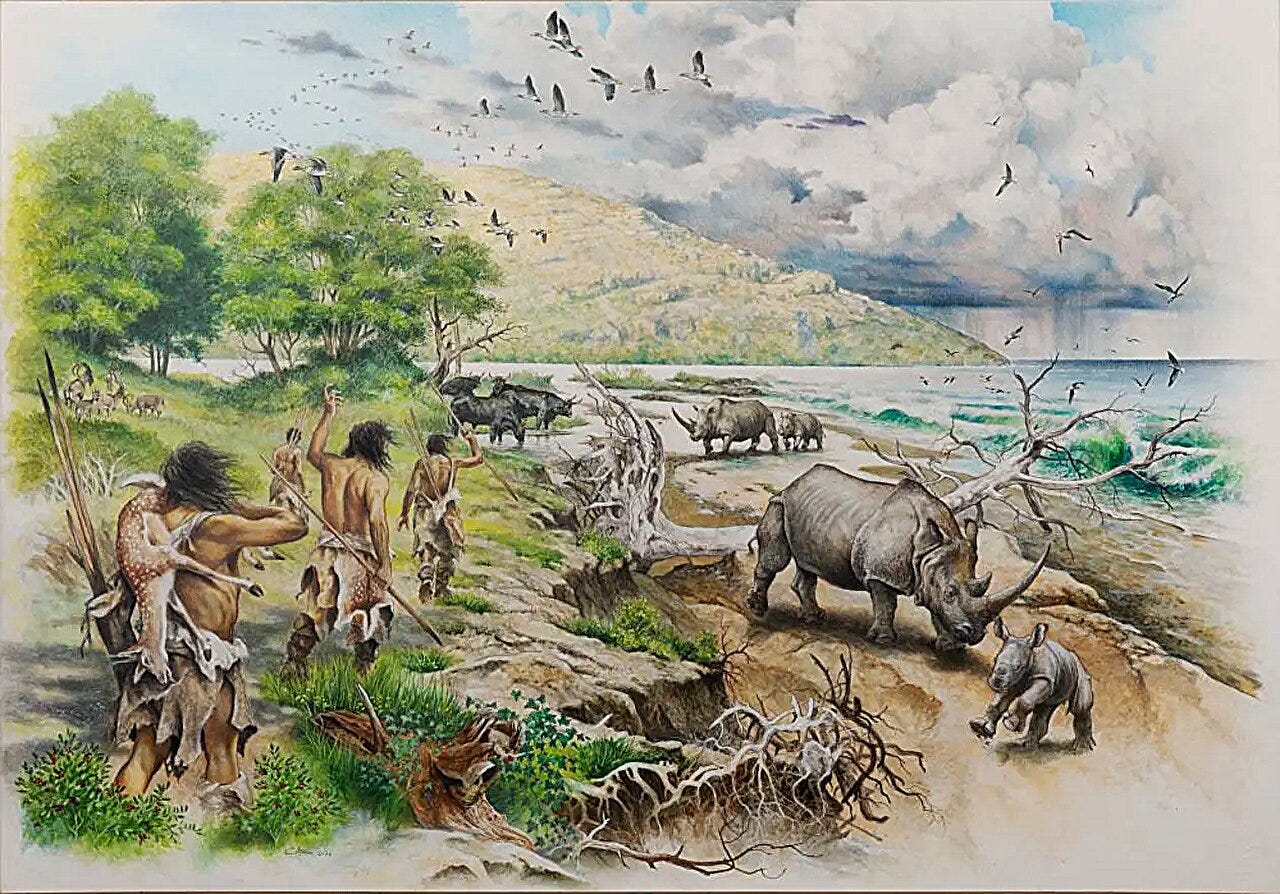
Zumoffen’s Ras el-Kelb material is the oldest of the three collections studied. He also gathered bones inside the cave at Nahr Ibrahim, farther up the coast, and a tooth from that lot dates to about 245,000 years, plus or minus 23,000, near the shift from the Lower to the Middle Paleolithic. The third collection comes from Naame, south of Beirut, which another Jesuit, Henri Fleisch, excavated in 1967; its main layers fall within Stage 5, and one tooth dates to 107,000 years, plus or minus 13,000. The three sites lie 15 to 30 kilometers apart, each near a river, on a coast that until now had no high-resolution climate record tied to human occupation.
Gabriele Russo, of the paleoanthropology group at the Senckenberg Centre for Human Evolution and Palaeoenvironment at the University of Tübingen, led both studies; Sireen El Zaatari, a professor in that group who conceived the broader project, supervised. If one stretch of the corridor stayed livable while the rest swung with the ice ages, it would have been open when the south was not, and the southern record would be a poor stand-in for it.


