
At Finca La Grajera, on the edge of Logroño, the Institute of Grapevine and Wine Sciences (ICVV) keeps a collection of grape varieties 410 meters above sea level, and one of them is an old Spanish cultivar called Heben. Its vines are trained along two cordon arms, pruned back to short spurs, and grafted, as most European vines have been since phylloxera, onto a rootstock known as R-110. For a new study, researchers picked young Heben leaves and sequenced the genome to more than 70-fold depth, because they needed a clean modern genome to set beside something much older.
The older thing was a grape seed from Valencia, recovered below the water table in the moat of the city’s Islamic wall and dated by its deposits to the tenth century CE. Ancient DNA in grape seeds comes mostly from the seed coat, which is maternal tissue, so what the team sequenced was in effect the genome of the vine that bore the seed. According to the study, published in Current Biology1 by Guillem Pérez-Jordà of the University of Valencia, Carolina Royo of the ICVV and eleven colleagues, that vine was a child of Heben and a full sibling of Viura, the main white grape of Rioja, known elsewhere in Spain as Macabeo. Most people picture a wine grape the way they would picture a strain of wheat, as the latest in a long line of parents and offspring, so that three thousand years of Spanish winemaking would mean something like three thousand years of vine generations. Heben fits that picture badly. It was setting seed before the tenth-century vine sprouted, and it is alive in Logroño now, one genetic individual kept going by cuttings for at least 1,100 years.
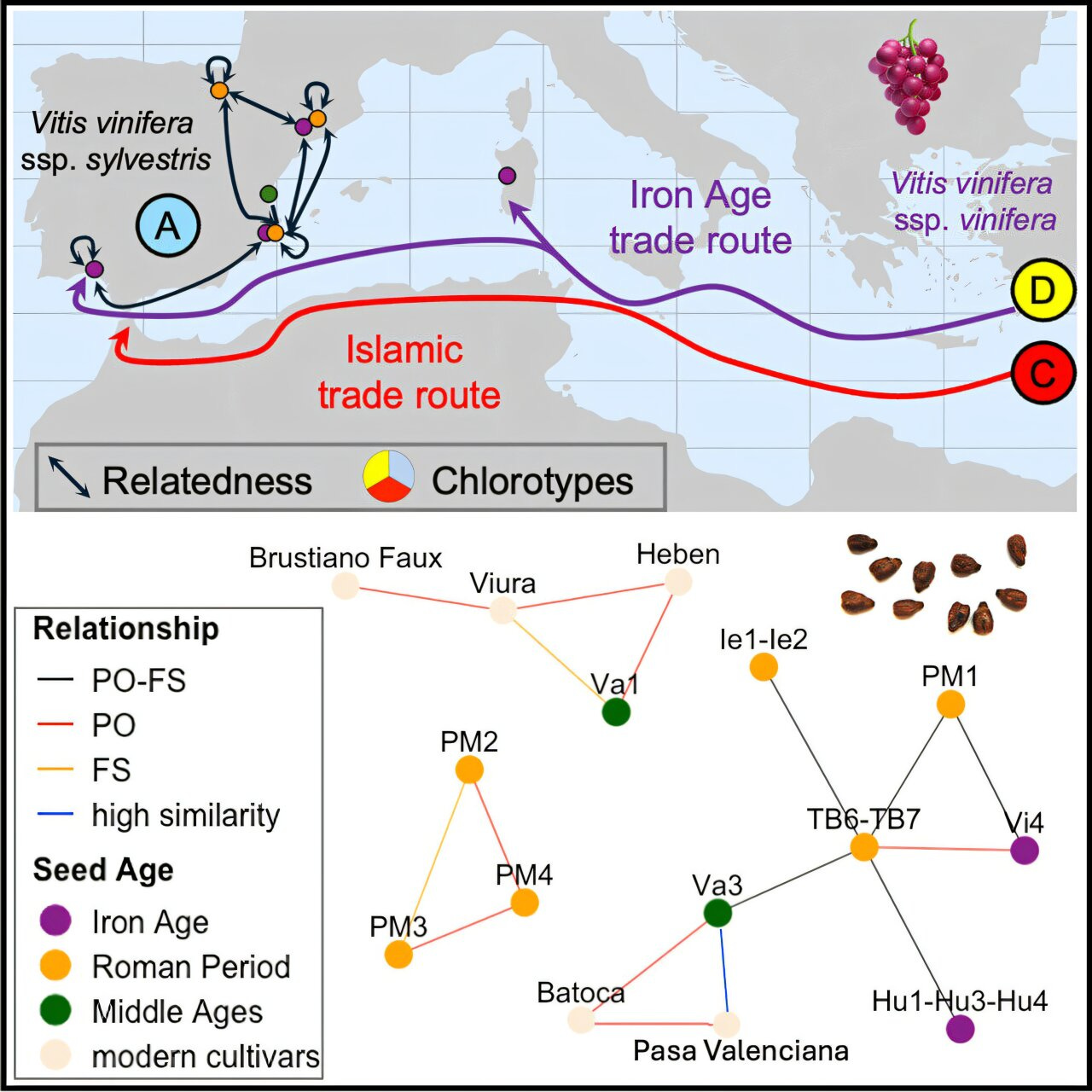
The Valencia seed is one of 28 the team managed to sequence, out of 164 waterlogged seeds put through DNA extraction, from six sites in Spain and one in Sardinia dated between the ninth century BCE and the fourteenth century CE.
Grapevines (Vitis vinifera) were first domesticated in the South Caucasus and the Near East, and how they reached the far western Mediterranean has mostly been argued from the genomes of living vines, which keep traces of ancestry but no dates, whereas seeds from dated layers carry both. Testing the seeds for kinship, against each other and against 140 modern vines, also let the team count how many times Iberia’s cultivated grapes have reproduced sexually since they arrived, and for some lineages the count is two or three.


