
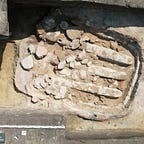
On a hilltop in Iași County, in northeastern Romania, where the Ursoaia and Roșior streams run together, a farming village of about 60 houses built the largest pottery kiln yet securely documented anywhere in the Cucuteni-Trypillia world. Its buried lower chamber measures 3.10 by 2.40 meters, and the grate it carried, a floor of loose clay slabs on which vessels were stacked for firing, covered roughly 7.5 square meters (about 81 square feet), a number that means little until it is set beside the kilns of the places that ought to have outbuilt it.
Cucuteni-Trypillia (Cucuteni in Romanian usage, Trypillia in Ukrainian) is a Copper Age farming culture, the Chalcolithic in technical terms, that spread across what is now eastern Romania, the Republic of Moldova and Ukraine. Its best-known settlements are the megasites of central Ukraine, among them Maidanetske, Talianki and Nebelivka, each covering well over a hundred hectares and ranking among the largest settlements in Europe in the early fourth millennium BCE. The intuitive assumption is that production scales with population, so the biggest kilns ought to turn up in the biggest towns. Where published estimates exist, kilns at those megasites had working surfaces of 2 to 4 square meters, and the largest reported before now, at Stolniceni I, a megasite in Moldova, reached 4.6 to 4.8. Ursoaia covers almost 8 hectares, and its kiln is more than half again the size of the one at Stolniceni I.
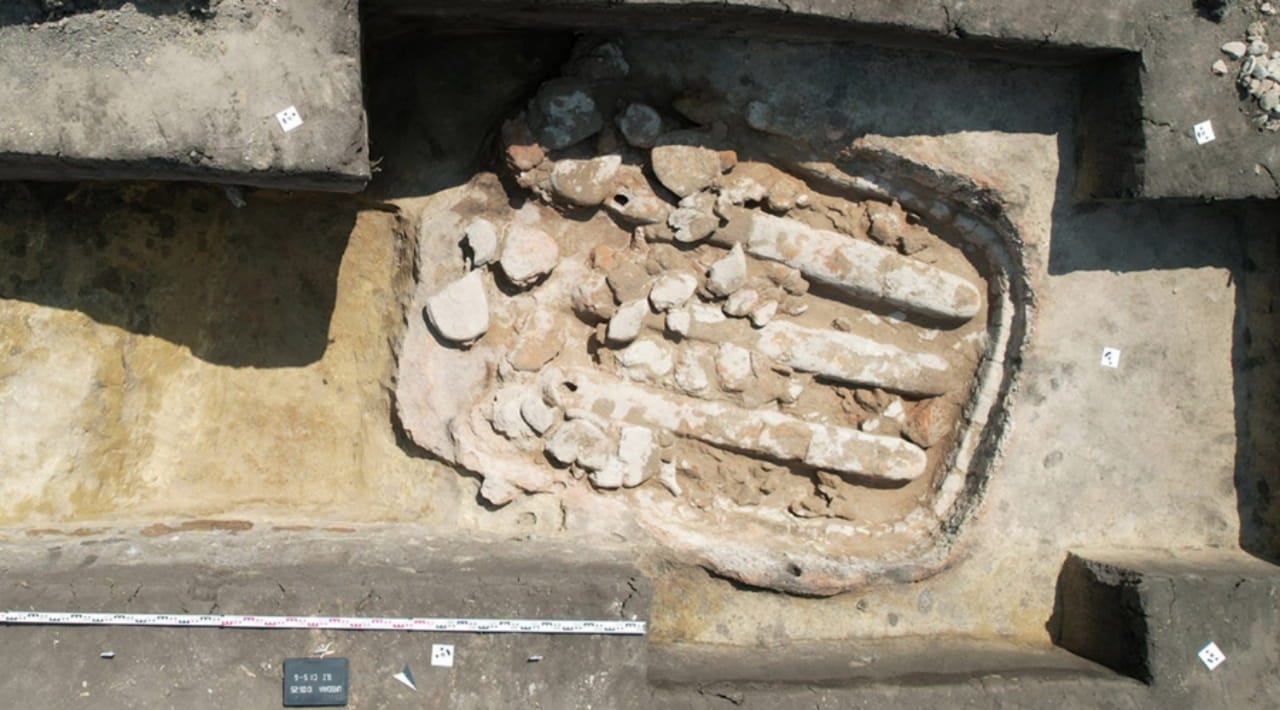
The kiln was excavated in 2025 and published this year in Antiquity1 by eleven researchers from Iași, with Diana Măriuca Vornicu of the Romanian Academy’s Institute of Archaeology as first author. One of her coauthors, Felix-Adrian Tencariu of the Institute of Interdisciplinary Research at Alexandru Ioan Cuza University of Iași, wrote the 2015 monograph (in Romanian) on prehistoric and protohistoric pottery-firing installations across Romania, so the verdict that this one is exceptional comes partly from someone who knows the ordinary ones well.
A household firing its own cooking pots and storage jars would have little obvious use for an upper chamber of around 12 cubic meters, and less reason to keep patching such a structure through firing after firing. The size bears on an old argument in archaeology about craft specialization, the point at which making a thing becomes a particular person’s or group’s job, and about whether that shift waits on cities and states or can begin among village farmers. The authors conclude that production at Ursoaia “likely moved beyond domestic requirements” toward a more intensive model. They stop there, and say plainly that calling the site a community-level workshop would take evidence they do not yet have.
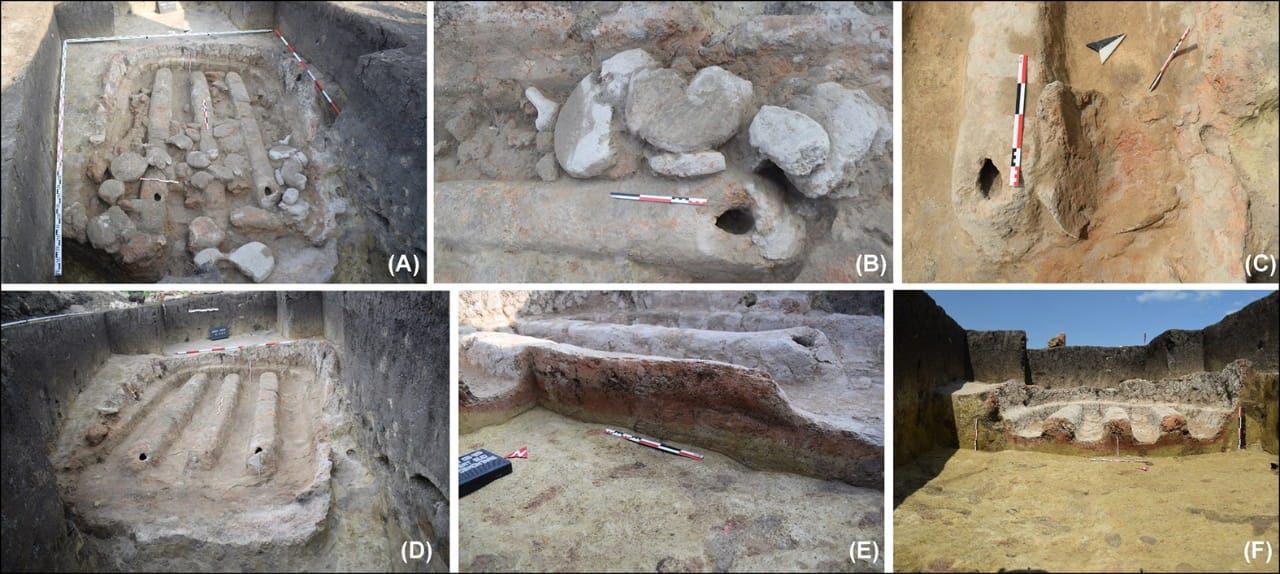
A magnetometer survey in 2024 traced a ditch enclosing almost 8 hectares and, inside it, about 60 burnt houses in small clusters, numerous pits and at least eight kilns. Fired clay carries a magnetic signal the instrument can read from the surface, so the figure counts houses that burned, which may not be every house that stood, and the map on its own cannot say how many houses or kilns were in use at the same time. One reading, a dipolar anomaly of up to 22 nanotesla right against the ditch, looked like a firing installation. A trench cut to test it exposed a well-preserved two-chamber updraft kiln (bicameral, in the specialist term), and the decorated pottery around it, together with radiocarbon dates, places the settlement in the phase Romanian archaeologists call Cucuteni B1.


