
In the Silberberg Grotto at Sterkfontein, northwest of Johannesburg, two technicians spent about two days in 1997 searching mining rubble by hand-held lamp for the spot where a shin bone had snapped. Stephen Motsumi and Nkwane Molefe carried a cast of the broken piece, which the paleoanthropologist Ronald Clarke of the University of the Witwatersrand had recognized in a box of monkey fossils. They found its match jutting from the breccia, the cemented rubble filling the cave. Behind it lay the rest of an Australopithecus skeleton, catalogued as StW 573 and nicknamed Little Foot for four small foot bones Clarke had noticed in 1994. Freeing it took more than a decade, and the sediment that held it has been dated to about 3.67 million years ago.
Anyone who learned human origins through Lucy probably holds a tidy picture of her genus. In that picture, Australopithecus walked upright on the ground, and its apelike shoulders, curved fingers and long arms were inheritance from tree-dwelling ancestors, no longer doing much. Lucy is the 3.2-million-year-old Australopithecus afarensis skeleton from Hadar, Ethiopia, catalogued as A.L. 288-1. She complicated that picture in 2016,1 when computed tomography (CT) scans suggested her arms had borne a good deal of her weight. But she was tiny, and among living primates the small ones tend to climb more. A study published September 16 in Science Advances 2removes that excuse.
Little Foot was a larger animal, and relative to its thigh, it loaded its upper arm like a gorilla that spends about a quarter of its time in trees. Kristian Carlson, a professor of clinical medical education at the Keck School of Medicine of the University of Southern California, and 15 co-authors compared thigh-shaft strength with upper-arm-shaft strength in more than 1,400 modern humans and apes. They fit a line through each group and measured each fossil’s distance from each line in standardized units. The number that matters is small enough to pass for a rounding error. StW 573 sat 3.2 units below the human line and 0.057 units from the line for female western lowland and Grauer’s gorillas, practically on it.
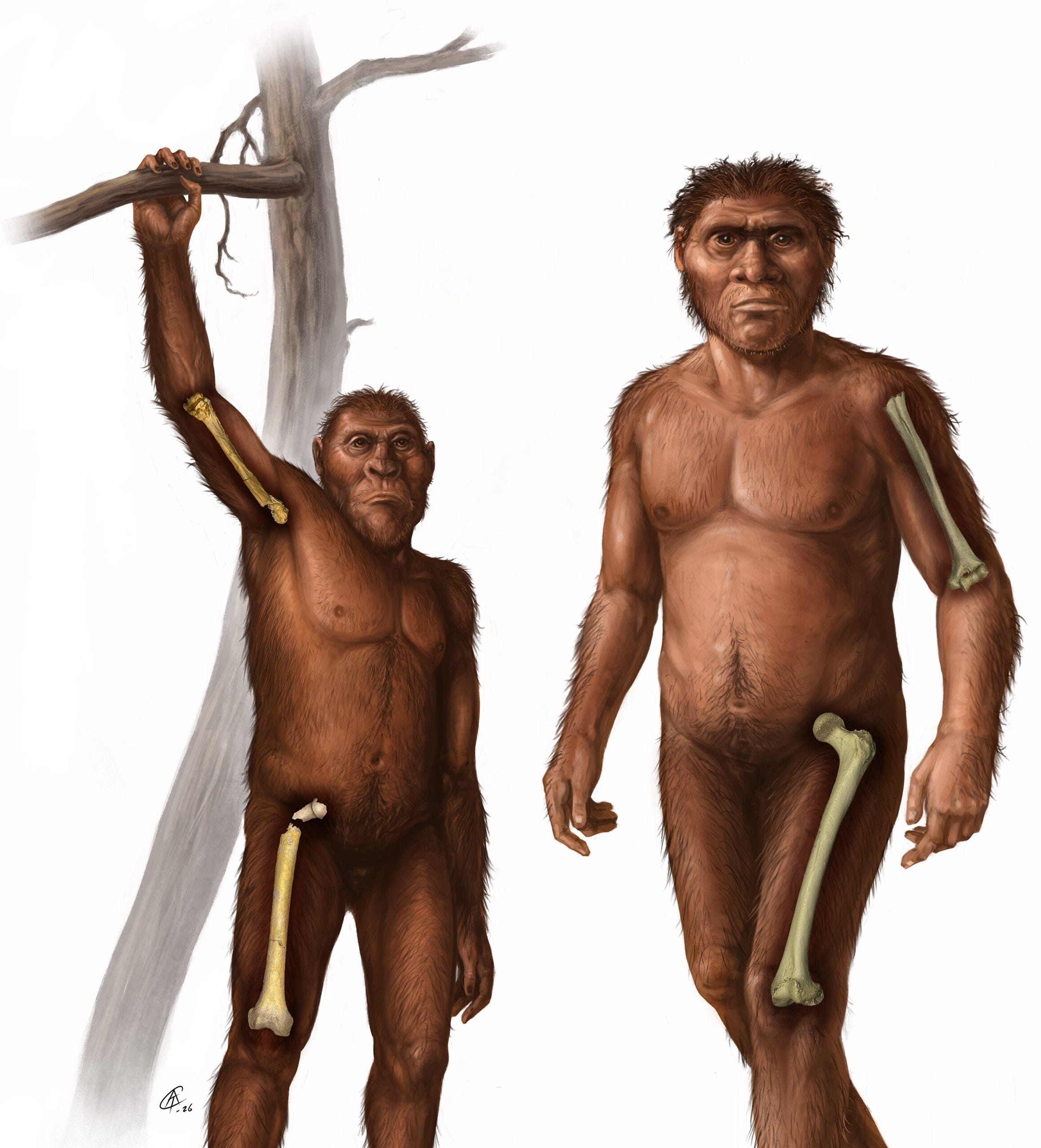
Researchers have argued for decades over how much australopiths (the informal name for members of Australopithecus) climbed. Zeresenay Alemseged, a paleoanthropologist at the University of Chicago, called the debate deadlocked in a 2023 review in Nature.3 A long arm or a curved finger bone could be climbing gear or a leftover that selection never cleared away. Limb shafts are harder to wave off, because they keep remodeling through life, partly in response to the loads they carry.


