

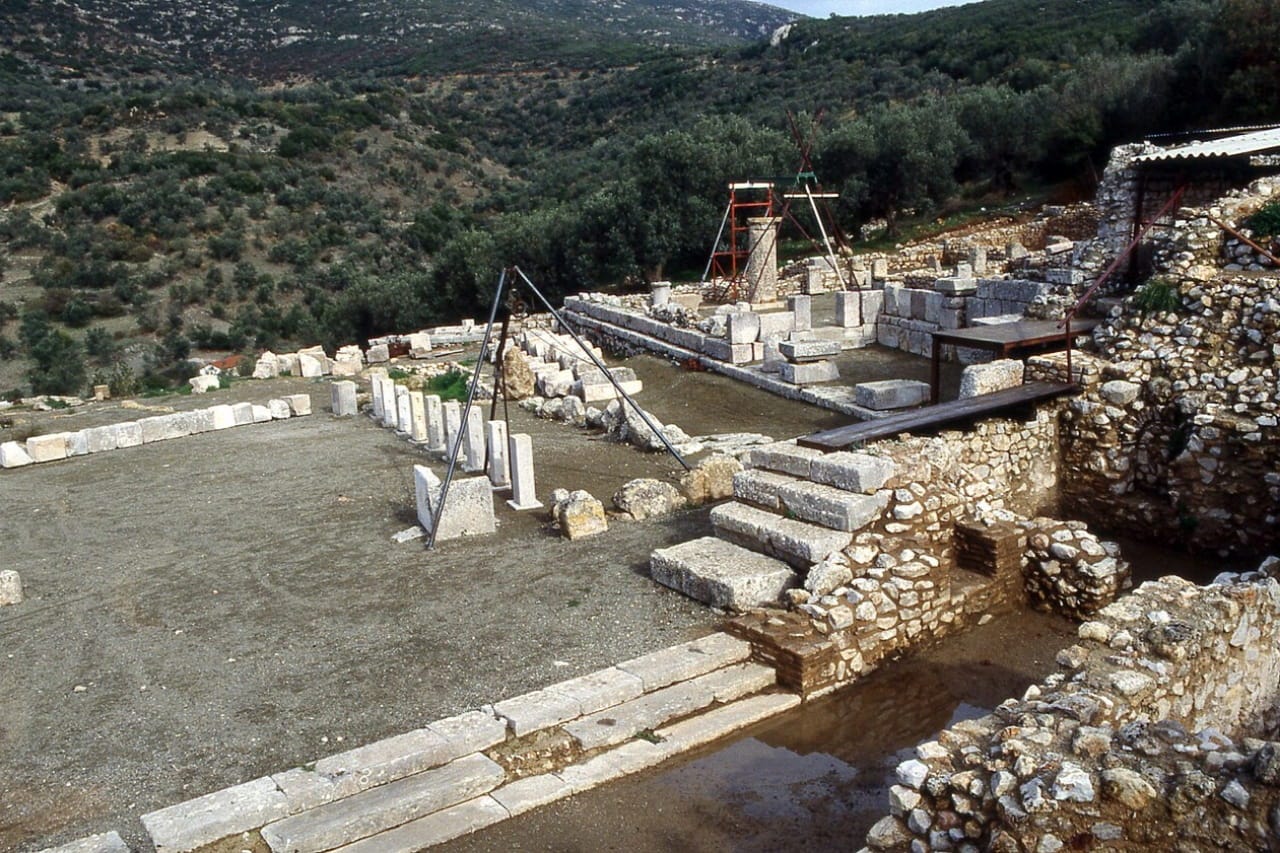
On the summit of Mount Kynortion, above the slope near Epidavros where a sanctuary of Apollo Maleatas would stand more than a thousand years later, three people were laid in pits on their sides, knees drawn up, under slabs of coarse limestone. Radiocarbon puts all three graves in the 19th century BCE, in the Middle Bronze Age. Ancient DNA marks two of them as first-degree relatives, probably father and daughter, and her tooth enamel carries a strontium signature foreign to the mountain while his matches the ground around it.
The assumption most readers bring to Bronze Age Greece is that an age of palaces, of exchange networks reaching across the Aegean and beyond, of newcomers carrying steppe-related ancestry into the region from around 2200 BCE, must also have been an age when large numbers of people left home and settled among strangers. Pottery and metal certainly moved along those networks, but whether many people moved with them and stayed is a separate question, one that a study published September 23 in PLOS One1 tried to settle by counting. Among 199 individuals from six sites in central and southern Greece, tested through tooth enamel or skull bone, the researchers found 17 whose chemistry says they grew up somewhere else.
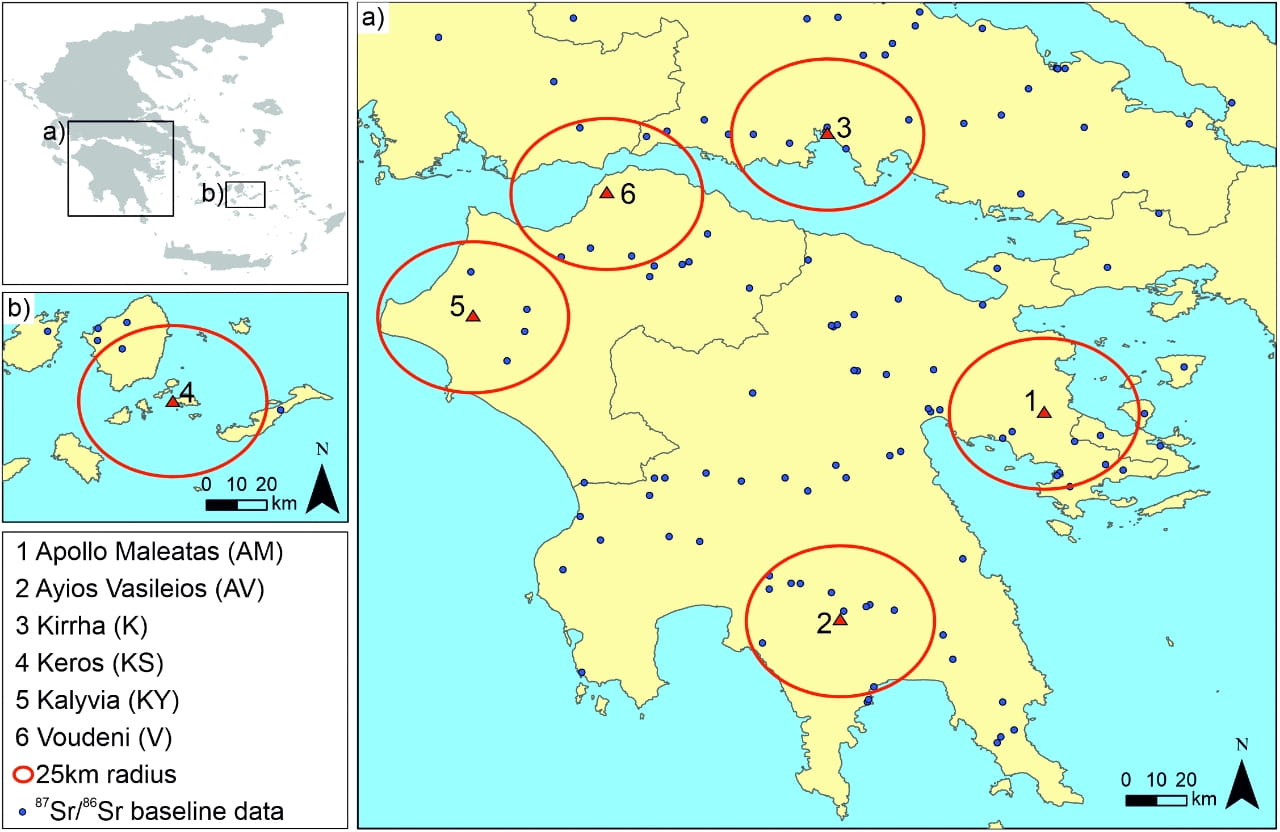
The six sites span about 2,300 years. The oldest is Kalyvia in Elis, a cemetery of rock-cut chamber tombs dated to roughly 3400 to 2800 BCE, straddling the end of the Neolithic and the start of the Early Bronze Age. Next are the rock shelters at Kavos on the Cycladic island of Keros, about 2500 to 2200 BCE, where most bones were systematically carried off after the bodies decomposed, leaving small bones and teeth behind, and the teeth are what this kind of analysis needs. The three graves on Mount Kynortion, filed in the study under the site name Apollo Maleatas, follow in the 19th century BCE. Kirrha, a low mound near the Corinthian Gulf by modern Itea, and the North Cemetery at Ayios Vasileios, 12 kilometers south of Sparta beside a recently identified Mycenaean palace, both cover the passage from the Middle to the Late Bronze Age around 1700 BCE. The youngest is Voudeni, a Mycenaean cemetery of more than 80 chamber tombs northeast of Patras, used from about 1450 to 1050 BCE, and at 102 individuals it supplies half the dataset.
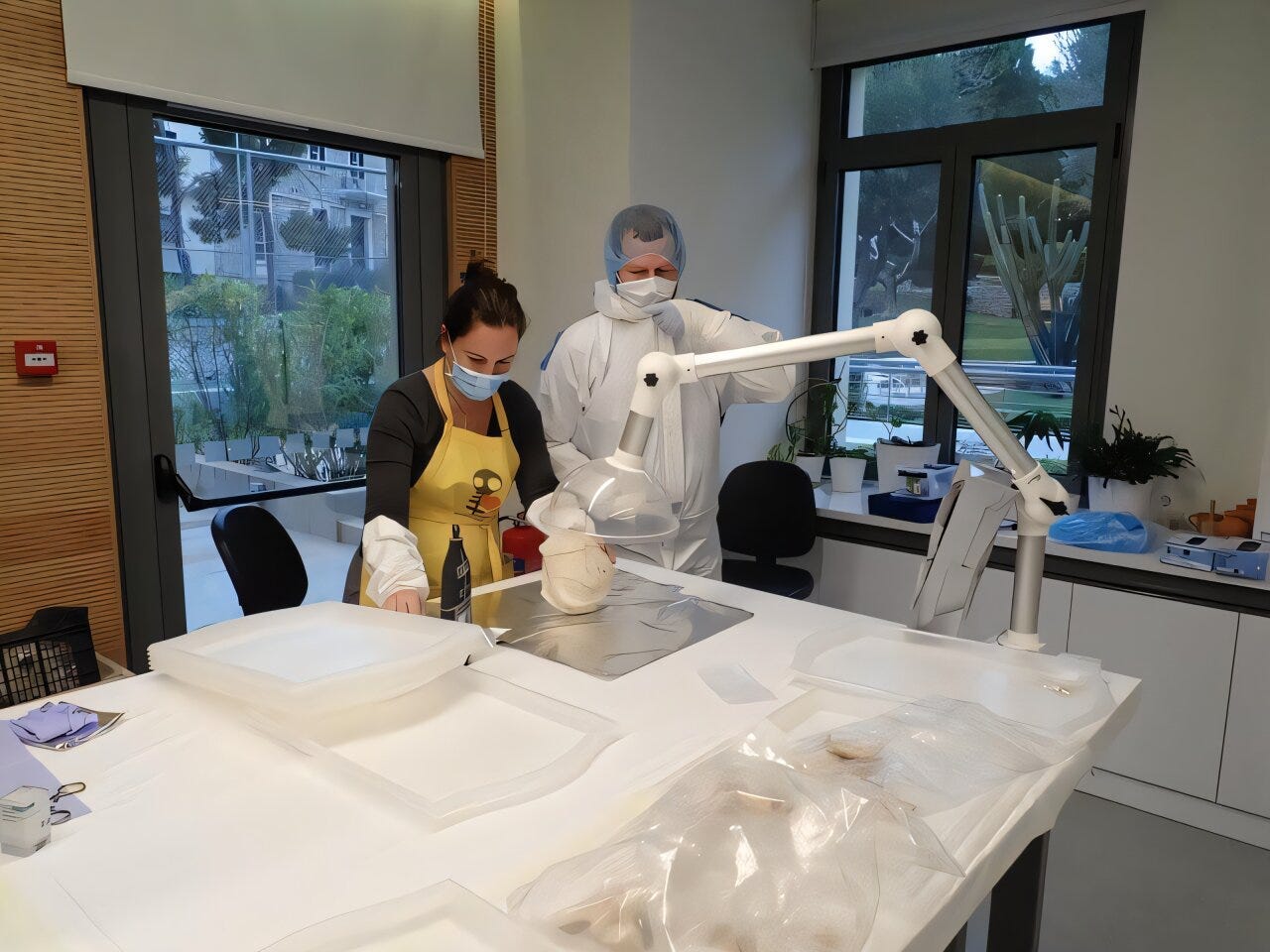
The count matters because archaeology, left to itself, cannot tell a traveler from a settler: an imported pot in a Mycenaean tomb could have come with a trader who sailed home the next week or with someone who married into the village and was buried beside it forty years later. The ratio of strontium-87 to strontium-86 in soil and water depends on the age and type of the underlying rock, passes into crops and then into the people who eat them without meaningful change, and is locked into tooth enamel as the enamel forms. A first molar begins at about birth and is finished by about age three; the petrous bone, the dense wedge of the skull around the inner ear, stops remodeling after about age two. The team led by Anja Frank, who did the work at the National Museum of Denmark and has since moved to Germany’s Federal Institute for Geosciences and Natural Resources in Hannover, sampled one or the other from each person (107 enamel samples, 92 petrous bones) and compared each result with two expected ranges: a surrounding-area range, built from published measurements within 25 kilometers of the site, and a burial-population range, built from the site’s own dead once obvious outliers were set aside.
Seventeen of 199 is about 8.5 percent, roughly one person in twelve. Broken out by period and pooled with earlier strontium studies from other Greek cemeteries, the share barely moves: between 5.9 and 8.2 percent for the Neolithic and Early Bronze Age, 5.4 percent across the Middle-to-Late Bronze Age transition, 9.8 percent for the Late Bronze Age, the era of the Mycenaean palaces. Single sites swing wildly when the samples are tiny (two of the three people on Mount Kynortion were non-local, a rate of 66.7 percent that means very little), but the larger samples sit close together, with Voudeni at 7.8 percent, Kirrha at 9.4, and Ayios Vasileios at 5.9. The authors point out that strontium studies of Bronze Age Italy and Denmark have found larger shares of outsiders, while conceding that overlapping ranges within Greece may explain part of the gap.
Nor did the newcomers come from one direction. At Voudeni and Ayios Vasileios some fall above the burial-population range and some below it, so each site drew on at least two source regions, and every one of the 17 could have grown up elsewhere in Greece, though their values would also fit parts of Italy, Cyprus, Turkey, and Spain.


