

In a grave at Bratskii Kamen, on the banks of the Angara River, three girls were buried together. The oldest was nine. The youngest was four. Genetic analysis shows two of them were cousins, and all three shared a rare mitochondrial signature that marks them as close maternal relatives. All three carried Yersinia pestis DNA in their teeth.
That single grave, multiplied across four cemeteries and forty-six individuals, is the core of a study just published in Nature,1 led by Ruairidh Macleod, Frederik Seersholm, Martin Sikora, and Eske Willerslev, working with the long-running Baikal Archaeology Project under Andrzej Weber. The team sequenced ancient DNA from teeth recovered at sites along the Angara, northwest of Lake Baikal, and found Yersinia pestis in eighteen of forty-six people. That is a 39 percent detection rate, which sounds almost implausibly high until you remember that ancient pathogen DNA degrades and that comparable PCR screening of known Black Death victims at a London plague pit returned a detection rate of only about 20 percent. The true infection rate among these Siberian hunter-gatherers was very likely even higher than what the genetics alone could capture.
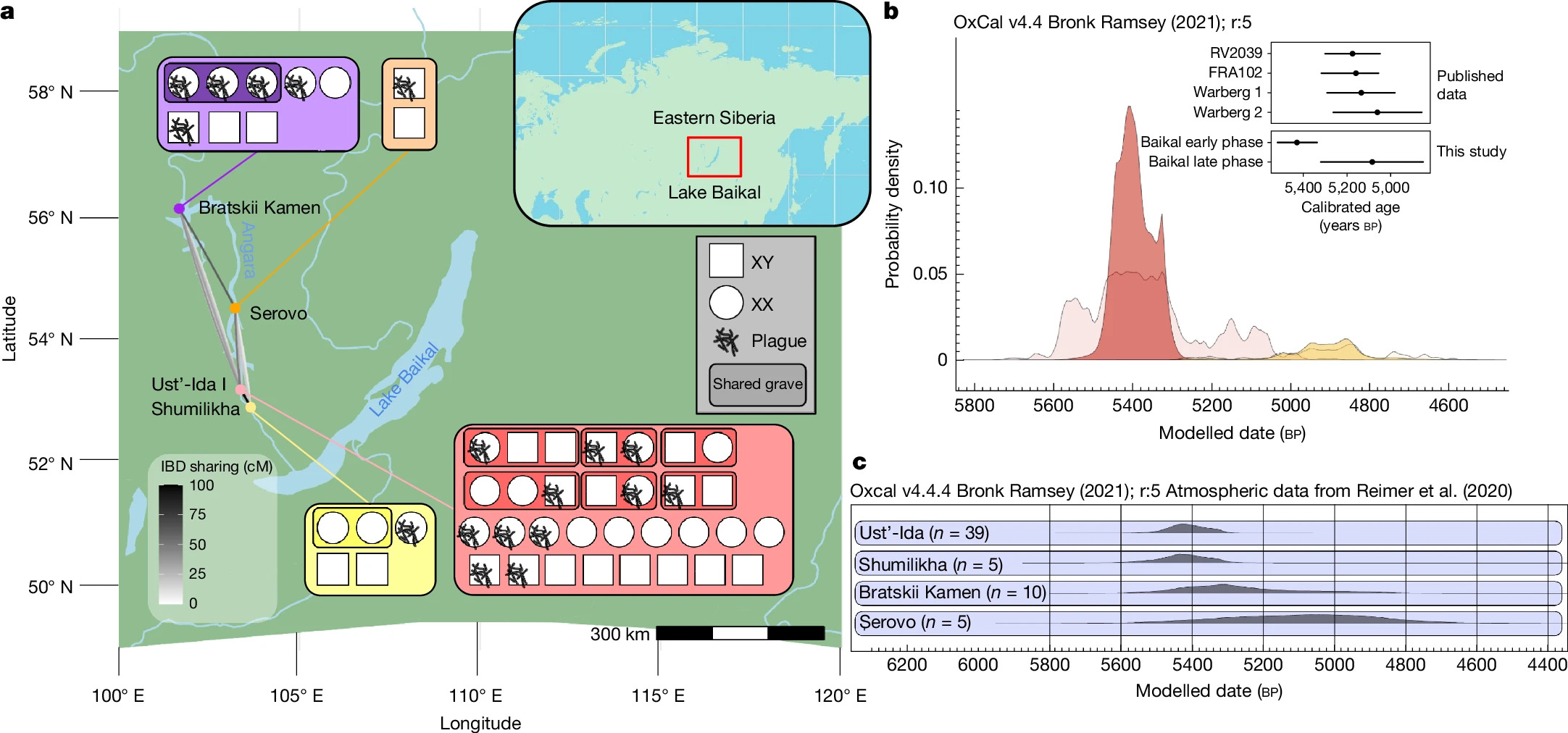
These people lived around 5,500 years ago. They were not farmers. They were not living in dense settlements. There were no rats riding grain ships, no fleas adapted to a human commensal niche, none of the conditions textbooks usually treat as prerequisites for plague to become an epidemic disease. They fished the Angara, hunted, moved with the seasons, and buried their dead in family plots that, it turns out, sometimes filled up all at once.
The puzzle had actually been sitting in the archaeological record since the 1990s. Excavators working these cemeteries had long noted an oddly high number of child and adolescent burials, clustered in narrow windows of time, with siblings and even parents and children interred together. Nobody had a clean explanation for it. The assumption, reasonable at the time, was that early strains of Yersinia pestis simply weren’t dangerous enough to cause this kind of pattern. Genomic work over the past decade had shown that the oldest known plague genomes, from Bronze Age Sweden and a hunter-gatherer in Latvia, lacked the genes that let plague hitch a ride in flea guts and erupt as the swollen-lymph-node bubonic form familiar from medieval history. Without those genes (ymt and the YpfΦ prophage), some researchers argued, early plague might have looked more like a mild, foodborne illness related to its close cousin Yersinia pseudotuberculosis than like a mass killer.
The Baikal data overturns that assumption fairly bluntly.


