

Two macaques sit in a lab, tapping a lever along to pop songs coming out of a speaker. Get the tempo right, more or less, and juice arrives; get it wrong, or don’t try at all, and nothing does. Over months of this, the monkeys learn to slow their taps down for a slow song and speed them up for a fast one. That much, a team of researchers reported in the journal Science1 in 2025, the monkeys can do; whether they ever manage to place a tap at the right moment inside the beat itself, rather than merely at roughly the right rate, turned out to be a much harder question to settle.
The paper carried a title built for headlines: “Monkeys Have Rhythm.” It is a good story to want to be true. Macaques are intelligent, trainable, and close enough to us on the primate family tree that comparative psychologists often treat them as a stand-in for the kind of brain our own ancestors carried around tens of millions of years ago. If that brain could be coaxed into keeping a beat, it would suggest the raw hardware for musical timing was already present in a common ancestor, waiting for one branch of the family to refine it into something like music. A rebuttal2 circulated in 2026, reanalyzing the same tapping data, argued that the study never actually showed the harder half of that claim.
Tempo matching means adjusting the rate of a repeated action to the rate of a repeated sound, faster or slower as needed. Synchronizing to a beat is a different and stricter thing: it means predicting when the next beat will land and placing an action right on top of it, or deliberately half a cycle off, and holding that relationship as the pattern continues. According to the rebuttal, neither of the two macaques in the original study ever produced the tapping phase, close to 0 degrees, that real synchronization would require, and neither showed the shift in phase that should appear when the beat is displaced by 180 degrees in a control condition. The original paper’s own figure caption claimed that the monkeys “synchronize,” a word its own phase numbers, according to the rebuttal, do not support.
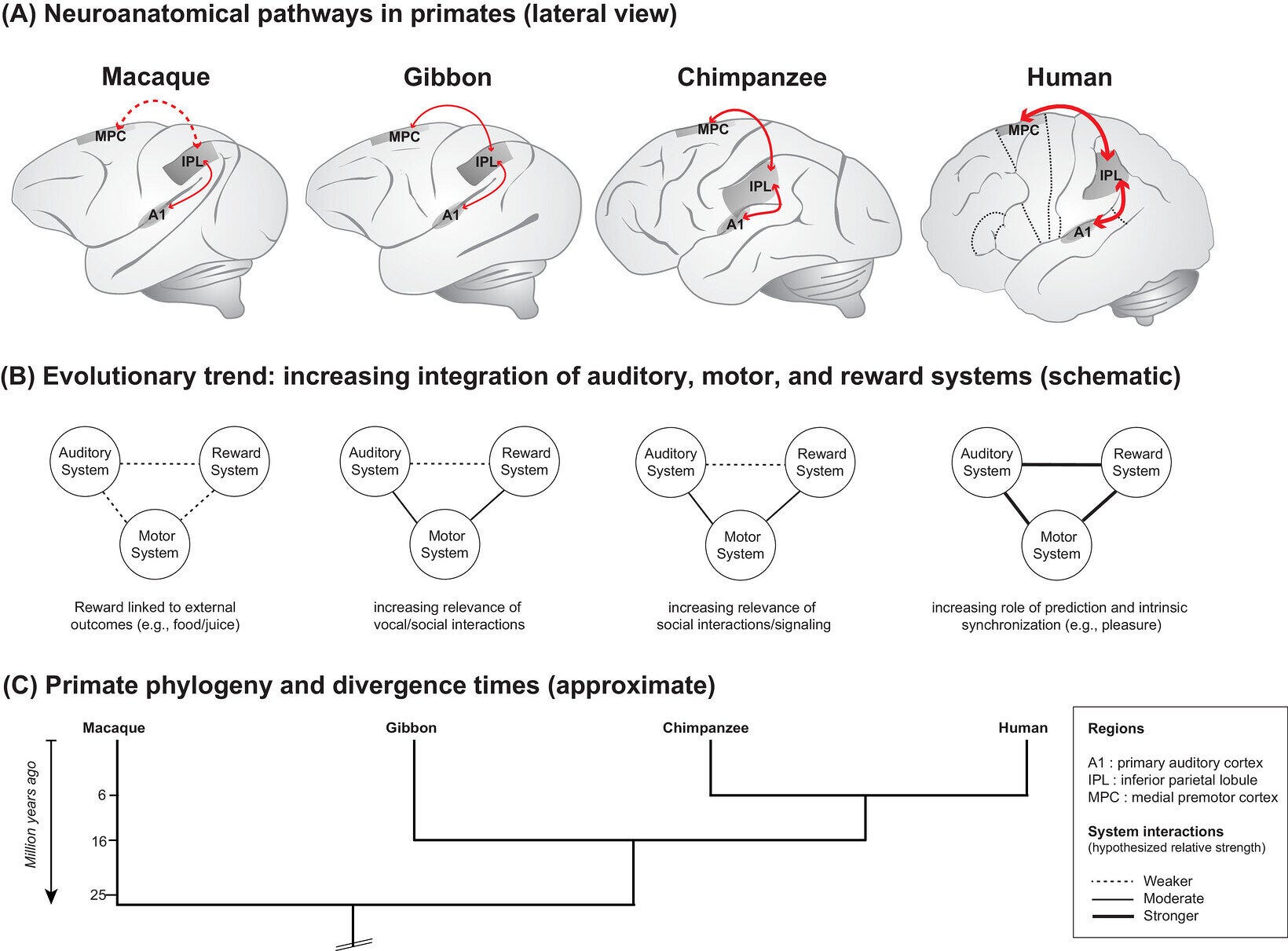
None of this is really a dispute about two monkeys. Henkjan Honing, of the University of Amsterdam, and Gábor Háden, of the HUN-REN Research Centre for Natural Sciences in Budapest, laid out the stakes in a critical review of the whole field published this year. Honing is also a co-author of the rebuttal against3 the original tapping study, which means the review is less a neutral referee’s summary than one side of an active dispute describing that dispute in its own terms. That does not make the phase data wrong, but it is a detail a careful reader should have. If beat synchronization evolved gradually, piece by piece, across the primate line, you would expect exactly this kind of graded picture, a little more than nothing in a macaque, more still in an ape, most of all in us. That is the premise behind what Honing and his collaborator Merchant have called the gradual audiomotor evolution hypothesis, or GAE, which the new review extends into a version called GAER, adding an explicit role for reward. The alternative is that something in the human lineage crossed an actual threshold rather than extending a shared trait a little further. Two disputed tapping curves cannot settle which of those is true. They mostly show how much weight one ambiguous data set has been asked to carry.


