

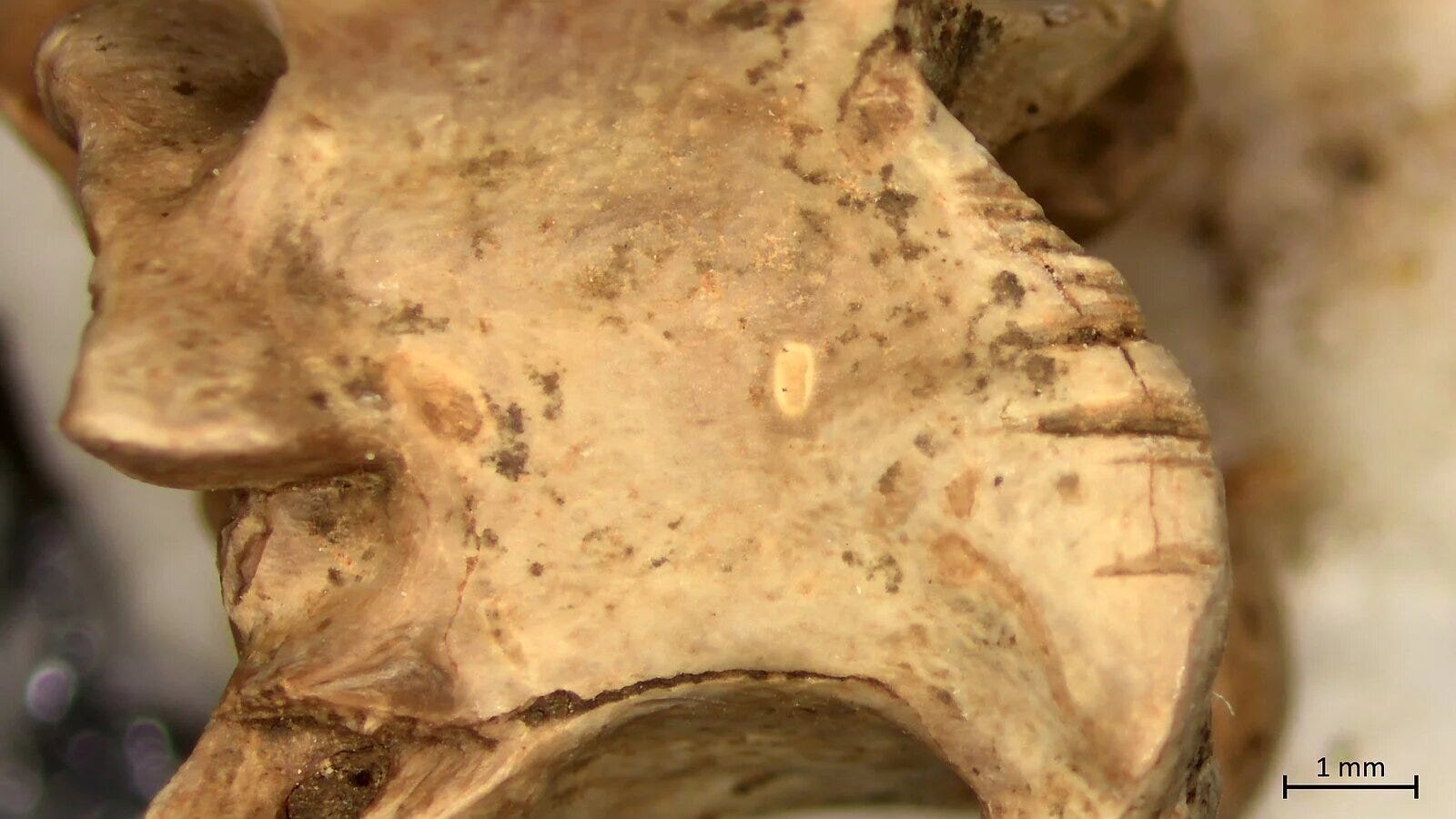
Eighty-two snake vertebrae from a terrace on Mount Carmel carry the same mark in the same place. Short linear grooves, V-shaped in cross section, sitting on the left lateral postzygapophysis of the trunk vertebra. The postzygapophyses are the paired projections at the back of a vertebra that lock into the vertebra behind it, and in a snake they sit just under the flank of the body. Often the same specimen carries several parallel striations, the signature of a blade worked back and forth rather than drawn once.
That regularity is the finding.1 A single cut mark on a single bone proves nothing much. Eighty-two of them, all on the left side, all on the same feature, spread through deposits that accumulated over roughly three thousand years, describes a technique. Someone at el-Wad Terrace was doing the same thing to snakes, the same way, for longer than the interval separating us from the founding of Rome.
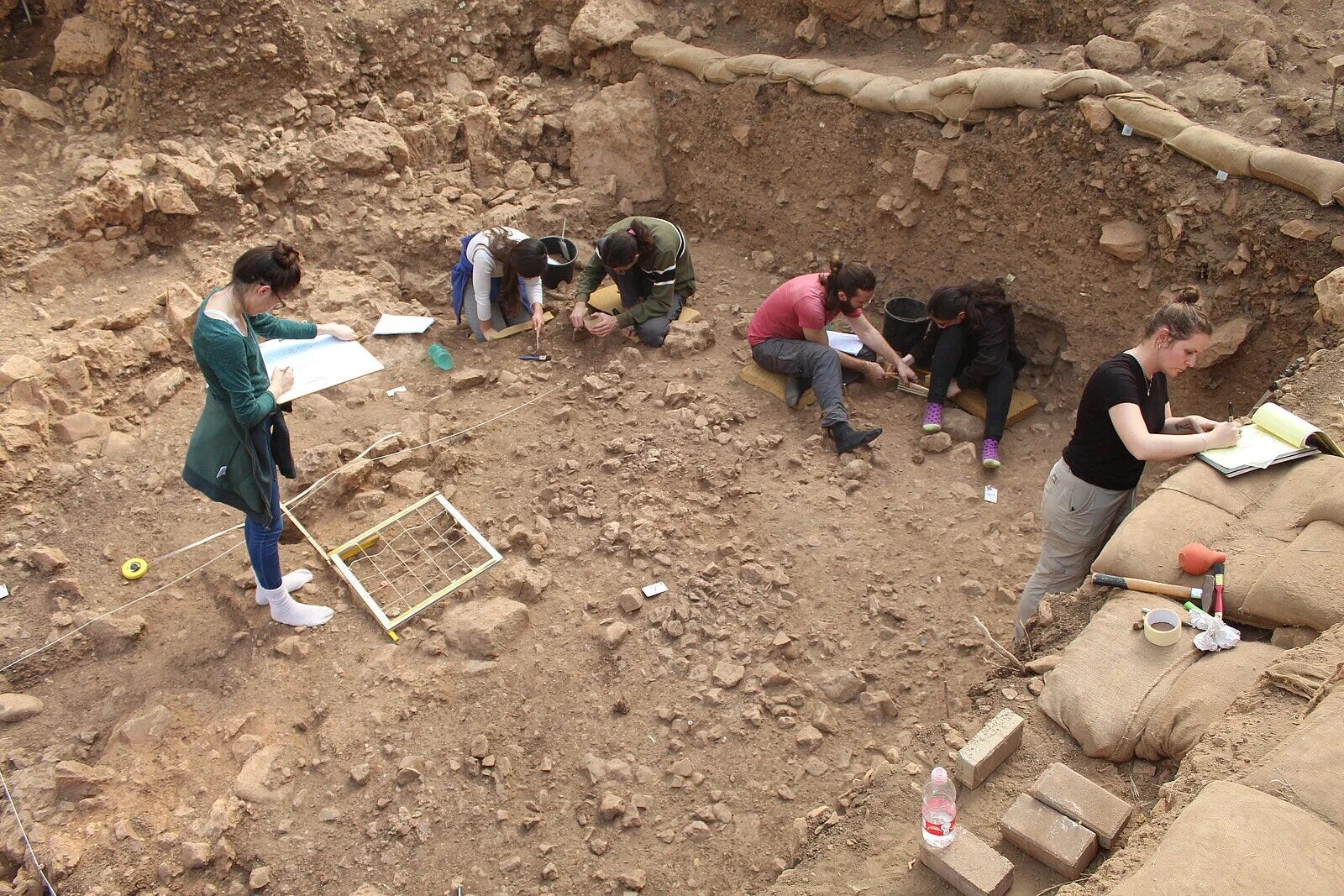
The site sits in the Nahal Me’arot Nature Reserve on Mount Carmel in Israel, excavated by the University of Haifa between 2001 and 2022. Its Natufian deposits run to 20 stratified layers spanning about 15,000 to 11,700 calibrated years before present, and they divide into four habitation stages. A prearchitectural stage came first. Then an architectural stage, when built dwellings went up and occupation was at its most intense and most sedentary. Then a postarchitectural stage at the end of the Early Natufian, when people came back seasonally and briefly rather than staying. Late Natufian deposits follow the same low-intensity pattern. Earlier work reading multiple lines of evidence at the site described this sequence as a full demographic cycle: growth, plateau, collapse, reorganization.
Ma’ayan Lev, Mina Weinstein-Evron, and Reuven Yeshurun ran the herpetofauna from all 20 layers through 5 mm and 1 mm sieves and counted what came out. Squamates, meaning lizards and snakes, make up between 25 and 42 percent of identified specimens in the coarse-mesh assemblages that represent the site’s macrofauna. That puts reptiles in the same numerical range as gazelle-sized ungulates and tortoises. Frogs and toads, by contrast, account for about one percent and can be set aside.
Six species do nearly all the work. The European glass lizard, Pseudopus apodus, is the single most common, at 975 identified specimens or 35 percent of the identified total. It is a legless lizard, up to 1.25 m long and 1.1 kg, ground-dwelling, diurnal, slow, and harmless. Next is the large whip snake, Dolichophis jugularis, at 881 specimens and 32 percent, a fast nonvenomous colubrid exceeding 2 m and 2 kg. Third is the eastern Montpellier snake, Malpolon insignitus, at 626 specimens and 22 percent, roughly the same size as the whip snake but rear-fanged, mildly venomous, aggressive, and an enthusiastic climber. Well behind them come the roughtail rock agama, Stellagama stellio, at 155 specimens; the common viper, Daboia cf. palaestinae, at 54; and the coin-marked snake, Hemorrhois nummifer, at 22.
The three abundant species are the three largest. That is the first hint that something other than chance is filtering what ended up in the deposits.


