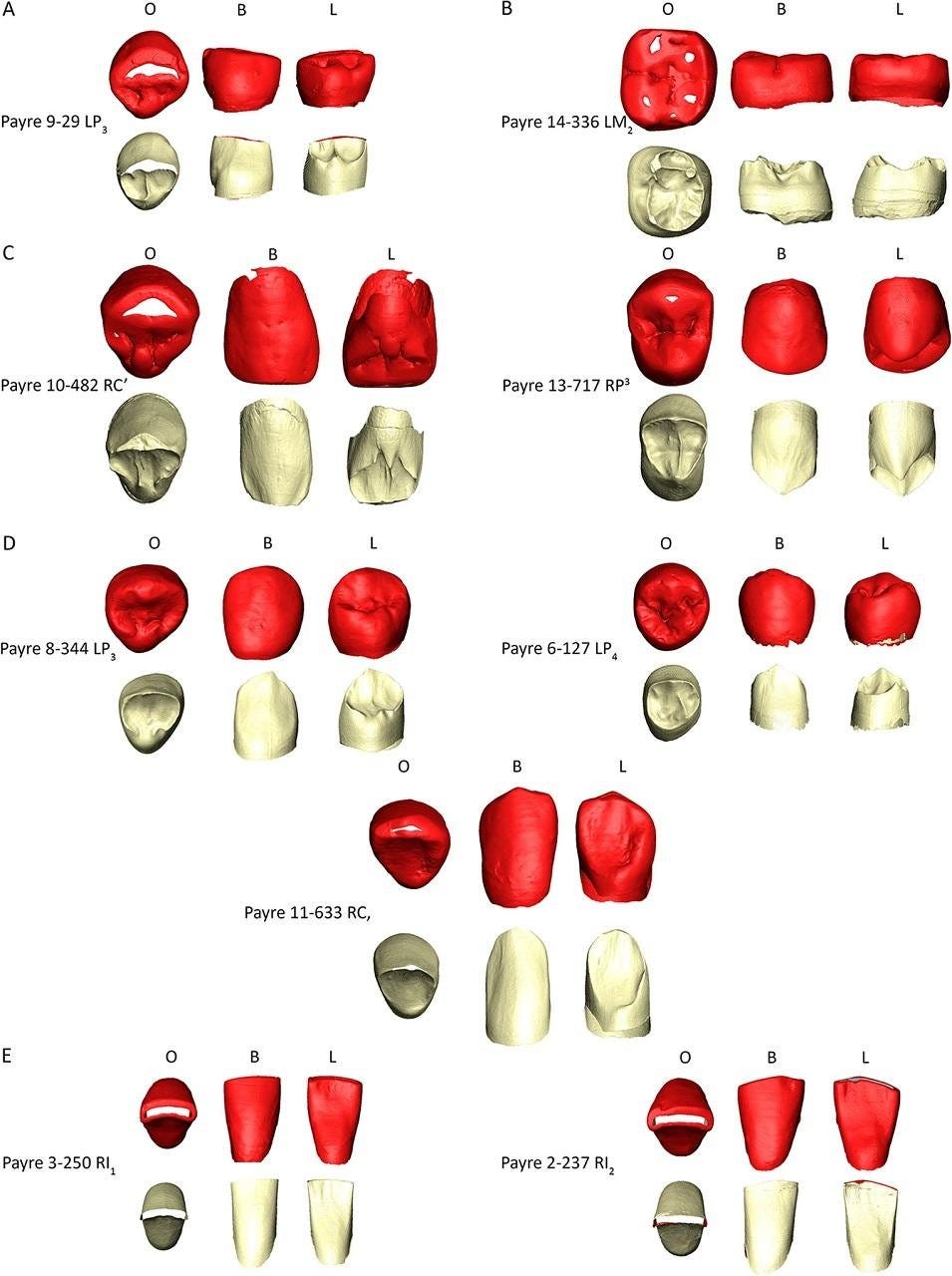
One of the nine teeth from Payre looks unmistakably Homo neanderthalensis. It is an upper canine recovered from level F of a collapsed cave in the Ardèche region of southeastern France, dated to around 250,000 years ago. The tooth is robust, and its inner surface carries a feature called a tuberculum dentale so strongly expressed that it forms a freestanding cusp. This small independent projection near the base of the tooth is virtually absent in modern humans. In Neanderthals, it is common. In this individual, it reaches the maximum grade on the scoring system used to classify it.
Compare that to two incisors from the lowest floor of the same site, level Gb. By metric standards, both fall outside the Neanderthal size range entirely. Their dimensions match modern humans.
The people who left their teeth at Payre were not a single undifferentiated group. Or if they were, they were not what anyone expected to find.