

The oldest date in the whole dataset comes from a post hole, sunk about twenty centimeters below the base of a burial mound at 1,843 meters, with a fragment of carved flint beside it. The sample falls between 8798 and 8537 cal BC. That makes it close to eleven thousand years old, the deepest sign of a person anywhere in the study, and the researchers do not really trust it. The context was exposed only partially, in a trench cut to examine the inside of the mound rather than to date what lay under it. When they ran their analysis of how different kinds of sites change through time, they left this date out.
That decision is a good way into what this paper actually is.
The post hole belongs to the Dolmen de la Font dels Coms, a site at the head of a valley about six kilometers outside the Aigüestortes i Estany de Sant Maurici National Park, in the northwest corner of Catalonia. The park covers close to 40,000 hectares of the central Pyrenees, granite country where the peaks run to 3,000 meters and even the valley floors sit above 1,500. For most of the twentieth century, archaeologists treated terrain like this as somewhere people went only when they had to, a refuge in wartime or a spot for some narrow seasonal task. Nobody, the thinking went, lived up here in any sustained way.
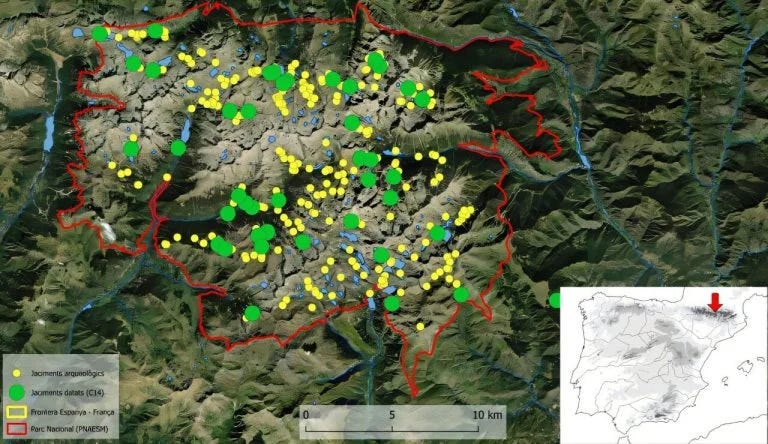
Ermengol Gassiot, Guillem Salvador-Baiges, and Laura Obea-Gómez, of the Universitat Autònoma de Barcelona, have spent two decades assembling the record that undoes that assumption. Their High Mountain Archaeology Group has surveyed the park since 2004 and logged roughly 380 archaeological sites inside it: huts, enclosures, rock shelters, stone circles, charcoal kilns. In a new paper in ArcheoLogica Data1 they publish the chronological backbone for all of it, an open database of 124 radiocarbon dates from 45 sites in and around the park, with the lab reports, sample details, and analysis code included. They describe it as the first openly published systematic series of absolute dates for a high-mountain area of the Pyrenees.
The headline is easy to state. People have been coming up here for more than ten thousand years, and they kept returning to the same places.
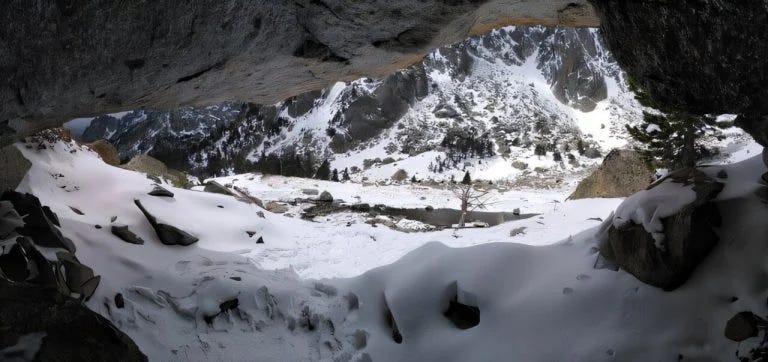
Three shelters carry the deep sequences. The Obagues de Ratera rock shelter, at 2,312 meters, has its first occupation in the early Holocene, around 8092 to 7660 cal BC, and then reappears again and again: through the Mesolithic, the shift into the Neolithic, the full Neolithic, the Chalcolithic, the Early and Middle Bronze Age, the start of the Iron Age, the Visigothic centuries of the early Middle Ages, and finally the nineteenth and twentieth. Cova del Sardo, lower down at 1,780 meters, runs back about 7,500 years. The Portarró shelter, at 2,280 meters, goes back roughly 7,300 years and holds something the team flags as a first: stone footings combined with timber, built around 5,000 years ago, in the late Neolithic, which they identify as the oldest stone architecture known in the Pyrenees.
None of these is a village with the lights left on for ten millennia. What the shelters record is return. Groups came up, used an overhang, left, and others came back centuries or millennia later to the same rock, often building on top of what was already there. Read across the whole park, that pattern of reoccupation is what lets the team call the presence continuous, even though the raw evidence is a scatter of separate visits.
That presence was not steady. Some windows were busier than others, and one of the busiest opens around 3300 cal BC, at the end of the Neolithic, and runs to about 2500 cal BC. That is roughly 5,300 years ago, the same few centuries in which, several hundred kilometers to the east in the Ötztal Alps, the man we call Ötzi died on a high pass. Two different ranges, one broad pulse of mountain use. It is a coincidence of timing rather than evidence of a shared cause, but it is the kind of coincidence that tells you the high country was on people’s minds across Europe at once.


