

The common narrative of human evolution often stops at the edge of the Ice Age. In this version of the story, Homo sapiens spent hundreds of thousands of years being forged by the harsh requirements of the Pleistocene, only to reach a sort of biological stasis once we figured out how to grow wheat and build cities. We tend to view the last 10,000 years as a period of intense cultural change but negligible biological change. The genes, we assume, have been trying to catch up with the inventions.
New data suggests the opposite is true. Rather than slowing down, the pace of our evolution may have actually hit the accelerator just as the glaciers began to retreat.
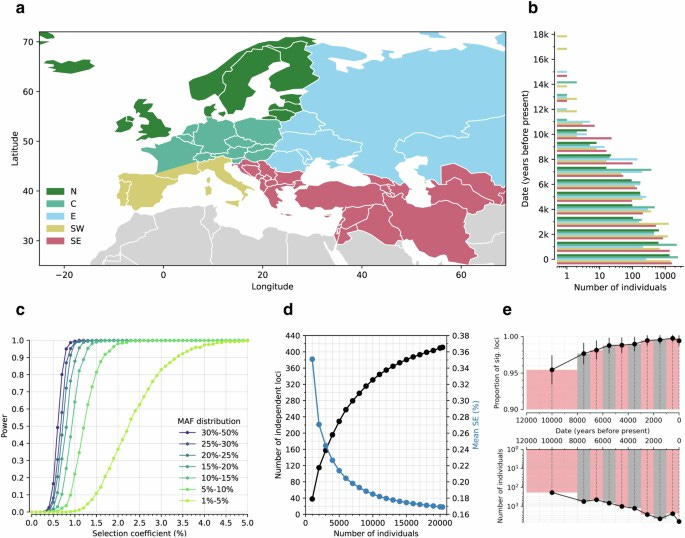
A team led by researchers at Harvard University recently published1 an analysis of nearly 16,000 ancient genomes, a dataset so large it effectively doubles the existing library of ancient human DNA. By looking at West Eurasians spanning the last 10,000 years, they found that directional selection—the process where specific genetic variants are actively pushed to higher frequencies because they offer a survival advantage—is not the rare event we once thought it was. It is pervasive.


