

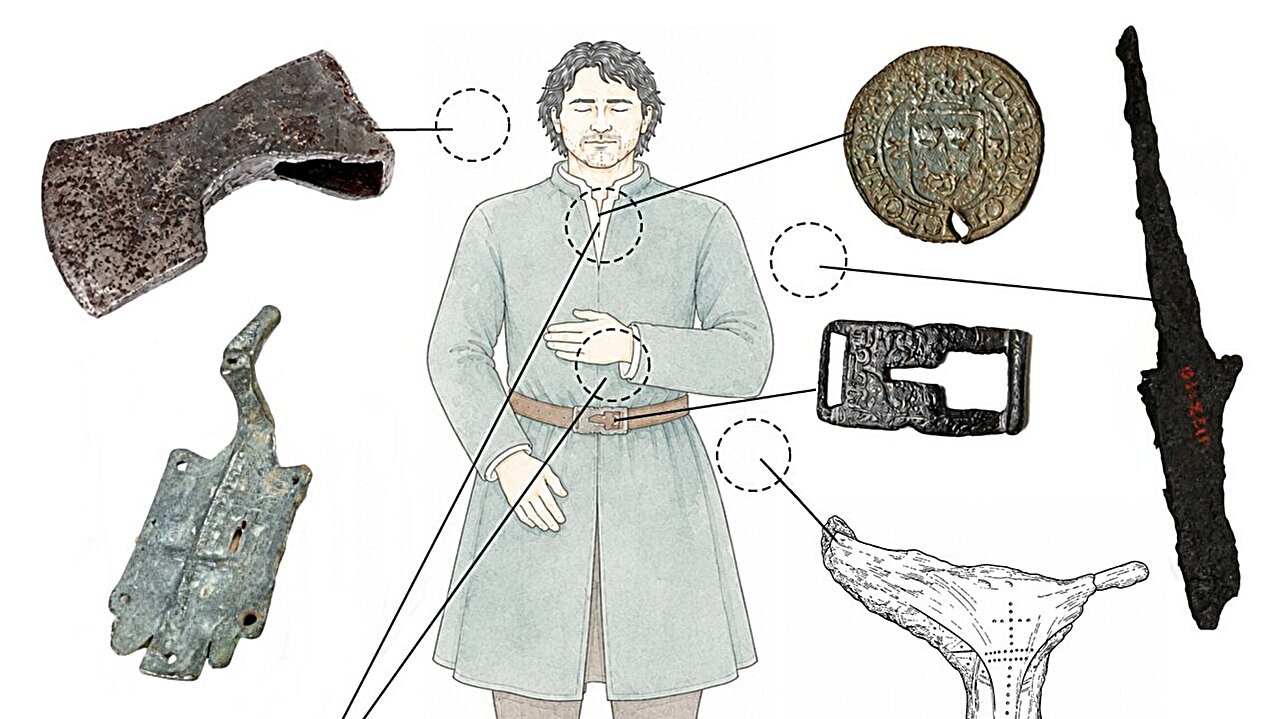
In 1970, construction work near the shore of Lake Yli-Kitka in Kuusamo, northeastern Finland, turned up a grave. The skeleton inside belonged to a man about forty years old, buried somewhere around the turn of the 17th century. The date came from a Swedish silver coin minted in 1573 and worn around his neck as a pendant or amulet. The grave goods were unusual for the region: an axe, a knife, copper rings, a small tin bird, and a drum hammer made from a reindeer antler. That last object, along with the bird, invited a particular interpretation. The man was identified as a noaidi, a Sámi ritual specialist, someone who used the goavddis drum to communicate with the spirit world.
The grave sat in Kuusamo for the next fifty years, attracting intermittent academic attention and eventually becoming the subject of a political dispute about where the remains should be housed and who, exactly, the man belonged to. Then a team from the University of Turku, collaborating with researchers at the Max Planck Institute for Evolutionary Anthropology and several other institutions, ran a full bioarchaeological analysis. The paper was published in BMC Genomics in 2026.1
The findings complicated almost everything that had been assumed about him.
Ancient DNA recovered from the man’s tooth placed him clearly within the Sámi genetic world. Both his mitochondrial haplogroup (V) and Y-chromosomal haplogroup (N1a1a1a1a2a1a1a1) are common in present-day Sámi populations. In principal component analysis, his genome falls close to contemporary Sámi, and particularly to a cluster of ancient individuals with Sámi-related ancestry, including three Iron Age individuals from the Leväluhta water burial site in western Finland and a previously published Viking Age individual from the Lofoten Islands in Norway. His genome shows short and medium-length runs of homozygosity consistent with origin in a small population rather than close-relative inbreeding, exactly what you’d expect for the historically low-density Sámi groups of northern Fennoscandia.
The team also found, interestingly, that the Kitka individual carries somewhat more Siberian-like ancestry than present-day Sámi from Finland do. That’s not a contradiction; it likely reflects subsequent gene flow into Finnish Sámi populations from surrounding non-Sámi groups with more West European ancestry. His genetic profile may look more like what Sámi populations looked like before that admixture accumulated.
When the team mapped identity-by-descent sharing between the Kitka individual and nearly 3,500 present-day Finns drawn from across the country, the highest sharing appeared not in Kuusamo, where he was buried, but far to the north, in Inari, Utsjoki, Sodankylä, and eastern Lapland. 66.7 percent of individuals from northern Lapland shared at least one IBD segment with him. The Kitka and Posio municipalities, immediately surrounding the burial site, showed much lower rates. The team’s modeling suggests that the IBD pattern in the northeast reflects something more specific than simple Sámi-related admixture distributed across Finland. The Kitka individual’s ancestry connects most strongly to the people of the regions historically associated with the northernmost Kemi Sámi speaker area, before Finnish settlement pushed those communities out or absorbed them. His genetic roots appear to have been roughly within 250 kilometers of where he died, somewhere in the northeastern borderlands, but not in Kuusamo itself.


