
Sesselfelsgrotte 1 spent roughly three decades as nothing in particular. Excavators pulled twelve small bone fragments out of a seven-meter sequence of limestone rubble in a Bavarian rock shelter sometime in the late 1960s or early 1970s, logged them, and moved on. Nobody recognized what they had until the 1990s, when a closer look at the fragments, none longer than five centimeters, identified them as the remains of a Neanderthal fetus. Two baby teeth from the same site, a worn upper molar and the broken half of a lower one, went unidentified for nearly as long.
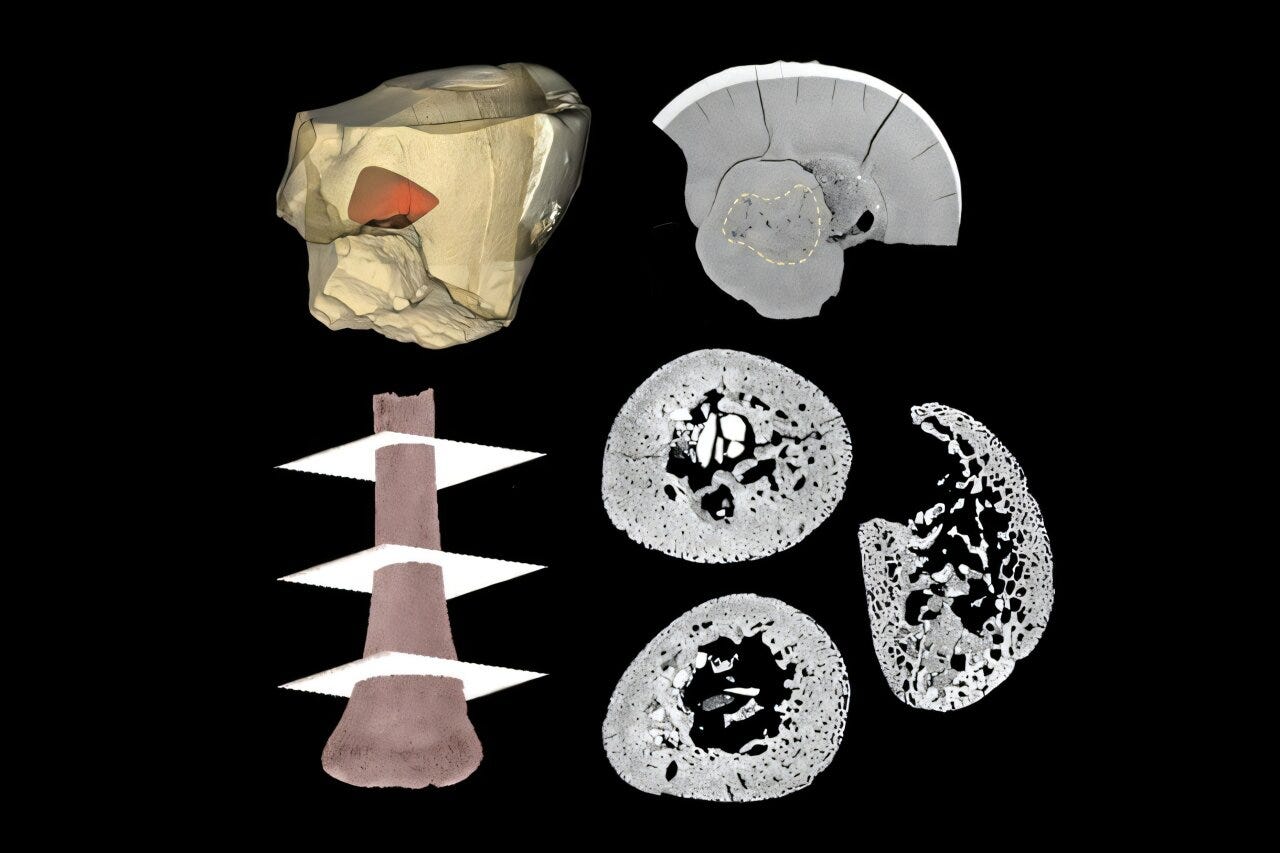
That delay matters less than what the bones and teeth turned out to contain. A new study using microcomputed tomography, a non-destructive scanning method that reads the internal structure of bone and dentin in three dimensions, has reconstructed how this fetus’s skeleton was forming in the weeks before it died, and found something unexpected buried inside the teeth of the other two children from the same cave.
Sesselfelsgrotte is one of the richest Middle Palaeolithic sites in western Europe, a rock shelter near Essing with a deep, complicated stratigraphy and a long excavation history. The fossils in question come from three separate layers and were never associated with each other in life, only in deposition. Sesselfelsgrotte 1, the fetal skeleton, comes from layer G5, dated through thermoluminescence to somewhere around the very end of one glacial stage or the very beginning of the next, roughly 50,000 to 90,000 years ago. The upper molar, Sesselfelsgrotte 2, comes from layer M2 and carries a more precise weighted age of about 75,900 years. The lower molar fragment, Sesselfelsgrotte 3, is harder to date but sits in the same general window.
When Thomas Rathgeber first examined the fetal bones in 2006, working from external measurements alone, he noted that the humerus and femur showed a robusticity closer to Homo neanderthalensis than to Homo sapiens, and estimated, by comparing the specimen against modern human and other Neanderthal fetal remains, that this individual died around eight months into gestation. His conclusion, translated from the original German, was direct: the bones likely belonged to a pregnant Neanderthal female who lost her child late in pregnancy during a stay at the site. He flagged the alternative readings too, including deliberate burial or simple natural deposition in cave sediment, and left the question open. A subsequent ancient DNA analysis1 of the femur has since confirmed the individual was in fact Neanderthal, closing off any doubt about species identity even as the circumstances of death remain unresolved.


