
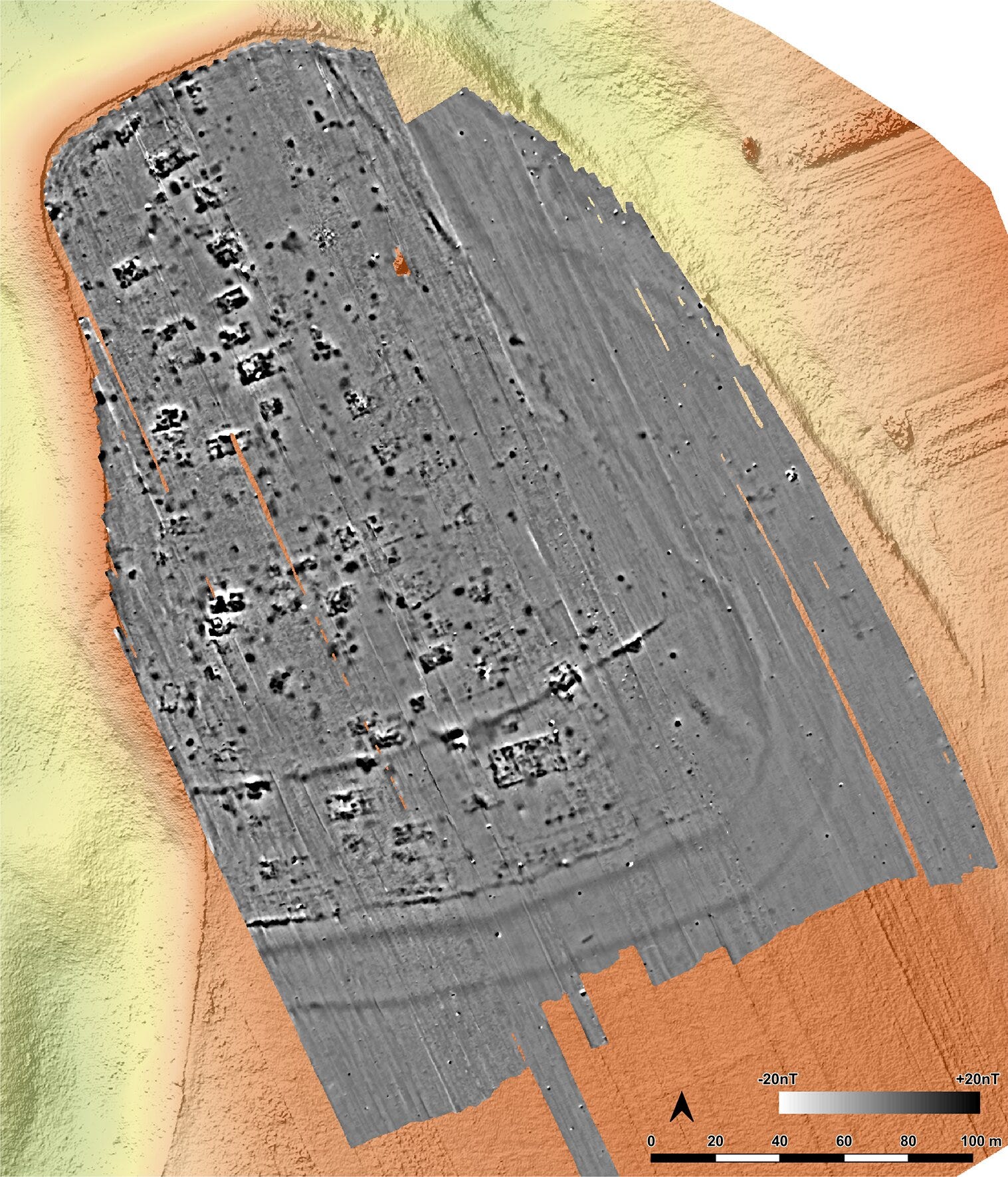
Somewhere around 4,000 BC, people living at a promontory above the Sitna river in what is now northeastern Romania built something that didn’t fit. Their settlement had roughly 45 houses, each between 70 and 120 square meters, arranged in orderly rows behind a system of ditches and palisades. The houses were consistent in size, similar in construction, and distributed across a plateau of about 4 hectares. Then there was House 5/6. At approximately 350 square meters — nearly four times the median size of the surrounding structures — it sat between the ditches, positioned squarely near what was probably the settlement’s main entrance. It faces you as you arrive. You cannot miss it.
This building, at the site now called Stăuceni-’Holm’, is what Cucuteni-Trypillia researchers call a mega-structure. A team from Friedrich-Alexander-University Erlangen-Nürnberg, working alongside the Botoșani County Museum and the National Museum of Bukovina, partially excavated it over four-week campaigns in 2023 and 2024. The results, published in PLOS One1 in March 2026, add a new site to a very short list and raise questions that the excavation cannot yet resolve.
The Cucuteni-Trypillia complex is one of the more genuinely puzzling phenomena in European prehistory. Its settlements, distributed across what is now Romania, Moldova, and Ukraine, range from small villages to enormous concentrations of population. The largest of them, the so-called mega-sites, covered hundreds of hectares and housed thousands of contemporaneous dwellings — Maidanetske, in Ukraine’s Cherkasy Oblast, counts around 2,930 houses across 170 hectares. Some of these sites were occupied continuously for over three centuries. And yet they show, at least on the surface, almost no signs of hierarchy. No palaces. No obviously elite burials. No administrative script. The houses look alike. The material culture is distributed without obvious concentration of wealth.
The question that has driven much of the recent research is how communities of this size organized themselves. Some scholars have argued for a fundamentally egalitarian or non-hierarchical social structure. Others have pushed back on this, pointing to subtle differences in building size and position that the older literature sometimes smoothed over. The mega-structures sit at the center of this debate, because they are the most visible departure from the pattern of uniformity — and yet their function remains genuinely unclear.
What a Mega-Structure Is, and What It Isn’t
A working definition has emerged from prior research, particularly a 2019 synthesis by Hofmann and colleagues that catalogued 140 mega-structures across 19 sites. They are rectangular, substantially larger than the surrounding buildings, positioned in visible or open locations, and often architecturally distinct from domestic dwellings. The relative scale matters more than absolute dimensions: a 350-square-meter building in a settlement where the median house is 91 square meters is an outlier in a way that the same structure wouldn’t be in a different cultural context.
Before the excavation at Stăuceni-’Holm’, the primary evidence for mega-structures came from geomagnetic surveys. When clay-rich structures burn and collapse, the fired material leaves strong magnetic anomalies detectable from the surface. Researchers have used the patterning of these anomalies — their density, distribution, and configuration inside a structure’s footprint — to infer internal features: walls, hearths, platforms, room divisions.
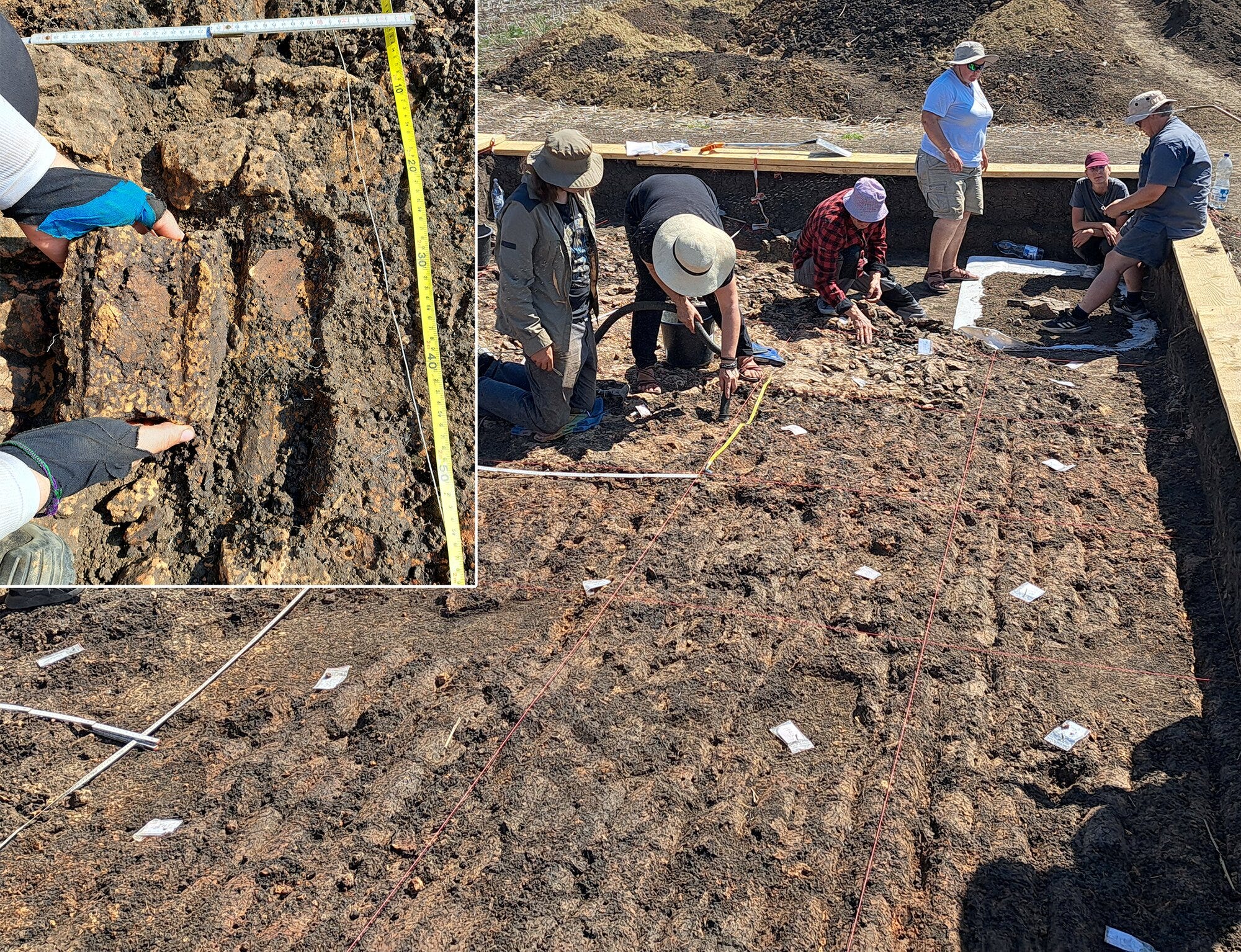
The excavation at Stăuceni-’Holm’ delivered a sharp correction to this practice. When the team dug into the mega-structure and mapped its geomagnetic signal at successive levels, they found that nearly all of the anomalies they had expected to correspond to interior installations disappeared without trace. No hearths. No raised platforms. No subdividing walls where the magnetogram had suggested them. What they were seeing, it turned out, was simply the varying density of collapsed daub — the fired clay that had once formed the building’s floor and walls. Remove the daub layer, and the anomalies vanish. Only the foundation ditch, cut deeper into the subsoil, remained clearly visible.
The authors frame this directly: no information on the interior layout of a Cucuteni-Trypillia mega-structure can be reliably derived from the magnetogram alone. Given how much of the existing comparative analysis rests on geomagnetic data, this is a meaningful caution.
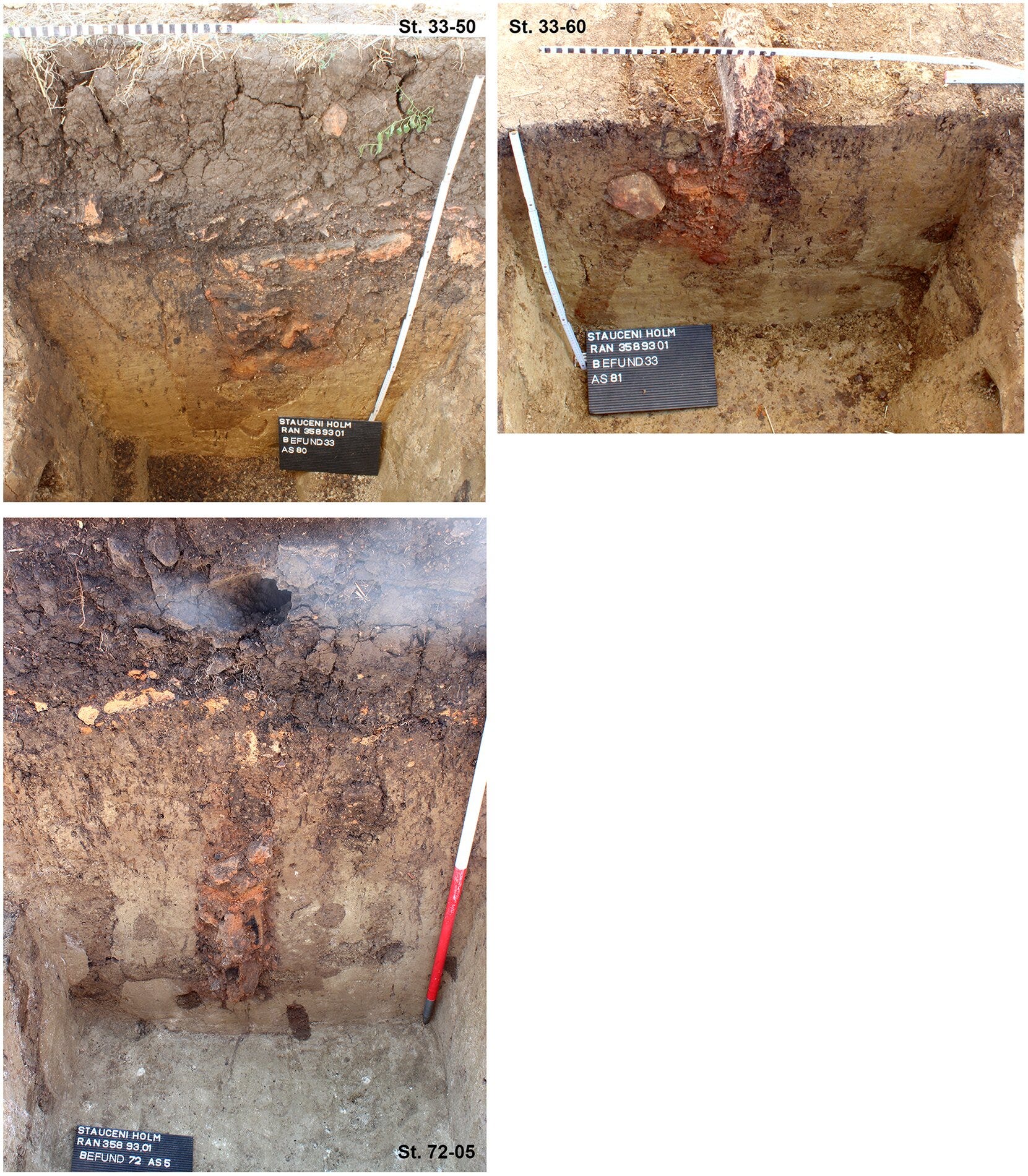
What the excavation did find was a foundation ditch tracing the building’s perimeter, roughly U-shaped in section, with postholes cut into it at intervals of 70 to 90 centimeters. The posts had been wedged in place using fragments of fired clay, apparently debris from earlier structures elsewhere on the site. Beneath the clay floor, small tree trunks had been split in half and laid flat-side-down, forming a wooden substructure over which a layer of clay was then applied and smoothed. Two substantial postholes ran along the building’s central axis, deep enough (more than 80 centimeters below the floor level) to have supported a roof. A third central post, if confirmed in the unexcavated northern portion of the structure, would divide the interior lengthwise into two halves.
Noticeably absent: ovens, storage features, grinding stones. The amount of burnt clay associated with the structure is far lower than what appears in the domestic buildings at the site, which typically burn thoroughly and leave substantial daub deposits. The mega-structure’s walls may have been largely wooden, burning without leaving much material trace.
The Dating Problem
The team’s working hypothesis, based on the pottery collected from the surface and during excavation, was that Stăuceni-’Holm’ dates to the Cucuteni A3 phase — a period generally assigned to roughly 4350 to 4050 cal. BC. If correct, this would make the mega-structure among the earliest known examples of the type, younger only than the Pre-Cucuteni mega-structure at Baia, dated to around 5000 BC.
Then the radiocarbon results came back.
Two short-lived samples from the building’s floor — a fragment of Prunus sp. fruit stone and a seed of Polygonum convolvulus, both drawn from protected locations between the floor timbers — returned dates placing the structure in the 40th to 39th centuries BC. That is, around 4000 to 3800 cal. BC. For Cucuteni AB material, not Cucuteni A3.
The team considers and rejects several ways out of this contradiction. The samples came from annually growing plants, so an old-wood effect can be excluded. They were recovered from stratigraphically secure positions connected directly to the floor’s construction. A pot found smashed in one of the foundation postholes — a small globular cup in fine-tempered clay, decorated with red ochre and incised designs in what the team identifies as Cucuteni A3 style with Precucuteni technical traditions — links the pottery type to the same depositional event as the radiocarbon dates.
The honest conclusion they reach is that something is wrong with the existing chronology, or at least with its application to this region. The absolute dating framework for Cucuteni A3 in the Upper Siret-Prut area rests on very few radiocarbon measurements, several of which carry high standard deviations and uncertain connections to diagnostic material. For that specific region, the published literature relied on four dates before 1995, three of them from charcoal at a single site. The Stăuceni dates, derived from short-lived plant material in an unambiguous context, may be the most methodologically sound anchor the region has.
The implication, if the dates hold, is that Cucuteni A3 may persist later in the western distribution area than current models allow. The researchers note that the absolute dates from Stăuceni-’Holm’ would be broadly contemporaneous with the mega-structures at Nebelivka and Dobrovody in Ukraine, and with the radiocarbon-dated mega-structure at nearby Ripiceni-’Holm’, dated to 4041-3975 cal. BC. What looked like a chronological outlier may instead reflect real overlap across the Cucuteni-Trypillia cultural zone that existing phase divisions obscure.
What Was Happening Inside
The finds from the building’s interior are sparse in the way that characterizes most excavated mega-structures. Concentrated pottery deposits, mostly as sherds, appear especially toward the building’s eastern interior. Among the more distinctive objects: a clay bowl bearing a zoomorphic protome in the form of a bull’s head with once-massive horns; three ladles, one still bearing traces of painted decoration on both faces; a single clay cone of the type sometimes labeled “conical idols” in the literature; and 87 flint artifacts, about half of them burned. The flint count is notably higher than the handful recovered from the Ukrainian mega-sites, though this likely reflects proximity to local raw material sources rather than functional difference.
Archaeobotanical sampling from the floor produced carbonized cereal grains (unidentifiable below the level of Cerealia), associated weed taxa including Polygonum convolvulus, Galium cf. aparine, Chenopodium album, and Echinochloa crus-galli, along with gathered fruits from cornelian cherry (Cornus mas), plum (Prunus sp.), elder (Sambucus sp.), and hawthorn (Crataegus sp.). Carbonized fruit stones are a marker of in-situ food consumption. Feather grass (Stipa sp.) awns appeared in several samples, consistent with insulation, bedding, or floor covering. One sample contained mineralized remains of henbane (Hyoscyamus niger), a psychoactive and medicinal plant.
None of this points unambiguously toward any single function. The food remains suggest something was consumed here, but not at the scale of a communal storehouse or dedicated feasting hall. The absence of ovens and grinding stones argues against sustained domestic food processing. The henbane is intriguing but insufficient. The researchers decline to commit to a function: storage building, unlikely; dedicated ritual space, no clear evidence; assembly hall for collective decision-making, possible; residence for a high-status household, not ruled out.
The structure occupies, in the settlement layout, a position analogous to what Hofmann and colleagues designate P5 in the larger Ukrainian ring-settlements: outside the main residential zone, well-visible to anyone approaching the site from the south, the only accessible direction given the steep slopes to the west, north, and east. That positioning has meaning. Something was meant to be seen there, or encountered upon entry.
Only about 25 percent of the building has been excavated. The northern half, unexcavated, may yet contain the third central posthole that would confirm the building’s internal division, an oven or hearth that would reframe the food residue evidence, or the absence of these things. The archaeology of Cucuteni-Trypillia settlements tends to reward patience. The building waited six thousand years to be partly reopened. Whatever it was, it was built to be noticed.
Further Reading
Hofmann R, Müller J, Shatilo L, Videiko M, Ohlrau R, Burdo N (2019). Governing Tripolye: Integrative architecture in Tripolye settlements. PLOS One. https://doi.org/10.1371/journal.pone.0222243
Gaydarska B, Nebbia M, Chapman J (2019). Trypillia Megasites in Context: Independent Urban Development in Chalcolithic Eastern Europe. Cambridge Archaeological Journal 30(1):97–121. https://doi.org/10.1017/s0959774319000301
Hofmann R, Müller J, Müller-Scheeßel N (2024). Trypillia mega-sites: a social levelling concept? Antiquity 98(398):1–21. https://doi.org/10.15184/aqy.2024.18
Diachenko A, Harper TK, Chernovol DK, et al. (2024). Testing scale-dependent temporal and spatial biases in relative chronology using AMS 14C dating: A case study of Early–Middle Cucuteni-Tripolye sites in Southeastern Europe. Journal of Archaeological Science: Reports 55:104495. https://doi.org/10.1016/j.jasrep.2024.104495
Asăndulesei A, Tencariu FA, Nicu IC (2020). Pars pro toto — Remote Sensing Data for the Reconstruction of a Rounded Chalcolithic Site from NE Romania: The Case of Ripiceni–Holm Settlement (Cucuteni Culture). Remote Sensing12(5):887. https://doi.org/10.3390/rs12050887
Ohlrau R (2020). Maidanets’ke. Development and decline of a Trypillia mega-site in Central Ukraine. Sidestone Press, Leiden.
Chapman J, Videiko M, Gaydarska B, Burdo N, Hale D (2014). Architectural differentiation on a Trypillia mega-site: preliminary report on the excavation of a mega-structure at Nebelivka, Ukraine. Journal of Neolithic Archaeology16:135–6.
Kirleis W, Corso MD, Pashkevych G, Schlütz F, Hofmann R, Terna A, et al. (2023). A complex subsistence regime revealed for Cucuteni–Trypillia sites in Chalcolithic eastern Europe based on new and old macrobotanical data. Vegetation History and Archaeobotany 33(1):75–90. https://doi.org/10.1007/s00334-023-00936-y
Mischka D, Mischka C, Kovács A, Aparaschivei C, Marinova E (2026). The mega-structure at Stăuceni-’Holm’, Botoșani county, Romania and the debate about the governing of Cucuteni-Trypillia-settlements. PLOS One 21(3): e0343603. https://doi.org/10.1371/journal.pone.0343603


