

At Rickeby, a low outcrop above what was once a bay of the Baltic Sea, more than a hundred footprints are pecked into the rock, cataloged in Swedish heritage records as Boglösa 138. Most are unremarkable on their own: ovals and outlines scattered across the stone with no obvious order. But one pair stands out. One footprint was carved the usual way, as a simple contour line, and at some point afterward somebody came back and began hollowing it out, turning a flat outline into a deep, scooped impression. They never finished the job. The footprint beside it, complete, is a different size.
A new study1 by Fredrik Fahlander, an archaeologist at Stockholm University, argues that this half-finished footprint isn’t a curiosity. It’s a clue, one piece of a pattern that runs through hundreds of similar carvings along the coasts of southern Scandinavia. These are podomorphs, pecked images of feet made in large numbers throughout the Nordic Bronze Age, roughly 1700 to 500 BCE. They usually get filed alongside the boats, animals, and human figures that make up the rest of the period’s rock art, but they don’t quite belong with them. Boats, animals, and human figures tend to lie sideways across the rock, as if caught mid motion; podomorphs are oriented vertically instead. They show up just as often well inland as along the coast, unlike the figures that cluster near the water. And they are conspicuously absent from two places where the other figurative motifs do eventually turn up: burial markers and bronze objects.
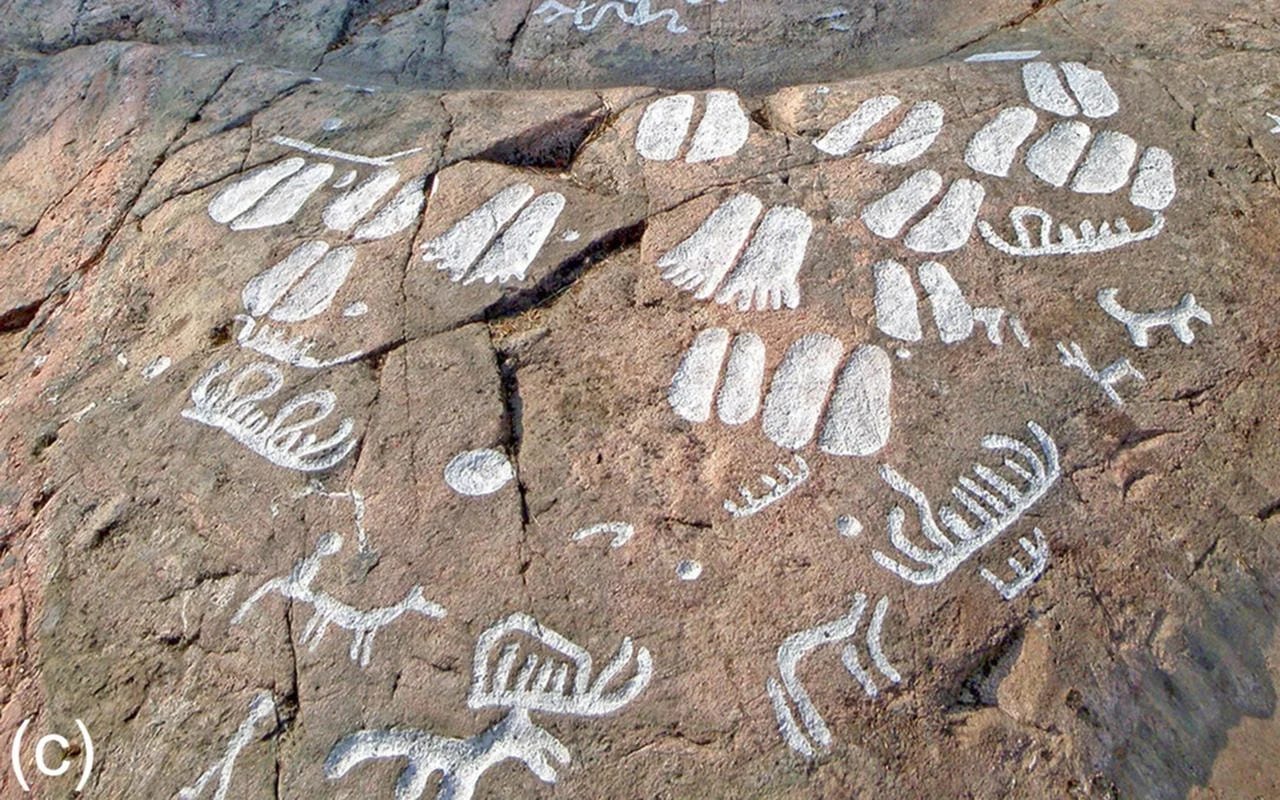
Fahlander’s case study covers the Mälaren region, a dense cluster of rock art on Sweden’s east coast that surrounds a freshwater lake today but opened onto the sea during the Bronze Age. Swedish heritage records list more than 7,000 rock art sites here. Of these, 611 contain at least one figurative motif, and 140 of those include podomorphs: 627 of them in total. Most sites with podomorphs have only one. Fifty have exactly that. The count drops fast from there: twenty-eight sites with two, twenty-three with three, thirteen with four, and only a handful of outliers beyond that. Rickeby is one of those outliers. So is Koppartorp, with 43 footprints, and an erratic boulder at Köping with 25. The footprints themselves run from 9 to 31 centimeters long, with most clustering between 18 and 25. Taken as literal foot tracings, that range would put the majority at the feet of seven to ten year olds, an odd demographic to dominate a centuries-long tradition, while the carvings at either extreme fall outside any plausible human foot at all.
Earlier explanations for the pattern have not lacked imagination. One reading treats the footprints as tracks left by a god too elusive to depict any other way. Another ties them to death, marking a route from burial mounds on higher ground down toward the water, the boundary between the living and whatever waited beneath the waves. A third, the most common, takes the carvings at face value: marks of real people, made to record a presence, an initiation, a memory. Each idea explains some of what’s on the rocks and ignores the rest. Single and paired footprints turn up constantly at sites with no trace of any larger religious narrative. Their orientation doesn’t track consistently toward water, or away from burial mounds, or toward anything else in particular. And the literal-portrait reading still has to explain those impossible sizes at the small and large ends of the spectrum, footprints too tiny or too large to belong to any human foot of any age.
Fahlander’s paper steps around the question of what the footprints represent and asks instead what they were built to do.


