
Most humans who survive to adulthood will burn themselves at least once. Usually it’s minor. Occasionally it’s severe. The statistics give you a sense of scale: in 2004 alone, thermal burns serious enough to require medical attention caused nearly 11 million injuries globally. More than 180,000 of those were fatal. And that’s just the burns we count. The minor ones, the ones people treat at home and never report, must number far higher.
No other species lives this way. No other animal regularly handles recently boiled liquids, touches hot surfaces by accident, or lives in such close proximity to open flames and high-temperature appliances. Even wild chimpanzees, our closest living relatives, show only opportunistic interest in fire. Savannah chimps at Fongoli in Senegal will watch grass fires approach, sometimes waiting until the flames get close before calmly relocating. They’ll forage in recently burned areas. But they don’t carry fire. They don’t cook with it. They don’t sleep next to it.
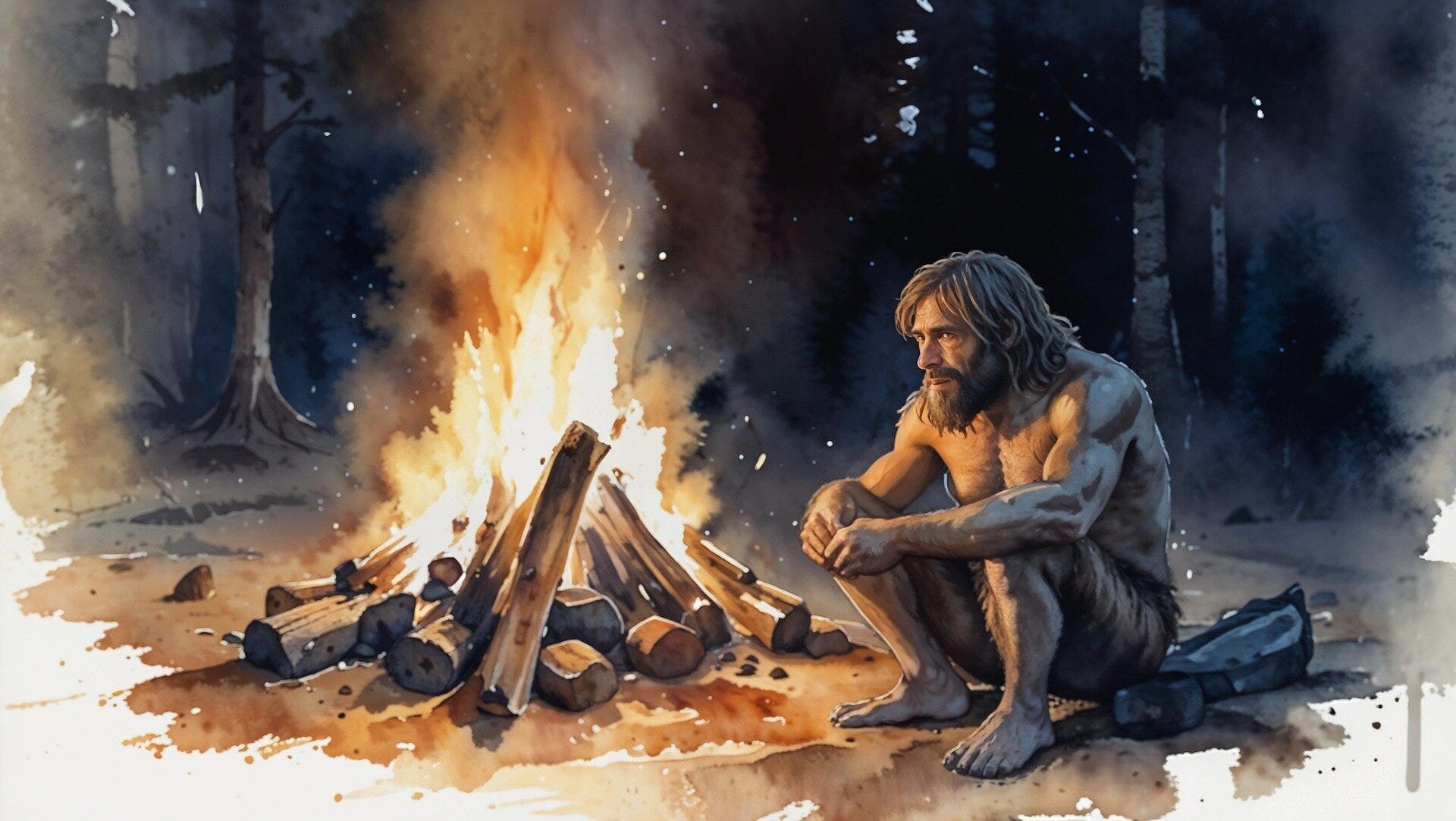
Humans do all of these things and have done so for at least a million years. The earliest undisputed evidence for controlled fire comes from Wonderwerk Cave in South Africa, dated to approximately one million years ago. Ash deposits there show temperatures between 500 and 700 degrees Celsius, with microscopic evidence of sustained, controlled burning. The fires were inside a cave, which means they almost certainly weren’t natural. Someone, either Homo erectus or Homo heidelbergensis, was tending them.
From that point forward, fire became inseparable from human life. It allowed our ancestors to expand into colder climates, to cook food and extract more nutrients with less chewing, to work at night, to keep predators at bay. The benefits are well documented. What hasn’t received much attention until now is the cost. Fire use meant exposure to high temperatures. And exposure to high temperatures meant burns.
A team led by Joshua Cuddihy at Imperial College London argues1 that this exposure wasn’t just an unfortunate side effect of an otherwise beneficial technology. It was a selective pressure. Burns, they propose, shaped the human body in specific and sometimes paradoxical ways. The hypothesis is straightforward: if our ancestors were burning themselves regularly for hundreds of thousands of years, natural selection would have favored traits that improved survival after thermal injury. Those traits are still with us. Some of them help. Some of them, when pushed to extremes, cause more harm than good.


