
Somewhere around 3600 BC, a man was laid to rest in a stone-walled tomb beside Loch Calder, in what is now the far north of mainland Scotland. Later, his son was placed there too. Then, some years after that, his son’s son. The bones of all three eventually ended up gathered together on stone benches inside the northern chamber of a cairn called Tulloch of Assery A, the remains partly disarticulated by the time of their final arrangement, coated in clay, handled and repositioned as each successive death brought another man to the same threshold.
That three-generation male line now shows up in ancient DNA. A new study published in Antiquity,1 led by Vicki Cummings, Chris Fowler, Iñigo Olalde, Sarah Cuthbert, and David Reich, analyzed 40 new aDNA samples from 22 individuals whose remains had been placed across five chambered cairns in Caithness and Orkney, dating from roughly 3800 to 3200 cal BC. The results map a network of biological relationships that reaches across community boundaries, across decades, and across the Pentland Firth.
The five tombs are Tulloch of Assery A and B, Tulach an t-Sionnaich, and Rattar East on the Scottish mainland, and Holm of Papa Westray North on the Orkney island of Papa Westray. Three of the mainland sites cluster within 200 meters of one another around Loch Calder. All three are intervisible. Rattar East sits on the coast, looking out toward the islands. Holm of Papa Westray North is on the other side of that stretch of water.
Each tomb belongs to what archaeologists call the stalled cairn tradition: drystone-walled chambers divided by upright slabs into internal compartments, set within a surrounding cairn. They look, from the outside, broadly similar. But they are not identical. Tulach an t-Sionnaich has a single box-like chamber. Tulloch of Assery A has two opposing chambers. Tulloch of Assery B is tripartite. The shared form announces membership in a common architectural tradition; the differences, the team argues, signal something equally deliberate.
What the Bones Say, and What They Don’t
The osteological picture at each site is difficult. Excavations recovered a combined minimum number of 37 individuals across the five tombs, but the assemblages are fragmentary, commingled, and in most cases heavily disturbed. At Tulach an t-Sionnaich, the human remains were sandwiched between a stone layer and a layer of animal bone — cattle, deer, bird, fish, mollusc — and intermixed with limpet shells, flint, and pottery. At Tulloch of Assery B, an adult skeleton had a leaf-shaped arrowhead embedded in a thoracic vertebra. At Holm of Papa Westray North, at least 14 individuals are represented, including four children, but much of the assemblage had been disturbed well before scientific excavation began, likely by antiquarian digging in the nineteenth century.
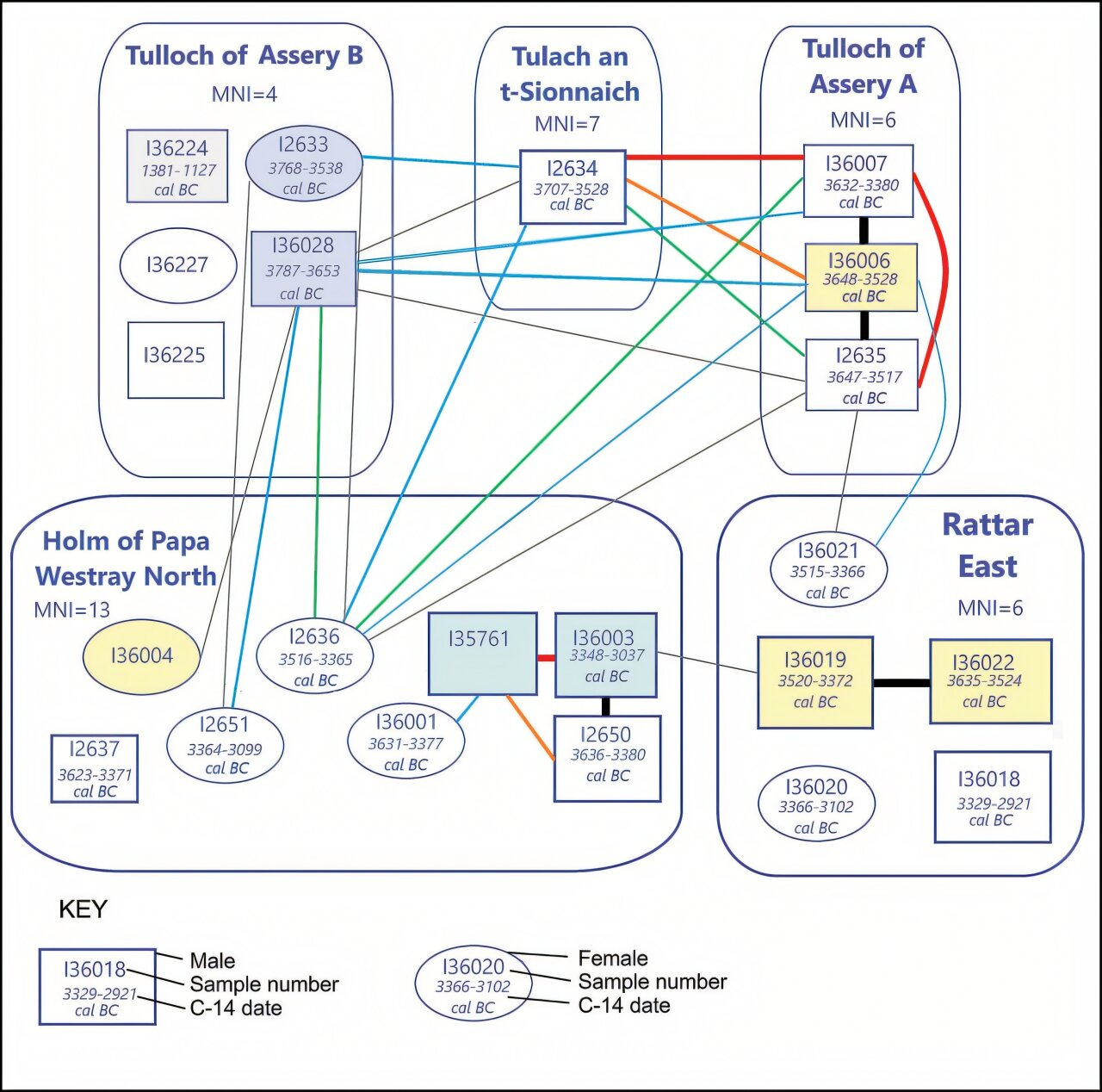
aDNA analysis was possible for only 22 of those 37 individuals. From that subset, the team identified nine pairs of close genetic relatives at the third degree or closer. All nine were male-to-male pairings. Beyond those close relationships, shared identity by descent analysis detected around 100 more distant relative pairs, including 11 pairs sharing enough DNA to indicate they were likely fourth- or fifth-degree relatives.
The specific relationships matter. At Tulloch of Assery A: the father-son-grandson sequence just described. At Rattar East: two brothers. At Holm of Papa Westray North: a father and son, plus a man who was the father’s maternal uncle or half-brother. And connecting the two areas of Loch Calder: the male buried at Tulach an t-Sionnaich was likely the paternal uncle, half-brother, or grandfather of one of the males at Tulloch of Assery A. The man at Tulach an t-Sionnaich and the senior male at Tulloch of Assery A may have been close enough kin that their communities recognized a shared patriline, even as they built separate monuments.
None of that, the authors are careful to note, means patrilineal descent was the only thing going on. Kinship is more complex than any single axis of relatedness. The closest relationship between any two women in the study was fifth degree. No mother-daughter pairing was detected. But the data do show a consistent pattern: in Caithness especially, it was fathers and sons, brothers, uncles and nephews, who ended up sharing the same stone chambers across multiple generations.
What makes the Holm of Papa Westray North picture stranger is this: two of the women buried there were more closely related, genetically, to men from the Loch Calder tombs than to any of the men buried alongside them on Orkney. One woman was a fourth-degree relative of the man at Tulach an t-Sionnaich. Another was a fourth-to-fifth-degree relative of the same man. Neither was closely related to the three principal males at Holm of Papa Westray North. Whatever brought them to that island tomb, it was not proximity to their nearest male kin.
Stone, Distance, and the Work of Memory
The team frames the tombs not merely as repositories for the dead but as what they call “technologies of descent and affinity.” Building a tomb in the style of existing tombs was itself an act of social positioning. Each time a new cairn went up near Loch Calder in the 3600s to early 3500s cal BC, those building it were placing themselves in explicit visual and material relationship with what was already there. The proximity was not accidental. The Tullochs of Assery are 30 meters apart.
There is something specific and deliberate in the arrangement at Tulloch of Assery A that speaks to how memory worked in these communities. The three generations of males had presumably been placed in the tomb at different times, each man carried in upon death. Yet the bones ended up gathered together on the same stone benches, some coated in clay, suggesting the disarticulated remains had been handled and intentionally repositioned. Relatedness was being actively maintained as a physical fact, remembered and reenacted in the arrangement of bone. The building and use of the tomb was not a single event but an ongoing practice.
The chronology, worked out through radiocarbon dating in combination with the genetic relationships, suggests the Loch Calder tombs were built and used in fairly rapid succession during the thirty-seventh and thirty-sixth centuries BC. The main phase of use at Holm of Papa Westray North comes somewhat later, with a father-son pair likely interred somewhere in the mid-3300s. The primary small single-chamber phase at Holm of Papa Westray North probably predates even those individuals. The tomb on the island began as a single box-like chamber within a round cairn, later extended into a four-stalled monument. It was rebuilt to accommodate more dead, or more categories of dead.
In Orkney, something different was happening with space. Orcadian stalled cairns were not typically built in tight clusters near one another. Even the concentration of cairns on the island of Rousay are not intervisible. And in Orkney, dry-stone walled houses appear alongside the cairns in the landscape, drawing on the same construction techniques and materials as the tombs themselves. The living and the dead occupied architecturally similar structures, but those structures were distributed differently across the terrain. In Caithness, the logic seems to have been aggregation around the dead. In Orkney, dispersal was the pattern for both.
The team interprets this as an emerging difference in how kin groups related to one another. Both regions shared a common architectural tradition and, the DNA confirms, maintained real biological connections across the Pentland Firth. But within a few centuries, communities on either side of that strait were expressing kinship differently through stone. Caithness communities built tombs near existing tombs. Orcadian communities moved away from existing sites, building new monuments and houses in new locations. The shared tradition was real. The divergence was also real.
Whether those two women at Holm of Papa Westray North had crossed the water themselves, or whether their ancestry simply reflected older patterns of movement between the regions, the DNA cannot say. Their presence in an Orcadian tomb, more closely tied genetically to men in mainland cairns than to the men beside them, suggests that the relationships between these communities were neither simple nor static. The tombs were built to last. The people in them had lives that ran in multiple directions at once.
Further Reading
Fowler, C. et al. (2022). A high-resolution picture of kinship practices in an Early Neolithic tomb. Nature 601: 584–87. https://doi.org/10.1038/s41586-021-04241-4
Olalde, I. et al. (2018). The Beaker phenomenon and the genomic transformation of north-west Europe. Nature 555: 190–96. https://doi.org/10.1038/nature25738
Corcoran, J.X.W.P. (1967). The excavation of three chambered cairns at Loch Calder, Caithness. Proceedings of the Society of Antiquaries of Scotland 98: 1–75.
Cummings, V. & Fowler, C. (2023). Materialising descent: lineage formation in early Neolithic southern Britain. Proceedings of the Prehistoric Society 89: 1–21. https://doi.org/10.1017/ppr.2023.2
Fowler, C. (2022). Social arrangements. Kinship, descent and affinity in the mortuary architecture of Early Neolithic Britain and Ireland. Archaeological Dialogues 29: 67–88. https://doi.org/10.1017/S1380203821000210
Ritchie, A. (2009). On the fringe of Neolithic Europe: excavation of a chambered cairn on the Holm of Papa Westray, Orkney. Edinburgh: Society of Antiquaries of Scotland.
Cummings, V., Fowler, C., Olalde, I., Cuthbert, S., & Reich, D. (2026). Building tombs and entombing the dead as technologies of descent and affinity in Neolithic northern Scotland. Antiquity 100(410): 324–339. https://doi.org/10.15184/aqy.2026.10291


