

Sheep and goats are a persistent headache for zooarchaeology. Their postcranial bones look so similar that for decades, excavation reports across Ireland simply noted “caprine” and moved on. The ambiguity is not a failure of method so much as a biological reality: Ovis aries and Capra hircus are close enough, skeletally, that even trained specialists working with good preservation can struggle to call it. Certain elements help. Horn cores, when present, are fairly diagnostic. Petrosal bones can be assigned. Mandibular teeth, in some configurations, give useful signals. But most of the time, from most assemblages, you get sheep/goat, and that’s what gets recorded.
The result is a gap in the Irish archaeological record that nobody quite knows how to fill. Goats almost certainly arrived with the first farmers around 5,900 years ago, part of the Neolithic agricultural package that crossed from Britain and Continental Europe. But because their bones vanish into the sheep/goat category, it’s nearly impossible to track them. There are no unambiguous goat remains from the Irish Neolithic. None from the Beaker period or the Early Bronze Age either. The earliest secure goat evidence comes from two Late Bronze Age sites: Mooghaun in Clare, identified through long bone metrics, and Haughey’s Fort in County Armagh, where horn cores large enough to be unambiguous turned up in the waterlogged sediment of a hilltop ditch.
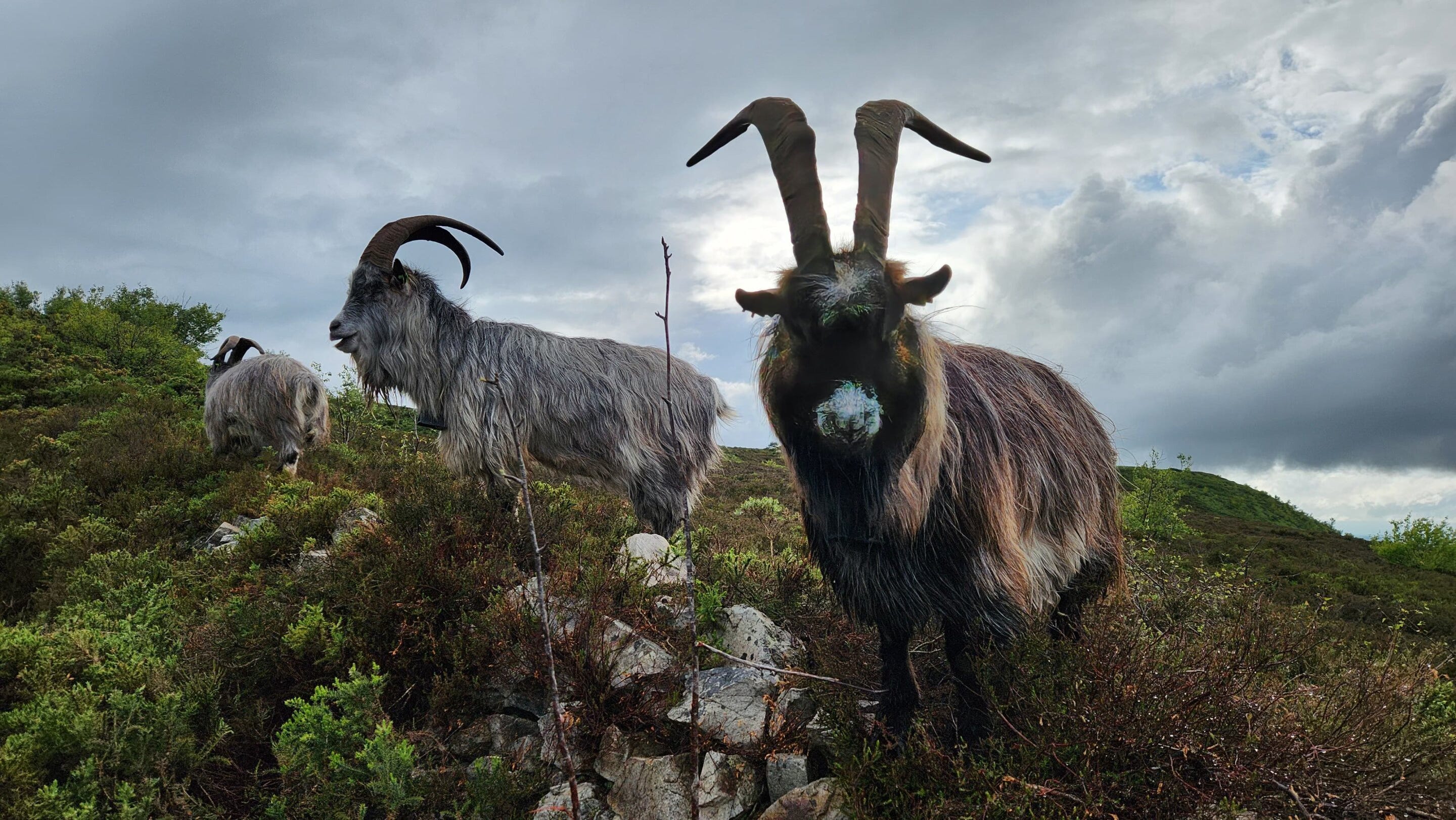
A new study1 by researchers at University College Dublin and Queen’s University Belfast has now returned to Haughey’s Fort with molecular tools the original excavators didn’t have. What they found there, and in a medieval assemblage from the port town of Carrickfergus, pulls a thread that runs from the Bronze Age to the present day.
Haughey’s Fort sits in the Navan complex in County Armagh, roughly a kilometer from the famous royal site of Navan Fort. The hillfort dates to 1100-900 BCE. Its inner ditch was waterlogged, which is good for bone preservation, and the assemblage it produced was dominated by cattle, with pigs secondary, and caprines present in small numbers. Among the caprine remains were two near-complete horn cores of exceptional size, one measuring 344 mm and another 348 mm. Their morphology left no room for doubt: these were goats, not sheep.
The team selected eight specimens across two sites: four from Haughey’s Fort and four from medieval Carrickfergus, a port town on the southern coast of County Antrim with roughly 800 years of continuous occupation since its founding by the Anglo-Norman John de Courcy in the late 1170s. The Carrickfergus samples came from stratified contexts dated to the 13th through 16th centuries.
To confirm species identity, seven of the eight samples went through ZooMS, short for Zooarchaeology by Mass Spectrometry. The technique works by extracting Type I collagen from bone, then identifying a peptide fingerprint using a mass spectrometer. For sheep and goat, the key marker is a single peptide with two amino acid differences between species. The goat marker appears at 3093 m/z; the sheep marker at 3033 m/z. It’s a small difference, but it’s reliable, and it requires only a small amount of material from a drilled sample site. Every specimen submitted to ZooMS came back as Capra hircus.
Ancient DNA was then extracted and sequenced from all eight samples. This confirmed species identification for six of the seven ZooMS-identified specimens; the seventh, Haughey2, had no surviving endogenous DNA. Genetic data also confirmed species assignment for one sample not submitted to ZooMS, Haughey4.
The DNA bore the signatures of age. Post-mortem damage to ancient sequences tends to show up as an accumulation of cytosine deamination at read ends, and the team found the expected pattern after enzymatic treatment. Read lengths were short, averaging 56 to 75 base pairs for most specimens, which is typical of degraded ancient material. One exception was Carrick1, whose average read length of 105 bp stood out among the Carrickfergus samples and may indicate it represents a somewhat later individual than its depositional context suggests.
Molecular sex determination, using the ratio of reads aligning to the X chromosome relative to chromosome length, produced a result that is hard to interpret without more data but is worth pausing on: all four Haughey’s Fort goats were male, and all four Carrickfergus goats were female. Whether that reflects something real about how these animals were kept, or is simply an artifact of a small sample, is genuinely unclear. The researchers are careful not to over-read it. But they do note that the prevalence of female goats at a major port town, combined with historical records suggesting goat hides were a significant export good from Carrickfergus, raises questions about the structure of medieval goat keeping in the region. A herd kept for milk and skins would be predominantly female. The medieval literature mentions goats in the town. A 17th-century list of offences prosecutable at the Quarter Session of the Grand Jury includes the keeping of cows, calves, sheep, or goats on the streets, in the churchyard, or at the quayside, which suggests that goats were common enough in urban Carrickfergus to cause a recurring problem.


