

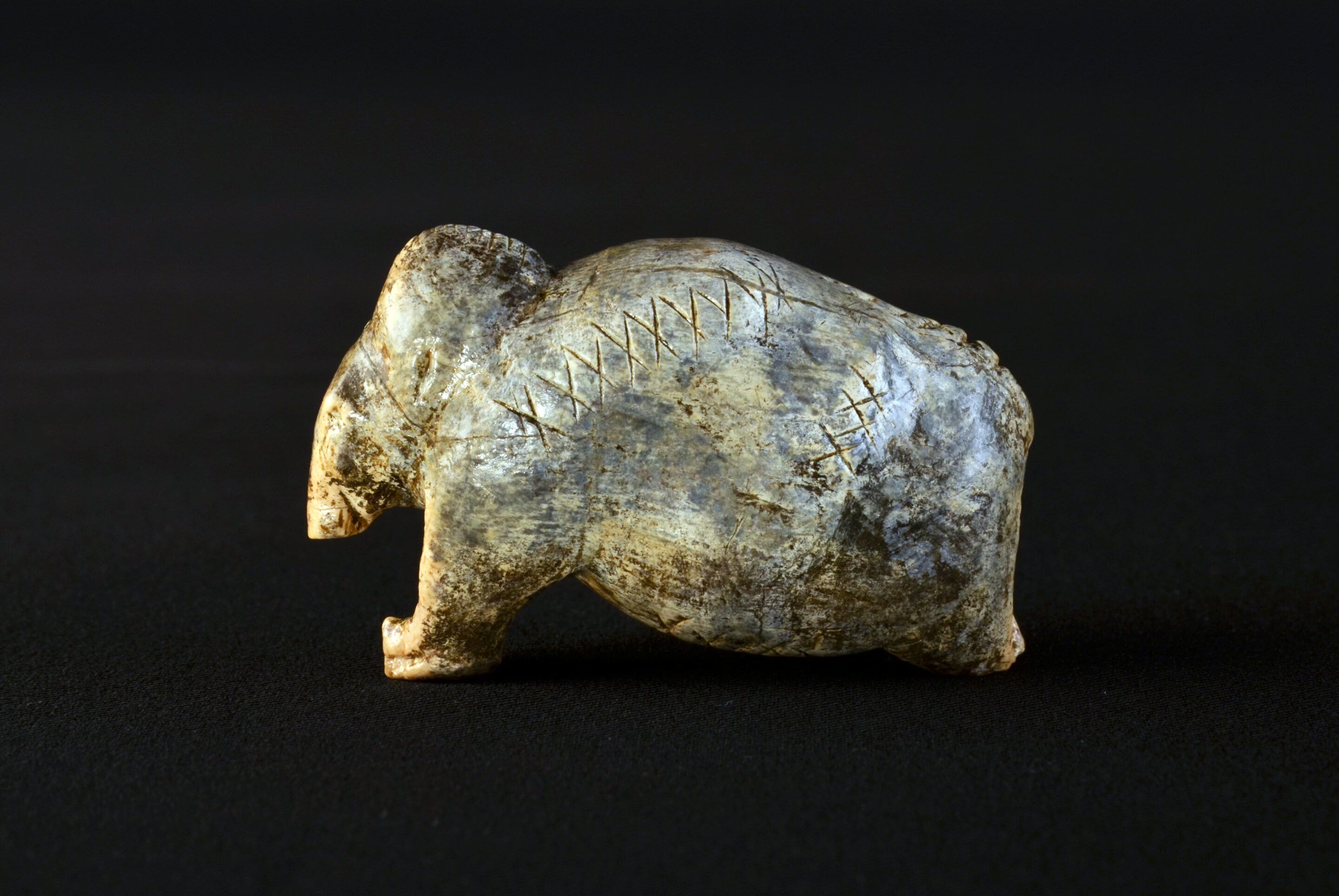
Somewhere in a cave in southwestern Germany, roughly 40,000 years ago, a person sat with a piece of mammoth ivory and carved a small mammoth. Then they covered it in crosses. Rows of them, repeated, organized. Whether those crosses meant something specific — an animal killed, a season, a ritual — we don’t know. But according to a study published this month in PNAS,1 the way those signs were arranged follows rules. Not the rules of modern writing, not the rules of spoken language. Something else. Something in between.
That’s the finding that makes this paper worth sitting with.
Christian Bentz, a linguist at Saarland University, and Ewa Dutkiewicz, an archaeologist at the Museum für Vor- und Frühgeschichte in Berlin, spent years cataloguing geometric signs on Aurignacian mobile objects — the tools, figurines, and personal ornaments left by the first Homo sapiens to settle Central Europe. Their corpus covers more than 260 objects and over 3,000 individual signs. Lines, notches, dots, crosses, zigzags, grid patterns. They catalogued all of it, and then they ran the numbers.
What they found is this: when you measure the statistical properties of those sign sequences — how repetitive they are, how much information each sign carries, how predictable the next sign is given the last one — the Aurignacian sequences look nothing like modern writing. But they look almost identical to the earliest known protocuneiform tablets from Mesopotamia, around 3500 BC.
That’s a gap of roughly 35,000 years between those two sets of marks. And the numbers say they’re doing something statistically similar.
The Swabian Jura in southwestern Germany is one of the richest concentrations of Aurignacian material anywhere in the world. Four cave sites sit within hiking distance of one another in the Lone and Ach valleys — Vogelherd, Hohle Fels, Geißenklösterle, Hohlenstein-Stadel — and together they’ve yielded an extraordinary range of objects. Bone flutes. Ivory beads. Animal figurines: woolly mammoths (Mammuthus primigenius), wild horses (Equus ferus), steppe bison (Bison priscus), cave bears (Ursus spelaeus), cave lions (Panthera spelaea). Female figurines. And, stranger, hybrid creatures — a lion-human figure, a creature that is part human, part cave lion, sometimes called the Lion Human, carved from mammoth ivory and found in Hohlenstein-Stadel.
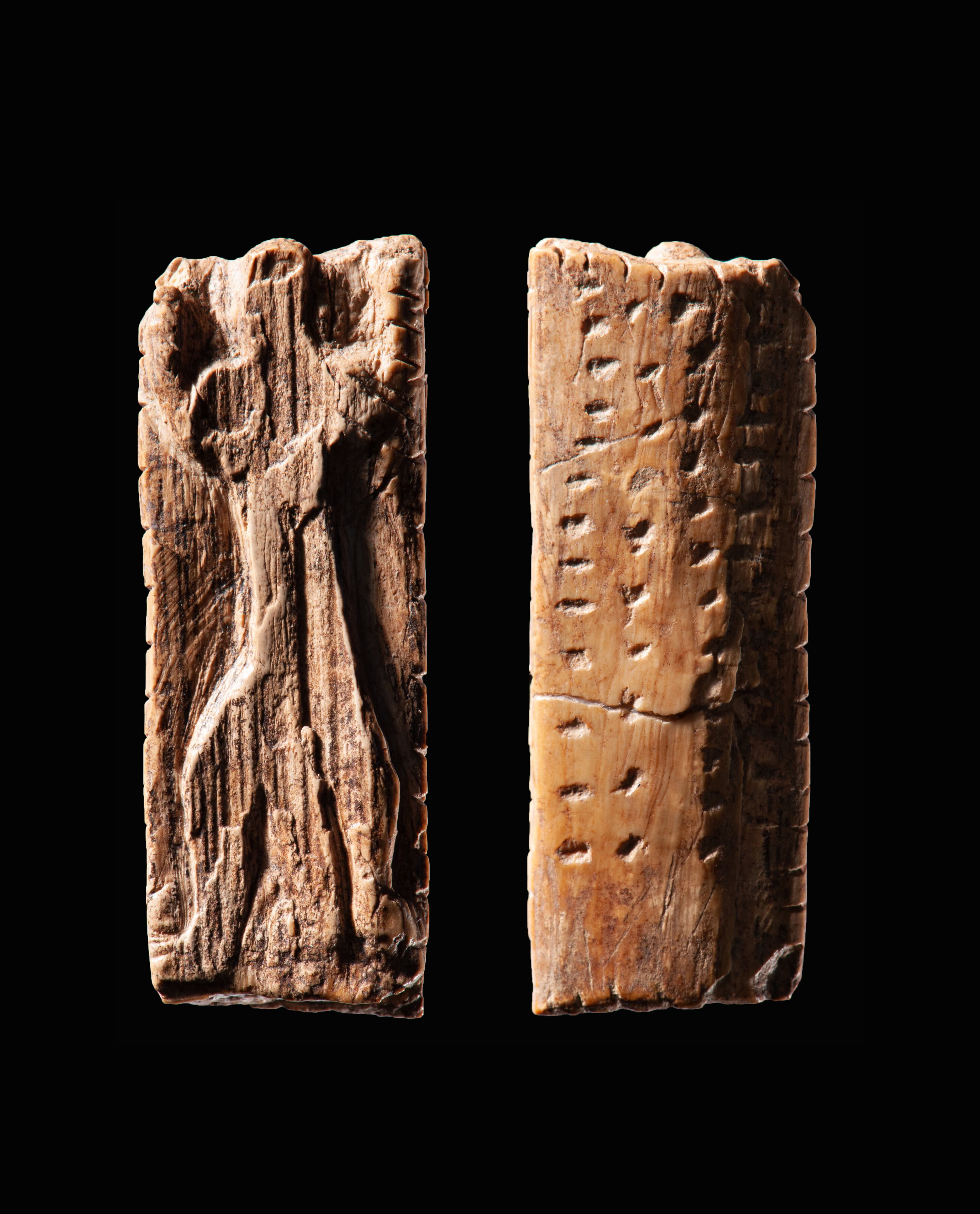
Many of these objects are covered in signs. The mammoth figurine from Vogelherd is engraved with rows of crosses. The “Adorant,” a plaquette from Geißenklösterle bearing a relief of a hybrid lion-human on one face, has rows of dots organized on the other. On the Lion Human itself, notches run at regular intervals along the arm.
Dutkiewicz has spent years analyzing these objects directly, first-hand, under microscopes. Her job in the collaboration was to assign each mark a sign type — distinguishing intentional, nonutilitarian engravings from butchery marks or tool-making notches. It’s harder than it sounds. The agreement between Dutkiewicz and other researchers familiar with the material runs between 91 and 94 percent, which is good, but not perfect. Some marks are genuinely ambiguous.
What results from that work is a database. Each artifact gets a coded sequence, rendered in UTF-8 characters, where a straight line is “|” and a notch is “v” and a cross is “X.” A typical Aurignacian sequence might look like: XX_vvvvvvvv_vvvv. You can read the repetition just looking at it.
That repetition is the key to the whole analysis.


