

There’s a story that gets repeated so often it has the texture of fact: that roughly one in 200 men alive today is a direct patrilineal descendant of Genghis Khan. The number is memorable. It implies something almost biblical about the scale of Mongol conquest and reproduction. It gets cited at dinner parties and in pop-science books. And it might be wrong, or at least far more complicated than anyone has acknowledged.
A study published in early 2026 in the Proceedings of the National Academy of Sciences1 has quietly unsettled the foundations of that claim. Not by disproving it outright, but by revealing that the genetic signature long associated with Genghis Khan’s lineage may actually be a cluster of related-but-distinct branches, and the branch found in the tombs of actual Mongol ruling elites is not the same branch that shows up widely in the modern population.
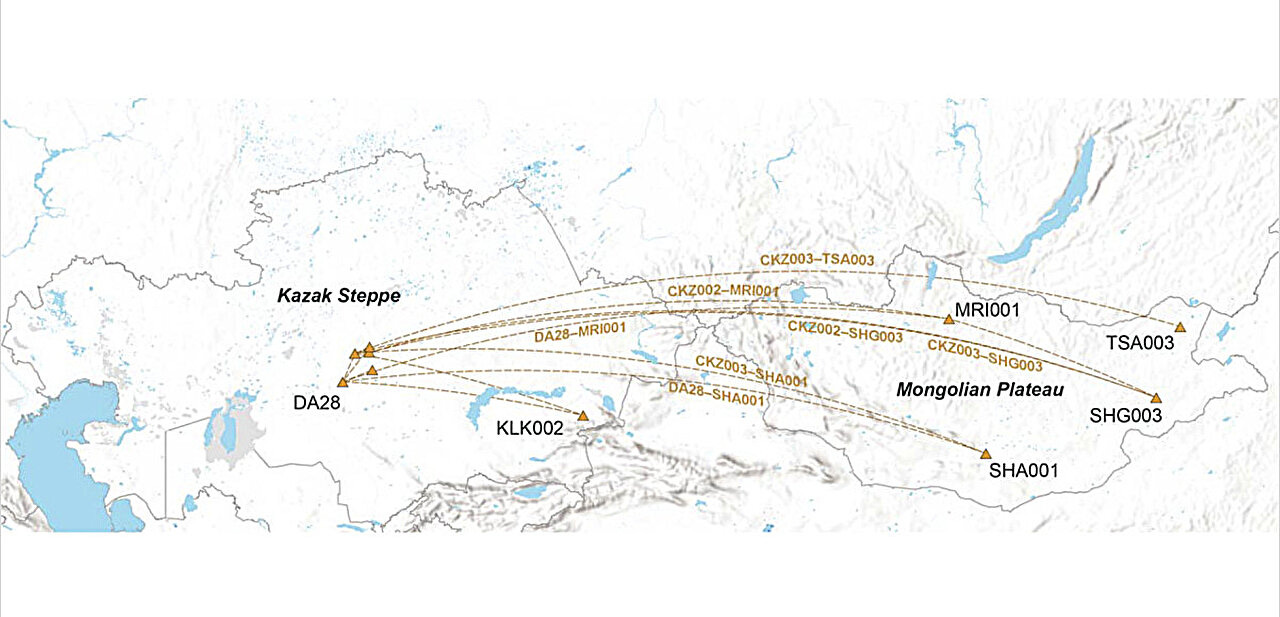
The research centers on four medieval burials in the Ulitau region of central Kazakhstan. Three of the individuals were male. One was female. All four came from elite mausoleums associated with the Golden Horde, the northwestern extension of the Mongol Empire, which was established and governed by the descendants of Genghis Khan’s eldest son, Jochi. Local Kazakh folklore holds that one of the four tombs belongs to Jochi himself.
Ayken Askapuli, a Ph.D. candidate at the University of Wisconsin-Madison and the study’s lead author, described the process as something like forensics. The team extracted ancient DNA from the remains and traced the ancestry of all four individuals to the Mongolian plateau. The three male individuals were paternally related and all carried the Y-chromosome haplogroup known as C3*, the genetic marker that has sat at the center of the Genghis Khan hypothesis for two decades.


