

There is a burial at Ajvide, on the Swedish island of Gotland, that keeps coming back to me. A woman, twenty to thirty years old, interred with two young children placed in her arms. A four-year-old boy. A two-year-old girl. The scene reads like a mother and her children, and for a long time, that is probably what most people assumed it was.
She was not their mother.
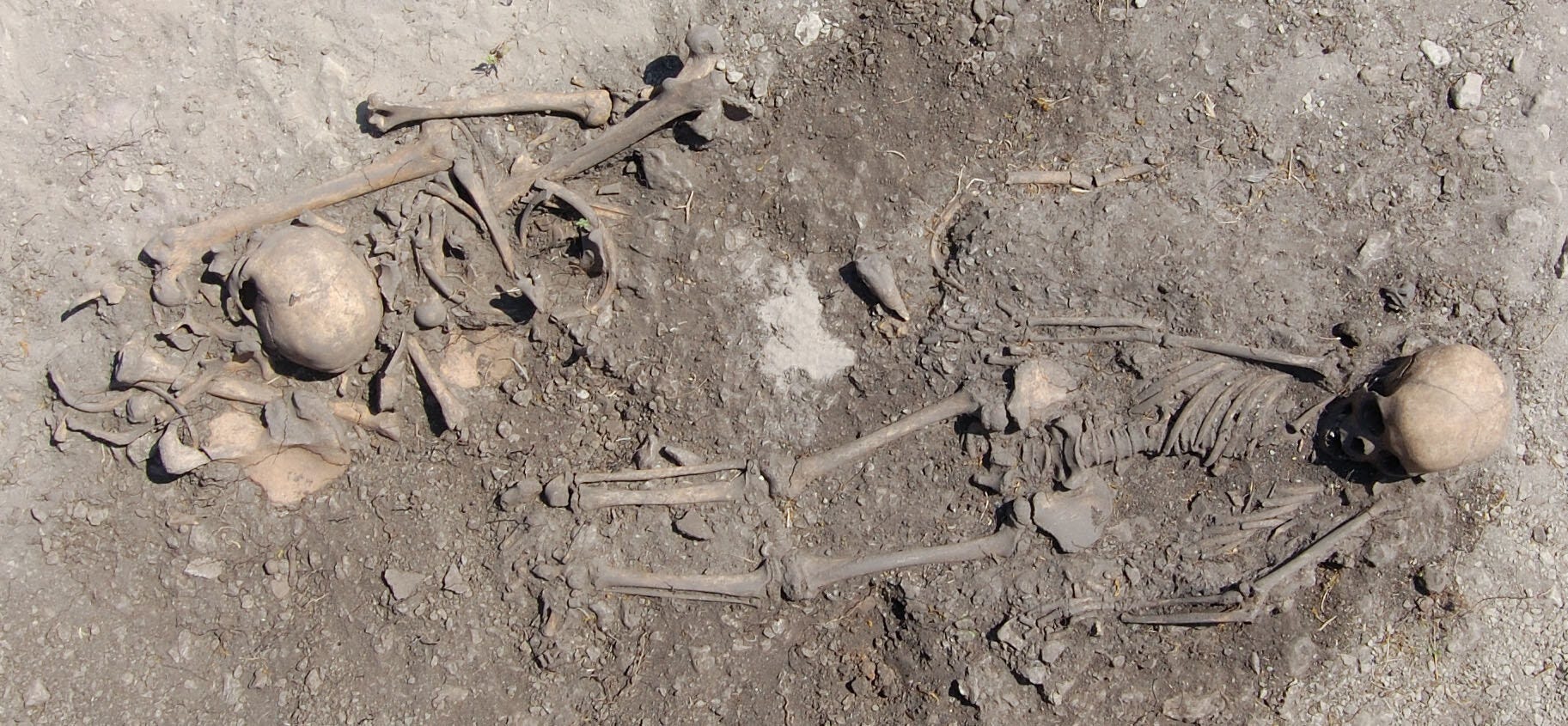
DNA extracted from all three individuals shows that the woman shared roughly the genetic overlap you would expect between an aunt and her niece and nephew, or between a half-sibling and younger siblings. The children, for their part, were full siblings, sharing a mitochondrial haplogroup, their young ages at death making certain relationships impossible. The woman’s mitochondrial lineage was different from theirs, which rules out a direct maternal connection entirely. The most probable relationships, given everything, are that she was the children’s paternal aunt, or possibly a half-sister. Their biological mother is not in that grave. She is not in any of the graves identified so far at Ajvide.
This is the kind of finding that forces a reconsideration. Not of the people, necessarily, but of what we assume about them.
Ajvide is one of the largest Stone Age hunter-gatherer cemeteries in Europe, with around 85 documented graves. The people buried there belonged to what archaeologists call the Pitted Ware Culture, or PWC, a maritime forager society that persisted along the Baltic coast and its islands from roughly 3400 to 2200 BCE. They hunted seals, caught fish, lived on a diet so marine-heavy that radiocarbon dates on their bones require a reservoir correction. By the time they were flourishing on Gotland, farming had already been established across much of Europe for thousands of years. The PWC people knew about farmers. They traded with them, absorbed small amounts of their ancestry over time. But they stayed genetically, culturally, and culinarily distinct.
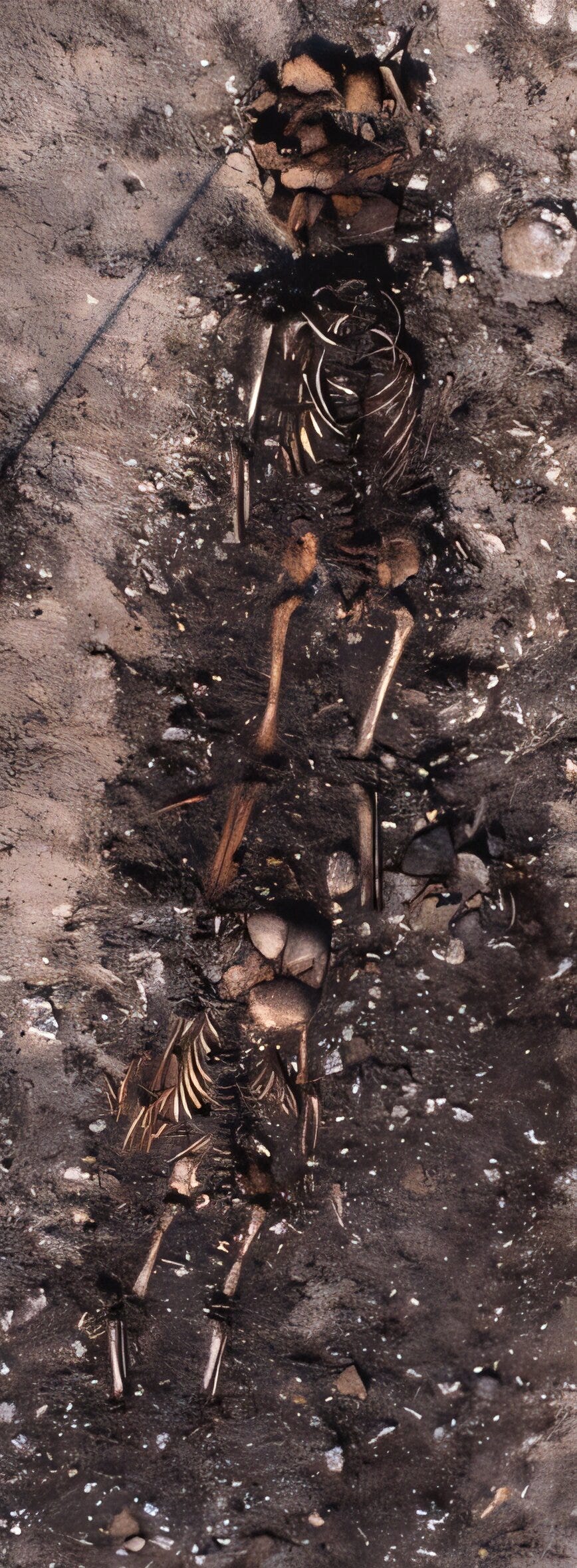
Among the 85 graves at Ajvide, eight contain more than one individual. A team from Uppsala University and Stockholm University recently sequenced ancient DNA from individuals in four of those shared graves, combining the new data with previously published genomes from 24 individuals across multiple PWC sites on Gotland. The results appeared in Proceedings of the Royal Society B.1
What they found, consistently across all four co-burials, is that the people buried together were close genetic relatives, but not always in the ways you might predict. First-degree relationships, meaning parent-offspring or full siblings, showed up. So did second- and third-degree relationships: grandparents and grandchildren, aunts and nephews, first cousins, half-siblings. Every single co-burial contained at least one of these connections. None of the co-buried pairs were unrelated.
That pattern is not obvious. It did not have to be that way.


