

The pit was small. Less than three meters across, half a meter deep. Yugoslav archaeologists found it in the early 1970s at Gomolava, a tell site near the River Sava in northern Serbia, and what they uncovered inside was immediately disturbing: dozens of human skeletons, layered and packed together, interred with ceramic vessels, bronze ornaments, and the articulated remains of a young cow placed carefully at the bottom. The bones were removed, curated at the Museum of Vojvodina in Novi Sad, and studied once with older methods. The conclusion at the time was pandemic — a disease outbreak, a burial of the unlucky dead.
That interpretation has now been overturned completely.
A new study published in Nature Human Behaviour1 by a large international team led by Linda Fibiger, Miren Iraeta-Orbegozo, Hannes Schroeder, and Barry Molloy has subjected the Gomolava remains to the full arsenal of modern bioarchaeology: ancient DNA sequencing, enamel peptide analysis for sex determination, strontium and carbon isotope profiling, radiocarbon dating, CT scanning, and detailed trauma assessment of every recoverable bone. What they found reframes not just this site but the entire question of how and why organized violence operated in later prehistoric Europe.
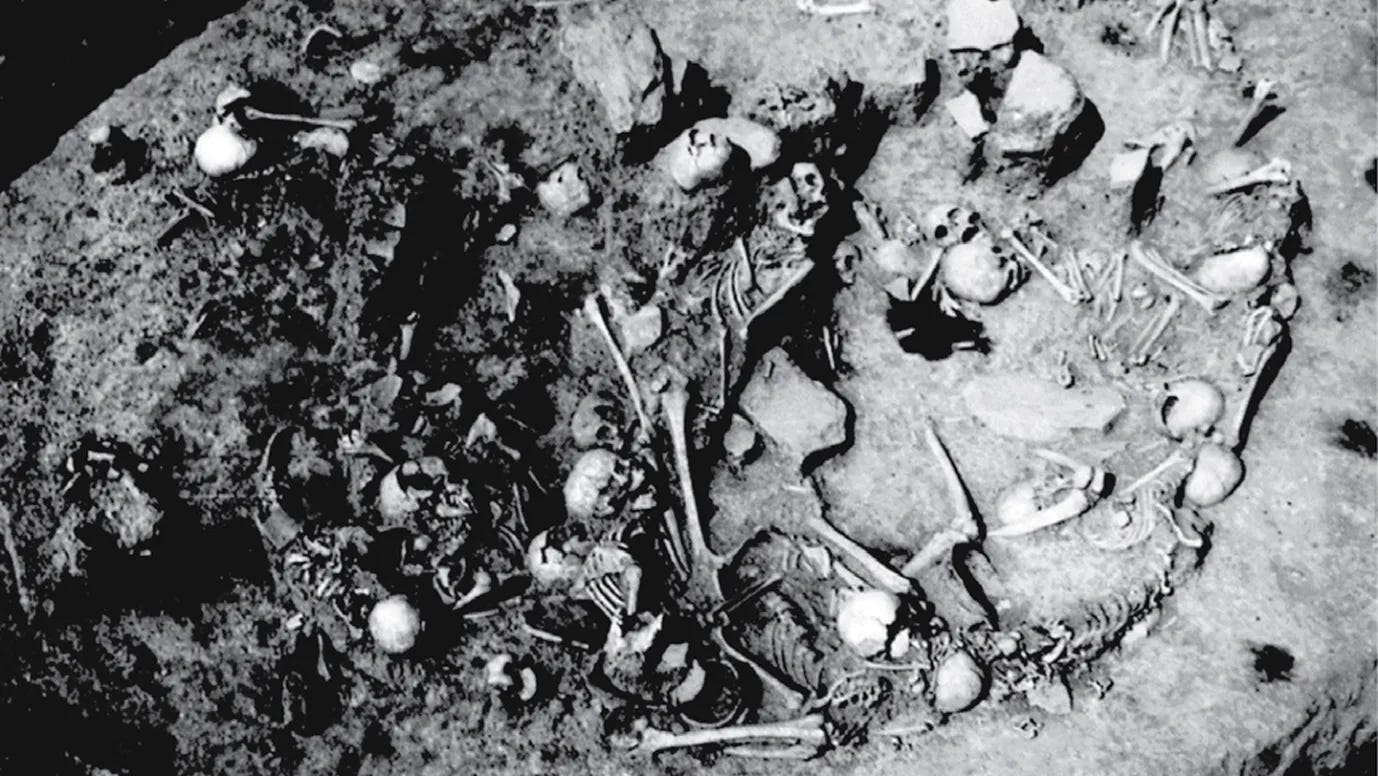
The burial contains 77 individuals. Juveniles between one and twelve years old make up just over half the assemblage. Of the 72 individuals that could be sexed using any method, 51 were female. Among adults specifically, the proportion reaches 87 percent. The team screened for pathogen DNA and found nothing. No evidence of infectious disease whatsoever. What they found instead, in bone after bone, were unhealed fractures concentrated on the back and top of the skull — the kind of injuries you get when someone above you, possibly on horseback, brings something heavy down on your head while you are fleeing or on the ground.
This was not a pandemic. This was a killing.


