
Anthropology.net
Evolutionary Insights by Anthropology.net
The Maya Drought That No One Triggered
0:00
-20:44

Paid episode

The full episode is only available to paid subscribers of Anthropology.net

The Maya Drought That No One Triggered

A new climate simulation shows that the catastrophic droughts coinciding with the Classic Maya collapse may have needed no external cause at all.

Somewhere in the sediment at the bottom of Lake Chichancanab on the Yucatán Peninsula, there is a record of what the rain did over the past two millennia. The isotopes in the calcium carbonate layers tell a story of prolonged drying that spans much of the first millennium CE, with the worst of it clustering in the period when the great southern Maya cities were fracturing, emptying out, going silent. Lake cores, stalagmites, leaf-wax compounds in ancient sediments from Belize to Honduras — they largely agree on the shape of things. The Classic period ended under dry skies.

What they cannot tell you is why.
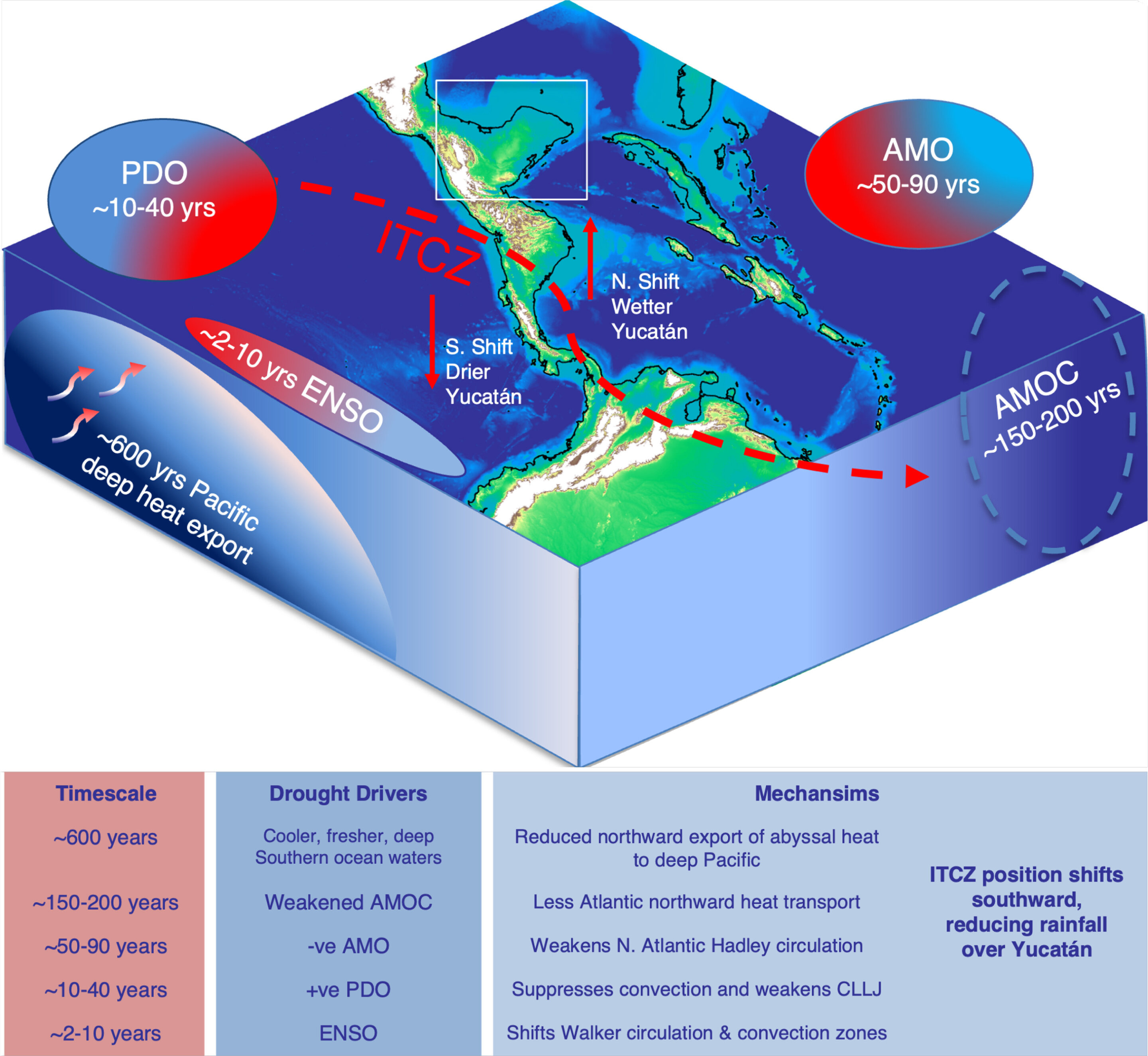
Illustration of the mechanisms linking Yucatán (area is outlined in white) hydroclimate variability to large-scale ocean atmosphere processes. It is the alignment of the dry phases of these natural variabilities, operating at multi-centennial (~600 year), centennial (~150–200-year), sub-centennial (~50–90 year), multi-decadal (~10–40 years) and inter-annual (~2–10 years) scales, which drives drought episodes across the Yucatán Peninsula. Credit: Quaternary Science Reviews (2026). DOI: 10.1016/j.quascirev.2026.109974

That question has attracted everything. Volcanic eruptions that sent aerosols into the stratosphere and deflected solar energy. Solar minima that weakened the seasonal rains. Shifts in the Intertropical Convergence Zone driven by cold freshwater pulses into the North Atlantic. Most of these hypotheses share a common logic: something external hit the climate system, and the climate system hit the Maya. A trigger, then a cascade.
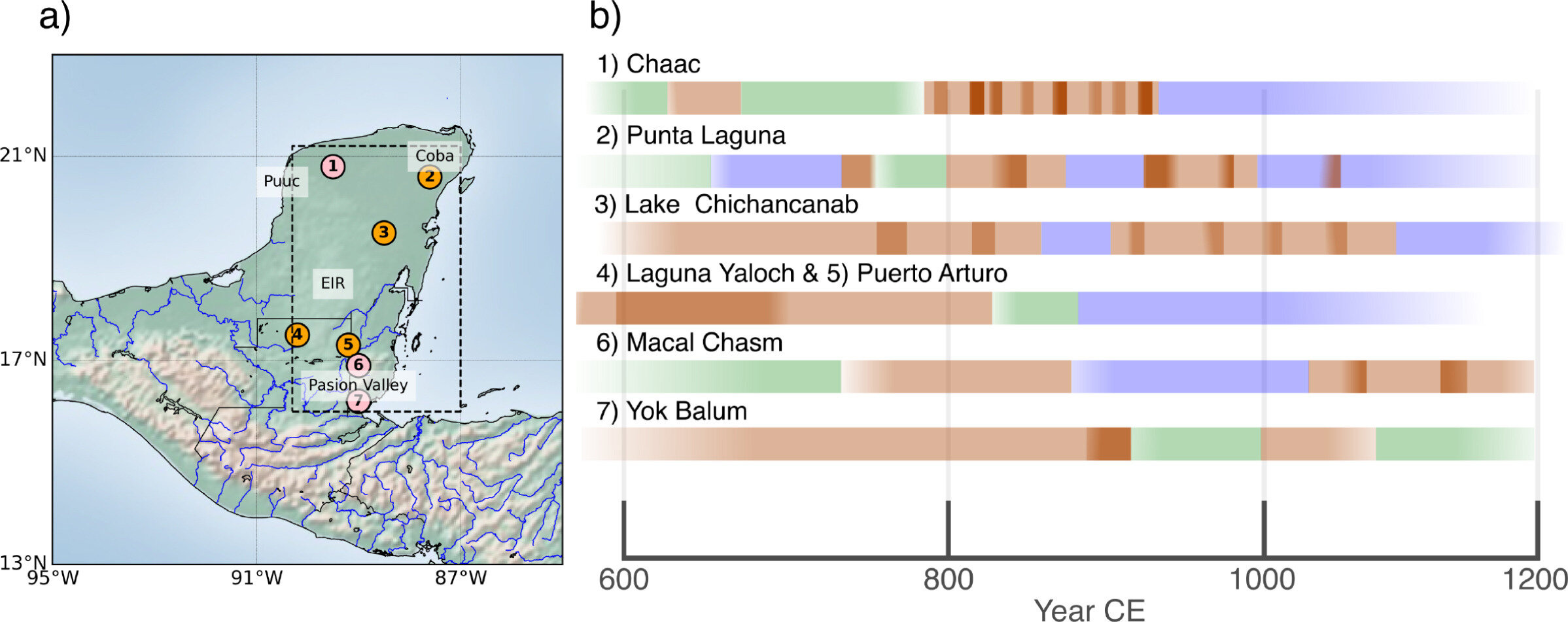
(a) The Yucatán Peninsula, home to the classic Mayan civilization, with key regions highlighted, and the location of the seven different paleo-climate proxies displayed. Outlines are drawn over the Yucatán area (90.3–87°W, 16–21.2°N) used when spatially averaging model data. (b) Summary of the reconstruction of the hydroclimatic conditions from 600 to 1200 CE from each site from each proxy. Brown represents dry, with darker brown very dry events, green—stable conditions where neither overly wet or dry was noticeable and blue—wetter conditions. Credit: Quaternary Science Reviews (2026). DOI: 10.1016/j.quascirev.2026.109974

A paper published this spring in Quaternary Science Reviews1 by Katherine Power and colleagues at Stockholm University makes a different argument. The droughts didn’t need a trigger. The climate system generated them on its own.

User's avatar

Continue reading this post for free, courtesy of Anthropology & Primatology.