

There is a particular stretch of mitochondrial DNA, a maternal lineage called haplogroup B4a1a1, that shows up almost everywhere across Remote Oceania. Samoa, Tonga, Vanuatu, Hawai’i, the Cook Islands, Aotearoa/New Zealand — wherever you look among the peoples of the Remote Pacific, this lineage dominates. Researchers named it the “Polynesian motif,” though that label is a misnomer, since the haplogroup predates Polynesia by millennia. It’s really more of a Pacific watermark: a signal so pervasive it has long seemed to hold the key to understanding how the Pacific was settled.
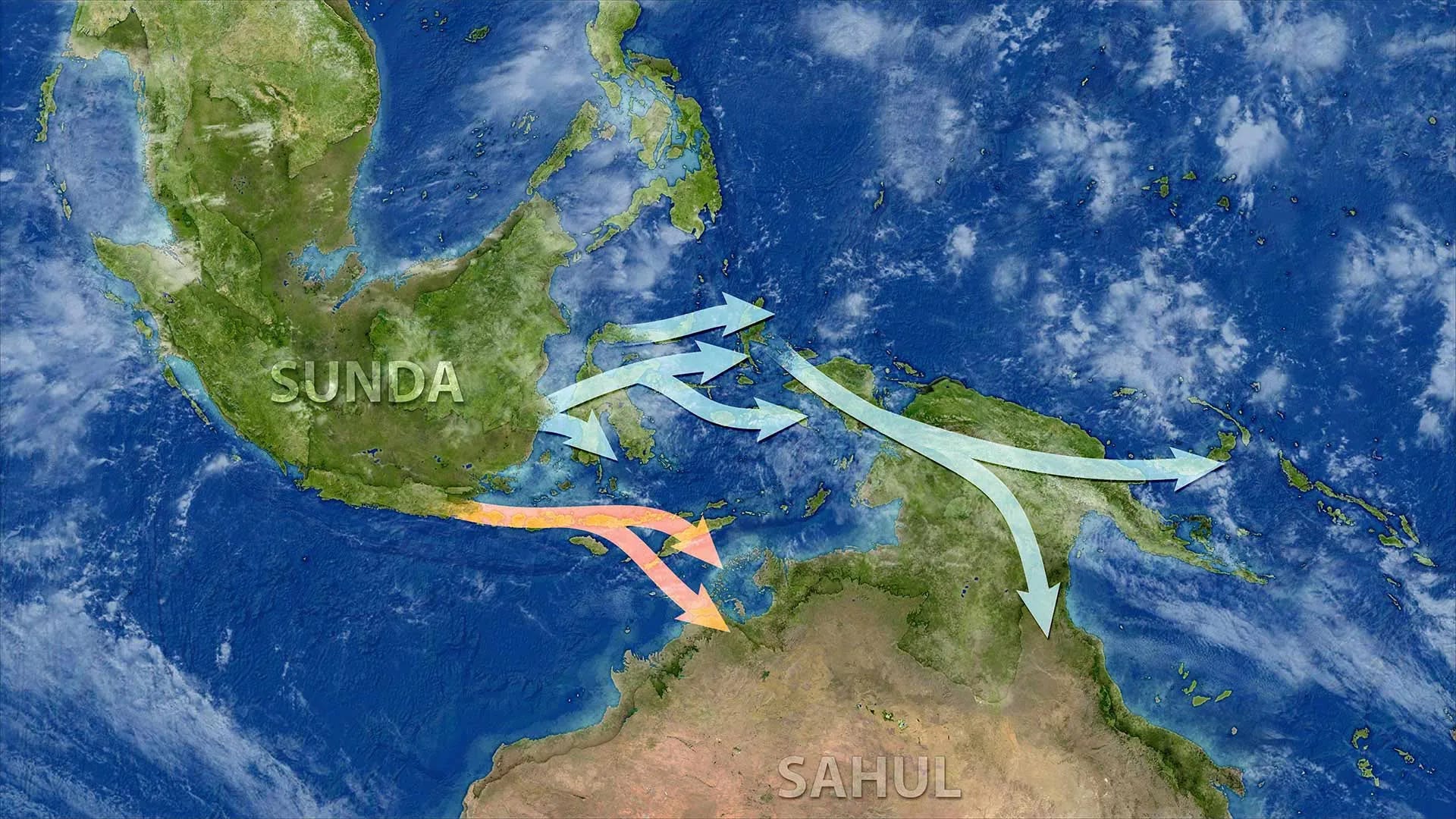
The standard explanation goes like this. Starting around 5,000 years ago, rice farmers expanded out of South China and into Taiwan. From there, Austronesian-speaking agricultural communities spread south and east through the Philippines and Island Southeast Asia, eventually reaching the coasts of New Guinea and the Bismarck Archipelago, where they developed the Lapita cultural complex — the pottery, the obsidian tools, the long-range voyaging technology that marks the beginning of Pacific colonization in the archaeological record. Under this “out-of-Taiwan” model, the Polynesian motif was part of what those migrants carried with them. It arrived from Asia in the mid-Holocene and swept east across the Pacific in the hands of Lapita colonists.
A new study,1 led by Pedro Soares of the University of Minho and Martin Richards of the University of Huddersfield, suggests this explanation is wrong. At least on the maternal line.
The team assembled the largest dataset of Polynesian motif mitogenomes yet analyzed: 1,364 complete mitochondrial genomes drawn from nearly 70 islands stretching from Island Southeast Asia to the far reaches of Remote Oceania, including 234 newly sequenced samples. Their goal was partly methodological — to validate whether their molecular clock approach actually produced reliable settlement dates — and partly substantive: to figure out where the Polynesian motif actually came from.


