

At a site in what is now Saxony-Anhalt, roughly 125,000 years ago, Neanderthals were doing something that sits oddly against the backdrop of everything else they were doing there. The lakeshore at Neumark-Nord was a landscape of serious predation: elephants weighing upwards of ten tonnes were hunted and butchered, their bones cracked and boiled in one of the largest grease-rendering operations documented in the Pleistocene record. Hundreds of deer, cattle, horses, and rhinoceroses were processed across the shoreline. And among all of that—tucked into the same sedimentary horizons as the elephant remains—are the carefully butchered shells of Emys orbicularis, the European pond turtle. Ninety-two fragments in total. Most of them no bigger than a hand.
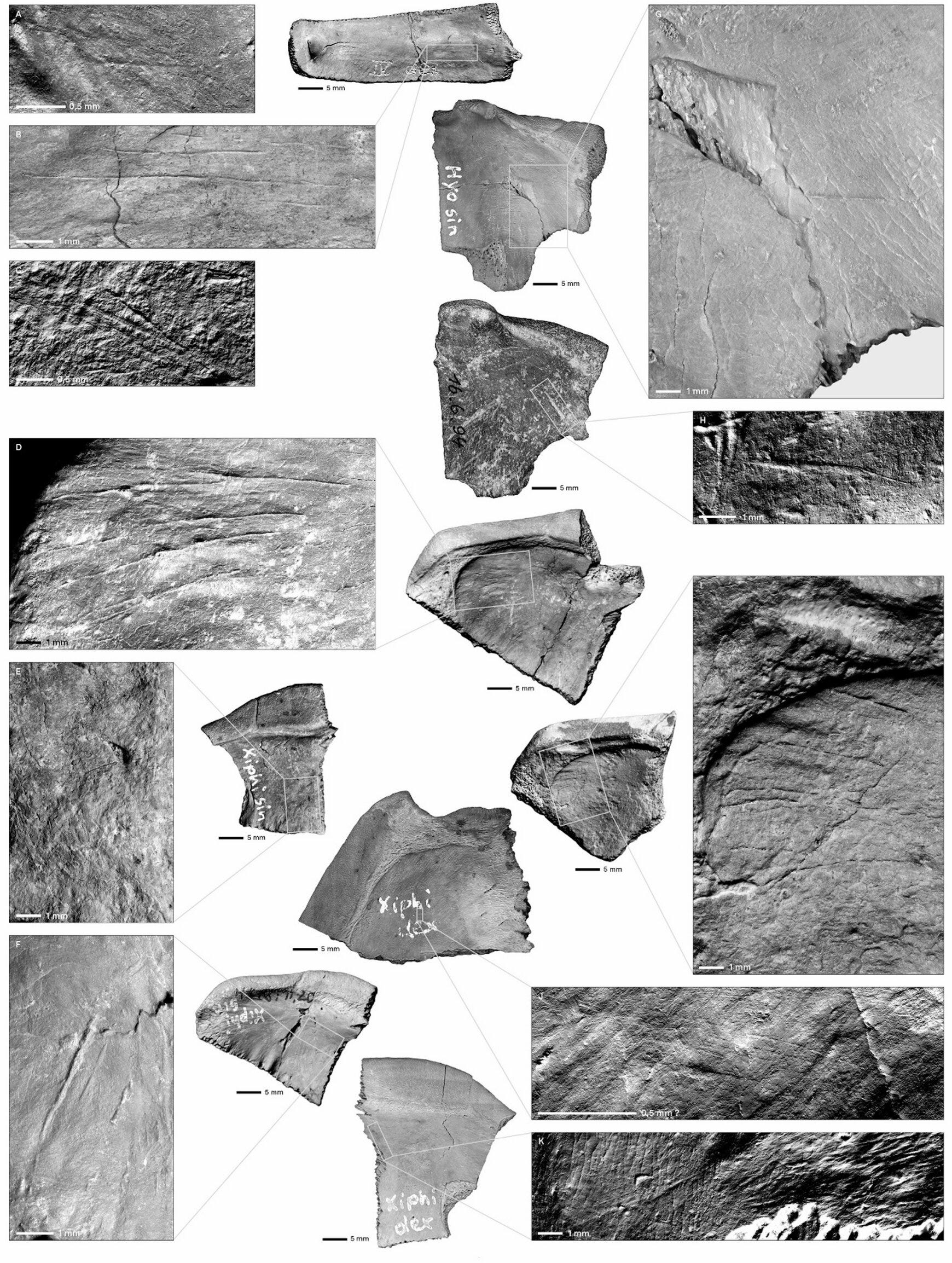
A new study in Scientific Reports1 by Sabine Gaudzinski-Windheuser, Lutz Kindler, Wil Roebroeks, and colleagues presents a detailed analysis of those fragments and makes a claim that has real geographic weight: this is the first documented evidence of Neanderthal turtle exploitation north of the Alps and Pyrenees, outside the Mediterranean basin where such evidence has been accumulating for decades.
The finding is not primarily about adding a species to a list. What makes the Neumark-Nord turtle assemblage interesting is the interpretive problem it creates. When Neanderthals at sites like Kebara in Israel or Gruta da Oliveira in Portugal collected tortoises intensively enough to affect local population sizes, the conventional explanation involves resource pressure—broad-spectrum foraging as a response to the scarcity or difficulty of obtaining larger prey. That logic cannot apply here. At Neumark-Nord, the large mammals were abundant, intensively exploited, and clearly the caloric foundation of Neanderthal subsistence at this location. A one-kilogram pond turtle in that context is not a substitute for anything. So why collect them at all?


