
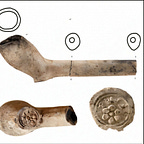
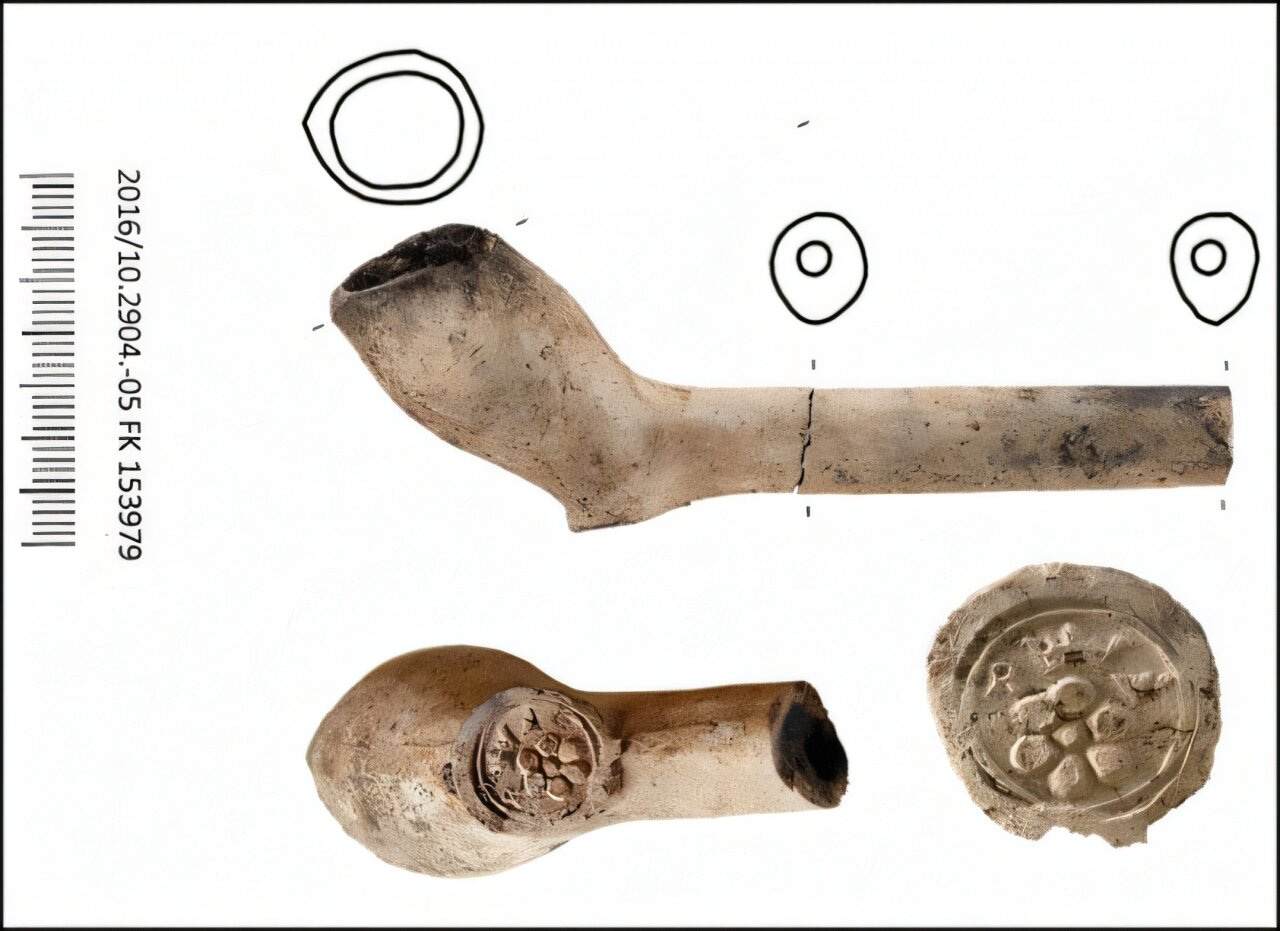
Somewhere between 1665 and 1680, a man was buried at the hip with a clay pipe. Traces of soot were still lodged in the bowl. The pipe maker’s stamp on the heel showed a crowned rose and the monogram RW, later traced to Reichard West, a pipe maker recorded in council minutes from Mannheim, Germany, who appears in the historical record between 1673 and 1675 and died around 1675 to 1676. Clay pipes of this period were fragile things, rarely lasting more than three years. The pipe had probably been purchased not long before the burial.
That small object, found at the hip of individual 229.2 in a cemetery beneath what is now the Stadtcasino concert hall in Basel, Switzerland, helped anchor an entire group of burials to one of the most significant mortality events in Swiss history: the last recorded plague outbreak in the country, which struck Basel between 1665 and 1670.
The site has a layered past. The former Barfüsserkloster, a Franciscan monastery founded in 1250, was abandoned after the Reformation in 1529 and its cloister and outbuildings repurposed as a kind of early institution adjacent to the city’s Bürgerspital, the municipal hospital. The cloister garden became a cemetery. Excavations in 2016 and 2017 uncovered the remains of 279 individuals buried in the post-Reformation period, including a cluster of four graves in the northern section of the site containing 15 individuals interred in coffins and earthen pits, some buried simultaneously.
A new study published in Antiquity,1 led by osteoarchaeologist Laura Rindlisbacher of the University of Basel, brings together ancient DNA analysis, stable isotope data, historical archival research, and detailed osteological observation to reconstruct who these people were before they died. The answer is not flattering to the city that produced them.
Fifteen Bodies, One Bad Life
The 15 individuals in graves 229 through 232 ranged in age from a child of 3 or 4 to an older adult. The average age at death was 17.7 years. Only four individuals survived beyond 20. Because so many were subadults, sex assessment was impossible for eight of them; of those who could be assessed, five were likely male and two likely female.
The demographic shape of this burial group is, by itself, unusual. In a cemetery that reflects ordinary background mortality, young children under six typically dominate the subadult count, because childhood disease in pre-modern populations was front-loaded. Here the picture is different: the largest spike falls in the 10-to-19 age range, a period that typically shows low mortality in non-catastrophic samples. The team considered and ruled out warfare as an explanation. There are no perimortem injuries. The mortality profile points to epidemic.
Ancient DNA analysis confirmed it. Teeth from ten individuals were sampled, and five returned positive results for Yersinia pestis. The best-preserved sample, from individual 229.2, produced sufficient genomic coverage to place the Basel strain on a maximum likelihood phylogenetic tree. It clusters most closely with Y. pestis strains recovered from plague contexts in London (1560-1635) and Marseille (1720-1722). All three carry a depletion in the pla gene region on the pPCP1 plasmid, a characteristic of post-Black Death strains first identified in Late Second Pandemic contexts after 1353. The depletion may have reduced transmission rates relative to earlier pandemic strains. It did not make the disease survivable for the five individuals who carried it.
What is striking is not just that these people died of plague, but what their bodies record of the years before they did.
Despite averaging under 18 years of age, the group shows a level of skeletal wear more consistent with a much older and more stressed population. The team applied a modified Index of Skeletal Frailty (ISF), a metric that accounts for accumulated pathological conditions across the skeleton. The average ISF for the Basel group was 3.3. For comparison, 18-to-25-year-olds in medieval London monastic and non-monastic burial contexts yielded an ISF of around 2.09. The Basel subadults were considerably more worn.
Every individual for whom teeth survived showed at least one carious lesion. All scored individuals displayed enamel hypoplasia, transverse bands of disrupted enamel development that form during periods of physiological stress in early childhood. Sixty-one percent of available teeth were affected. Degenerative spinal changes consistent with spondyloarthrosis deformans were found in all 15 individuals. Among those under 15, the changes were described as light but present; those aged 15 to 25 showed medium-stage degeneration. Two individuals had worn their front teeth down from habitual use of the mouth as a tool, a pattern associated with trades that require holding or manipulating objects by the teeth.
Seven healed traumatic fractures appear across four individuals. Two people had congenital conditions: a cleft palate and an idiopathic scoliosis of the thoracic spine.
Who the Hospital Would and Would Not Take
Stable isotope analysis of rib collagen from 11 of the 15 individuals shows a diet dominated by C3 plants and animals that consumed them. The isotopic values cluster closely together, with no meaningful differences between subadults and adults, or between likely males and females. The group ate the same food. It was not much of a diet. Compared with other Basel skeletal assemblages, the δ¹⁵N values sit at the lower end of the distribution, suggesting limited animal protein intake relative to populations with access to better nutrition.
The consistency of the isotopic data matters because it points toward shared social circumstances. These were not individuals from different rungs of Basel’s hierarchy who happened to die together. The bones suggest they came from the same corner of the city’s social world.
That world was structured in ways that made survival during an epidemic a matter of social capital, not just biology. The Bürgerspital, the municipal hospital right next door to the cemetery site, admitted patients with full citizenship status from the city or its surrounding Landschaft, or those with the financial backing of an employer. Domestic servants, even those from the Landschaft, could be expelled from the city if they fell sick. The hospital records confirm that 76 burials took place at the Bürgerspital in 1667 alone, during the last outbreak, compared with a typical annual count of 10 to 60. But those 76 represent only those who qualified for entry.
City physician Felix Platter left a detailed report on the 1610/1611 epidemic in the Basel suburbs. The data, analyzed in the early 1980s by historian V. Lötscher, shows that roughly 77 percent of those who fell ill and died in the suburbs were under 20 years old. Young people in the 15-to-20 age range showed a lethality rate of around 72 percent, compared with 54 percent among adults. Women survived infection at higher rates than men.
These numbers map closely onto the demographic structure of grave group 229-232.
The explanation Rindlisbacher and her colleagues propose is not simply that plague preferred the young. It’s that precarious work conditions prior to and during the epidemic shaped who was already immunologically depleted when Y. pestis arrived. Enamel hypoplasia forming between the ages of three and six reflects physiological stress during precisely the years when, in Early Modern contexts, children from poorer households were being integrated into family labor. The degenerative spinal changes in adolescents point to physically demanding work that left skeletal traces. If you could not stop working, you could not recover from illness, and you could not avoid the crowded conditions that spread the pathogen.
The flip side of this is less visible in the bones but present in the archival record: access to social networks during a crisis determined who received care at all. Citizenship status, respectability, and ties to an employer were not just social niceties. They were the mechanism by which a person gained entry to institutions with shelter and medical attention. Those outside that network died in a cloister garden that wasn’t even recorded in the official list of Basel’s plague cemeteries.
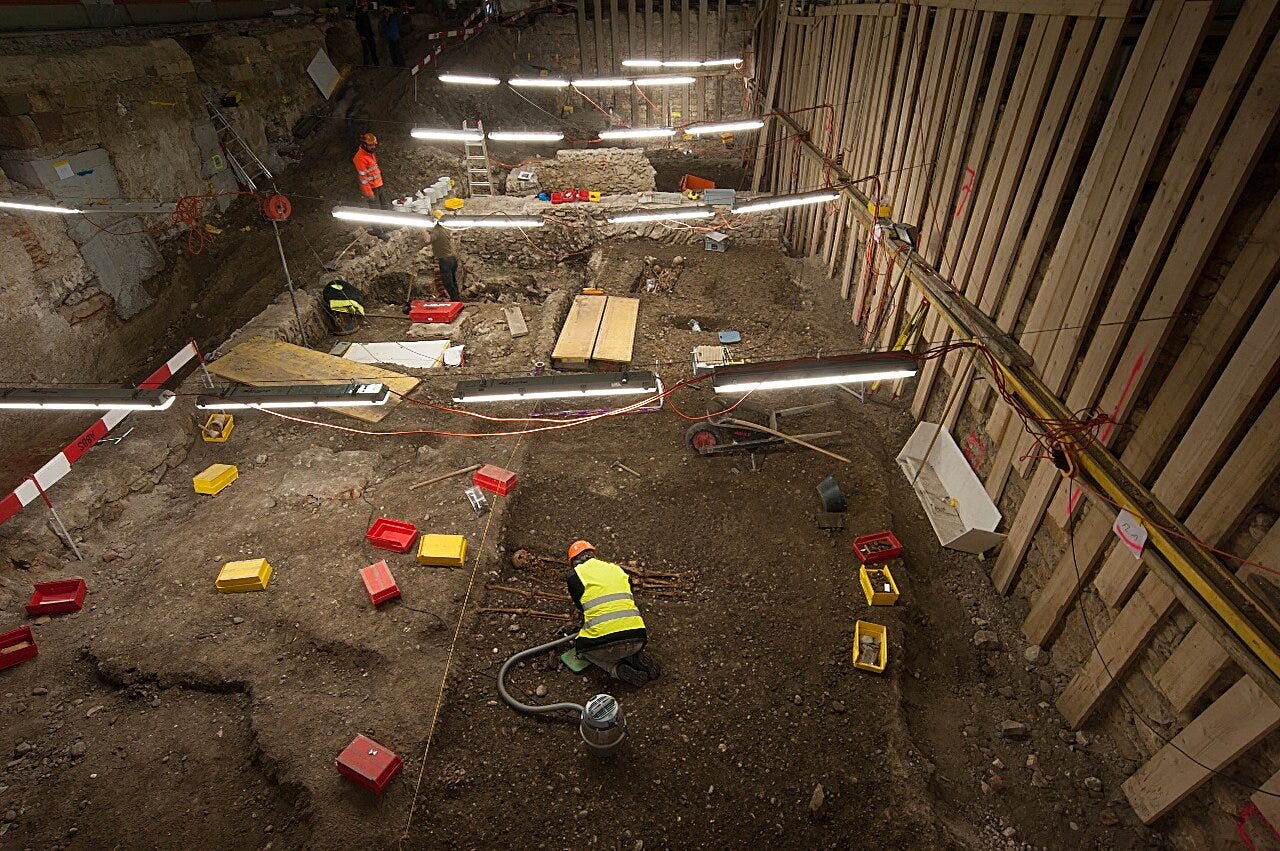
The team is careful to note that the Stadtcasino site is not a simple lower-class cemetery. The diversity of burial practices across the larger assemblage, including coffin burials, personal items, and coins, suggests a range of social positions among the hundreds interred there over the decades. The 15 individuals in graves 229 to 232 represent one moment in that longer story, likely the epidemic of 1667 to 1668, and probably the most socially marginal of the hospital’s associated dead. A broader comparative analysis of the full assemblage is ongoing.
What the study adds, precisely, is the bridge between osteological evidence of hard short lives and the documentary evidence of a city that structured access to survival along lines of citizenship, employment, and social standing. The bones do not lie about the labor. The archives do not lie about the gates.
Further Reading
Spyrou, M.A. et al. (2019). Phylogeography of the second plague pandemic revealed through analysis of historical Yersinia pestis genomes. Nature Communications, 10. https://doi.org/10.1038/s41467-019-12154-0
Susat, J. et al. (2020). Yersinia pestis strains from Latvia show depletion of the pla virulence gene at the end of the second plague pandemic. Scientific Reports, 10. https://doi.org/10.1038/s41598-020-71530-9
Castex, D. & Kacki, S. (2016). Demographic patterns distinctive of epidemic cemeteries in archaeological samples. Microbiology Spectrum, 4. https://doi.org/10.1128/microbiolspec.poh-0015-2015
Marklein, K., Leahy, R., & Crews, D. (2016). In sickness and in death: assessing frailty in human skeletal remains. American Journal of Physical Anthropology, 161, 208-225. https://doi.org/10.1002/ajpa.23019
Lewis, M. (2016). Work and the adolescent in medieval England AD 900-1550: the osteological evidence. Medieval Archaeology, 60, 138-171. https://doi.org/10.1080/00766097.2016.1147787
Lötscher, V. (1987). Felix Platter. Beschreibung der Stadt Basel 1610 und Pestbericht 1610/11. Basel: Schwabe. [VERIFY — cited indirectly through the Rindlisbacher et al. paper; confirm bibliographic details before listing]
Alfani, G. & Murphy, T.E. (2017). Plague and lethal epidemics in the pre-industrial world. Journal of Economic History, 77, 314-343. https://doi.org/10.1017/S0022050717000092
Rindlisbacher, L., Flatscher, E., Gerling, C., Krause-Kyora, B., & Pichler, S.L. (2026). All equal in the face of death? Life histories of confirmed victims of the last plague epidemic in Basel (Switzerland). Antiquity, 100(410), 500-516. https://doi.org/10.15184/aqy.2026.10297


