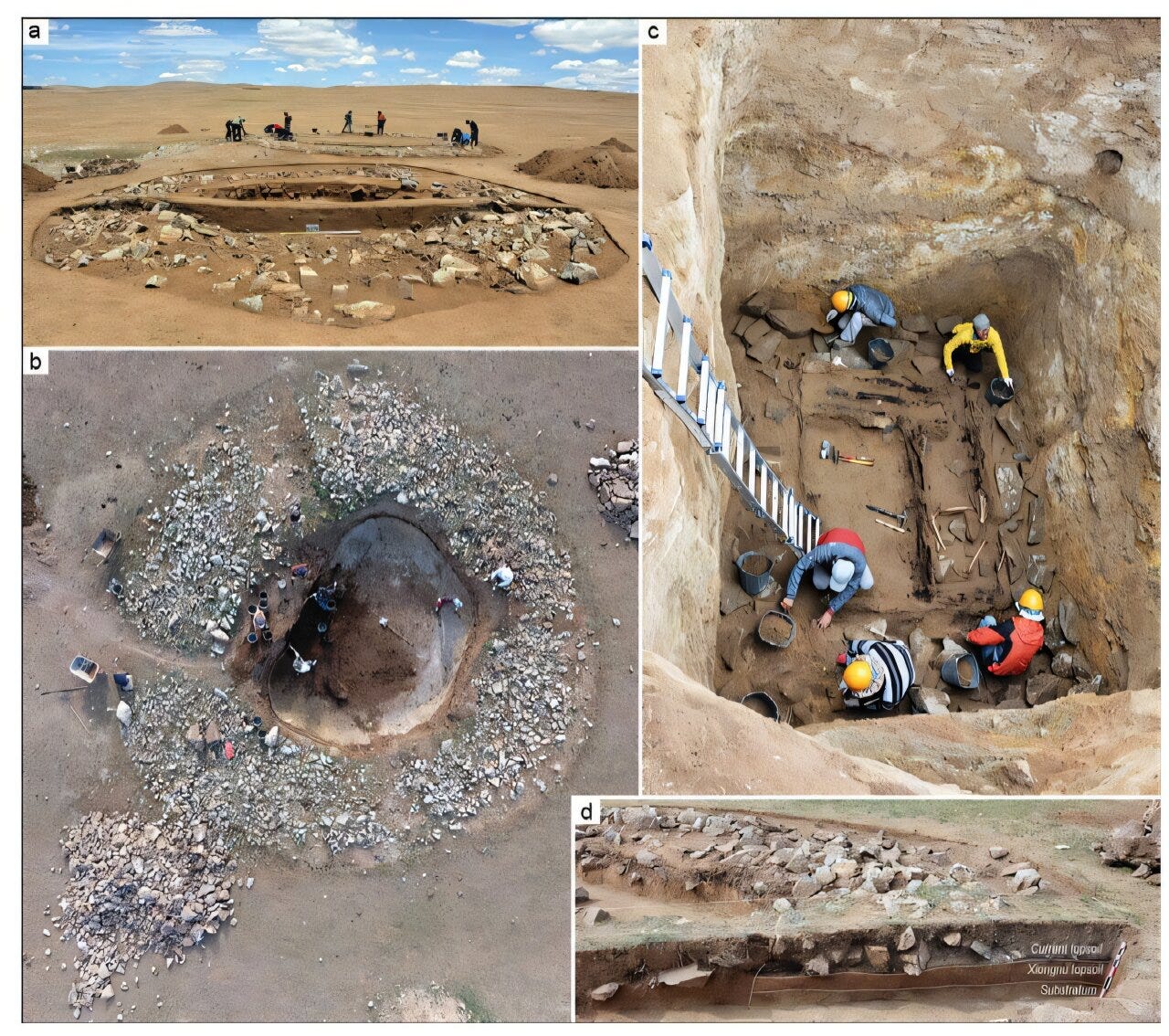
Two brothers shared a bloodline, a father, a lineage stretching back six generations. They did not share a grave site. One was buried in one of the richest tombs at Tamir, beside his wife, surrounded by gold earrings and Chinese lacquerware, deep within the cemetery’s honored center. The other lies 200 meters away, at the edge of the site, in a tomb that offers no hint he belonged to the same family at all.
That gap is the whole story, in miniature. The Tamir necropolis, perched on a promontory where the Tamir and Orkhon rivers meet on the Mongolian steppe, has spent the last several years yielding ancient DNA that traces two extended families across nearly two centuries of use. The obvious read is that this was a family cemetery, the kind of place where bloodline determined your spot in the ground. A team led by Ameline Alcouffe at the University of Toulouse decided to actually test that assumption rather than accept it, and the answer1 they got back complicates the picture considerably. Genetic kinship explained some of what happened at Tamir. Status, wealth and political alliance explained more.