

Novilara sits inland from the Adriatic coast in what’s now the Marche region of Italy, and between the 8th and 7th centuries BCE it was one of the largest cemeteries of the Picene culture, a group whose material world has always been easier to read than its people. Excavators have been pulling burials out of Novilara since the 19th century, more than 400 in total across two campaigns a century apart, and the graves themselves are eloquent. Amber earrings. Bronze brooches. Spindle whorls and weaving tools tucked beside the bodies of women. Weapons beside men. A carved stone stele showing ships and armed figures, mysterious enough that archaeologists still argue over what it commemorates. Some burials cluster together, richly furnished, as if kin groups were staking a claim to status that would outlast them.
None of that tells you what anyone actually ate.
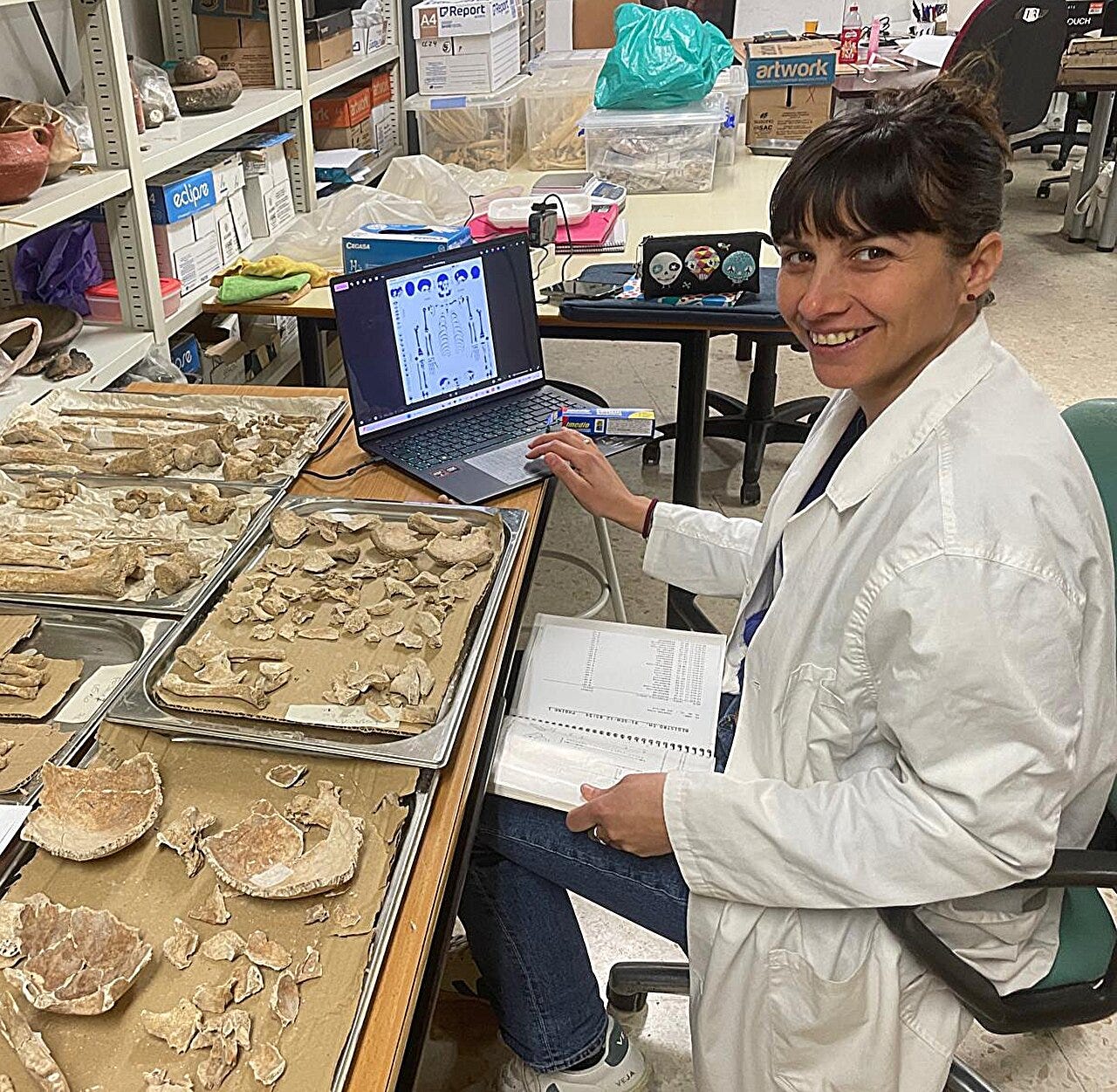
A new study in the Journal of Archaeological Science,1 led by Zita Laffranchi and Marco Milella with colleagues from the universities of Córdoba, Pisa, Bern, and Sapienza, went looking for that missing layer. The team sampled bone collagen from 148 individuals at Novilara and measured three stable isotopes: carbon, nitrogen, and sulphur. Carbon separates plants that photosynthesize differently, mainly wheat and barley versus millet-type crops. Nitrogen climbs with each step up the food chain, so it tracks how much animal protein someone was eating. Sulphur does something else entirely: it flags where someone’s food, and by extension where they, came from, because sulphur signatures shift with proximity to the sea and with local geology.
Put together, these three numbers turn a skeleton into a kind of diary, written not in words but in diet, one that nobody at the time could have edited for effect.


