

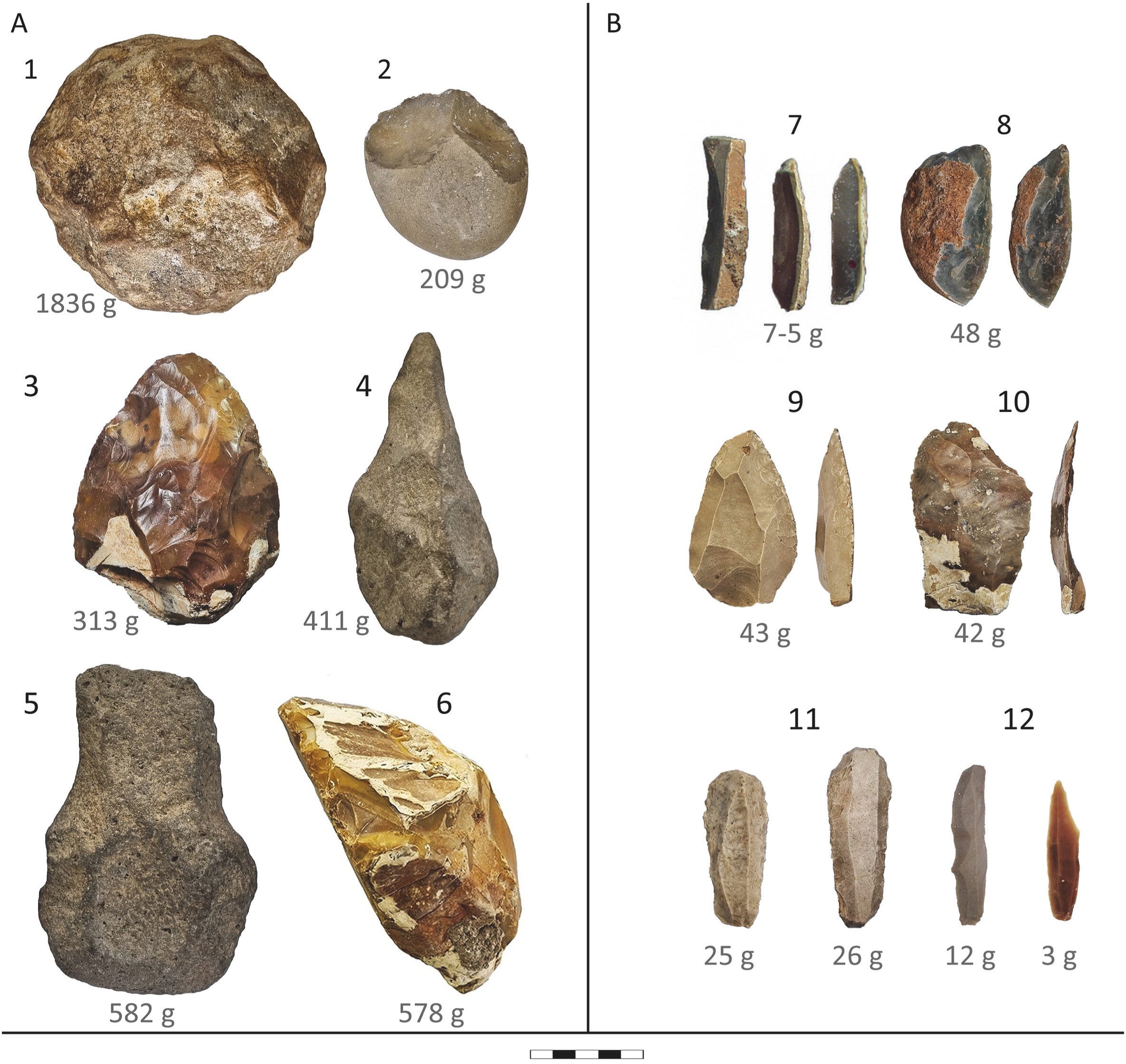
Pick up a handaxe from the Lower Paleolithic Levant and you’re holding something built for a specific kind of work. The thing weighs half a kilogram. Its working edge runs nearly the full perimeter of the tool. It was not designed for delicate operations. Wherever use-wear analysis has been done on these implements, the results point in the same direction: fat residues, protein traces from large mammals, evidence of repeated contact with bone. One handaxe from the late Acheulian site of Revadim, Israel, was found directly associated with an elephant rib bearing cut marks. Fat residues were identified on the tool’s surface. Another pair of handaxes from Shishan Marsh 1 tested positive for horse and rhinoceros proteins.
These were butchery tools. Heavy-duty tools, in the technical sense: thick, massive, built to withstand the forces involved in dismembering very large animals.
Then, around 200,000 years ago, they vanished. Not just handaxes. The entire suite of heavy implements that had characterized the Levantine Lower Paleolithic for over a million years: chopping tools, cleavers, shaped stone balls, core scrapers. In the Middle Paleolithic record of the same region, they are essentially absent. What fills the gap is something entirely different: Levallois flakes, Quina scrapers, backed pieces, blades. Smaller, lighter, more precisely engineered tools.
The standard explanation has always been cognitive. Hominins got smarter, the argument goes, and smarter hominins made better tools. The transition from Modes 1 and 2 to Mode 3 and beyond reflects an expansion in mental capacity, social complexity, cumulative culture. Heavier, simpler implements were replaced by sophisticated light-duty technologies because early humans were now capable of producing them.
A study published this year in Quaternary Science Reviews1 by Vlad Litov, Miki Ben-Dor, and Ran Barkai at Tel Aviv University offers a different account. The question they asked was whether this technological shift might be explained not by what was happening inside hominin minds, but by what was happening outside: specifically, by what animals were available to hunt.


