
There’s a specific kind of power that lives in restricted space. The Classic Maya k’uhul ajaw — the divine king — expressed his authority partly through enclosure. His palace at the center of the city was internally segmented, its rooms accessible only to those with the right rank. Political decisions happened inside. The public stayed outside. The architecture didn’t merely reflect hierarchy; it produced it, embedding the logic of who mattered into stone and sightline.
That is what makes a building excavated in 2024 at Ucanal, in the Petén lowlands of Guatemala, genuinely strange. Structure K-1 is a colonnaded open hall — no thick masonry walls, no segmented interior, no enclosed space separating the deliberations of rulers from the people standing in the plaza below. The columns that define its facade leave the interior visible from outside. Whatever happened in that building, anyone in Plaza K could watch.
Christina Halperin of the Université de Montréal and her colleagues on the Proyecto Arqueológico Ucanal argue that Structure K-1 was a popol nah, a council house, and their paper in Antiquity1 places it at a pivotal moment in Maya political history. The building dates to the Terminal Classic period, roughly AD 810–950, a stretch of time that archaeologists have long recognized as a period of profound disruption across the Southern Maya Lowlands. Populations fell. Sites were abandoned. The epigraphic record, so voluble during the Classic period, goes quiet at site after site. What is less well understood is what came after the disruption — not the collapse, but the reinvention.
Ucanal offers a case study. The site was an important Late Classic center, capital of the K’anwitznal polity, and it did not simply fade. Instead, the archaeological and epigraphic evidence suggests something more like a rupture and reboot. Sometime in the early ninth century, a fire event destroyed a Late Classic royal tomb. Jade ornaments and human remains were burned, then incorporated into new construction at temple-pyramid K-2 in Plaza K. Halperin and colleagues have interpreted this as a deliberate act of rejection: an attack on or ritual erasure of the previous dynastic order.
What emerged in the wake of that event was a new ruler named Papmalil — the name itself is foreign, likely connected to Gulf Coast peoples, possibly the Putun or Chontal Maya. He didn’t claim the site’s traditional emblem glyph as part of his royal title. On a monument at the nearby site of Caracol, Altar 12, he is depicted seated facing another ruler, at the same level, in a horizontal rather than hierarchical arrangement. That visual choice is not incidental. It represents a departure from centuries of iconographic convention in which the k’uhul ajaw was positioned higher, larger, and to the dominant right of everyone else in the scene.
A building that did something different
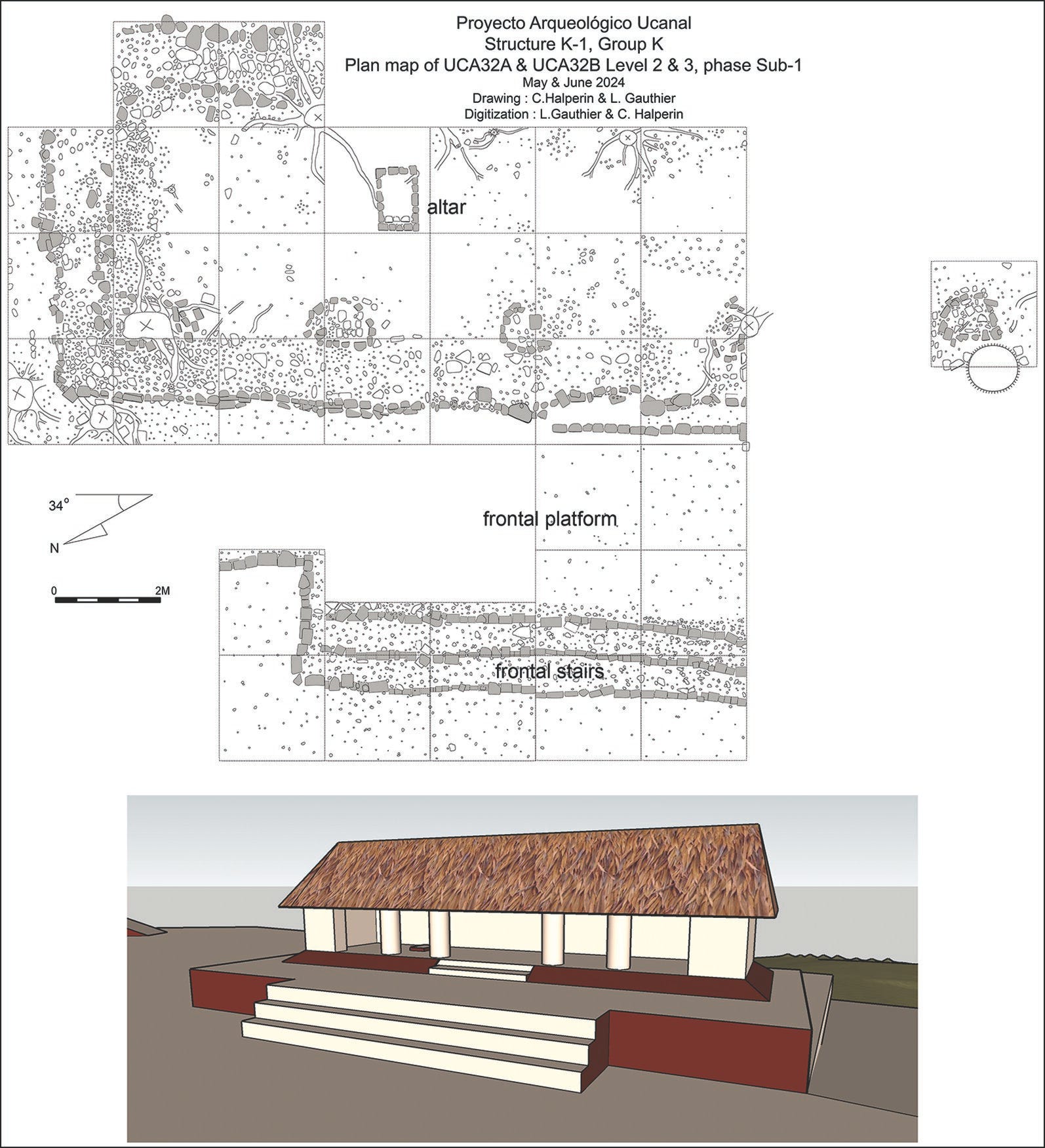
Structure K-1 was constructed during Papmalil’s reign or shortly afterward. It sits on the eastern side of Plaza K, facing the open public space. Excavations in 2024 uncovered the columned bases of the second construction phase, each a low platform of neatly cut stones supporting wooden columns roughly 0.80 meters in diameter. No masonry benches. Walls likely perishable. A broad frontal staircase and raised platform in front of the colonnade would have served as a stage. A small off-center altar was found inside, with Early Postclassic incense burners deposited on top of it before being buried under later construction.
The radiocarbon date from the fill of this phase — calibrated to AD 783–880 at 95.4% probability — places it firmly in the Terminal Classic. Ceramic typology corroborates this. The building orientation, at 33–34° east of north, is unusual: it differs from the cardinal alignments of every other public building at Ucanal, and from the Late Classic causeway wall that lies directly beneath it. That departure from the site’s standard cosmological grid is hard to dismiss as accidental.
Halperin and colleagues argue that the design of K-1 was doing something specific. Ethnohistoric documents from the sixteenth century describe council houses — popol nah in Yucatec Maya, popol pat in Pokoman — as places where rulers, lineage heads, nobles, and other authority figures assembled to deliberate on political agreements, adjudicate disputes, plan for war, and prepare for ceremonies. The functions were diverse. What made the building form distinctive was its spatial logic: open, visible, accessible in the sense that the proceedings inside could be witnessed by people who had no formal political title.
This is the part that matters. The team is careful not to overstate the case. Spectacle and politics were deeply intertwined in Classic Maya governance too — public plazas hosted performances that consolidated the king’s authority by making it visible and legible to crowds. But watching a performance staged by a divine king at the foot of a temple-pyramid, with the palace behind locked walls, is a different kind of political participation than watching leaders deliberate in a building whose entire facade is open to the plaza. In the latter case, the crowd becomes a kind of constituency.
The material record from Papmalil’s reign and after reinforces this reading. Non-elite and middle-status residents at Ucanal gained increasing access to imported goods during the Terminal Classic period. Water infrastructure projects specifically benefited lower-topographic-zone residents. Architectural distinctions between elite and non-elite residences narrowed. There is no evidence of a Terminal Classic palace at Ucanal at all. The largest residential groups appear to have been elaborated versions of common patio groups rather than anything resembling Classic period palatial complexes.
The broader pattern
Ucanal Structure K-1 is not entirely without precedent. Council houses are attested in the Northern Maya Lowlands during the Late Classic period, and the Puuc region in particular shows a tradition of open-hall architecture. But the political context there was different. Polities in northern Yucatan placed less emphasis on divine kingship throughout the Classic period, with fewer carved stelae celebrating named rulers and fewer elaborate royal tombs. The open hall form may have had an easier path in regions where absolutist kingship was never as entrenched.
What the team is documenting at Ucanal is the spread of this architectural logic into the Southern Lowlands — a region where divine kingship had been the dominant organizing principle for centuries — in the context of political crisis. A similar Terminal Classic colonnaded open hall has been identified at Yaxha, and both predate what would become, during the Postclassic period, a widespread template: open halls with low off-center altars, facing public plazas, in political centers from the Petén lowlands to the Guatemalan highlands.
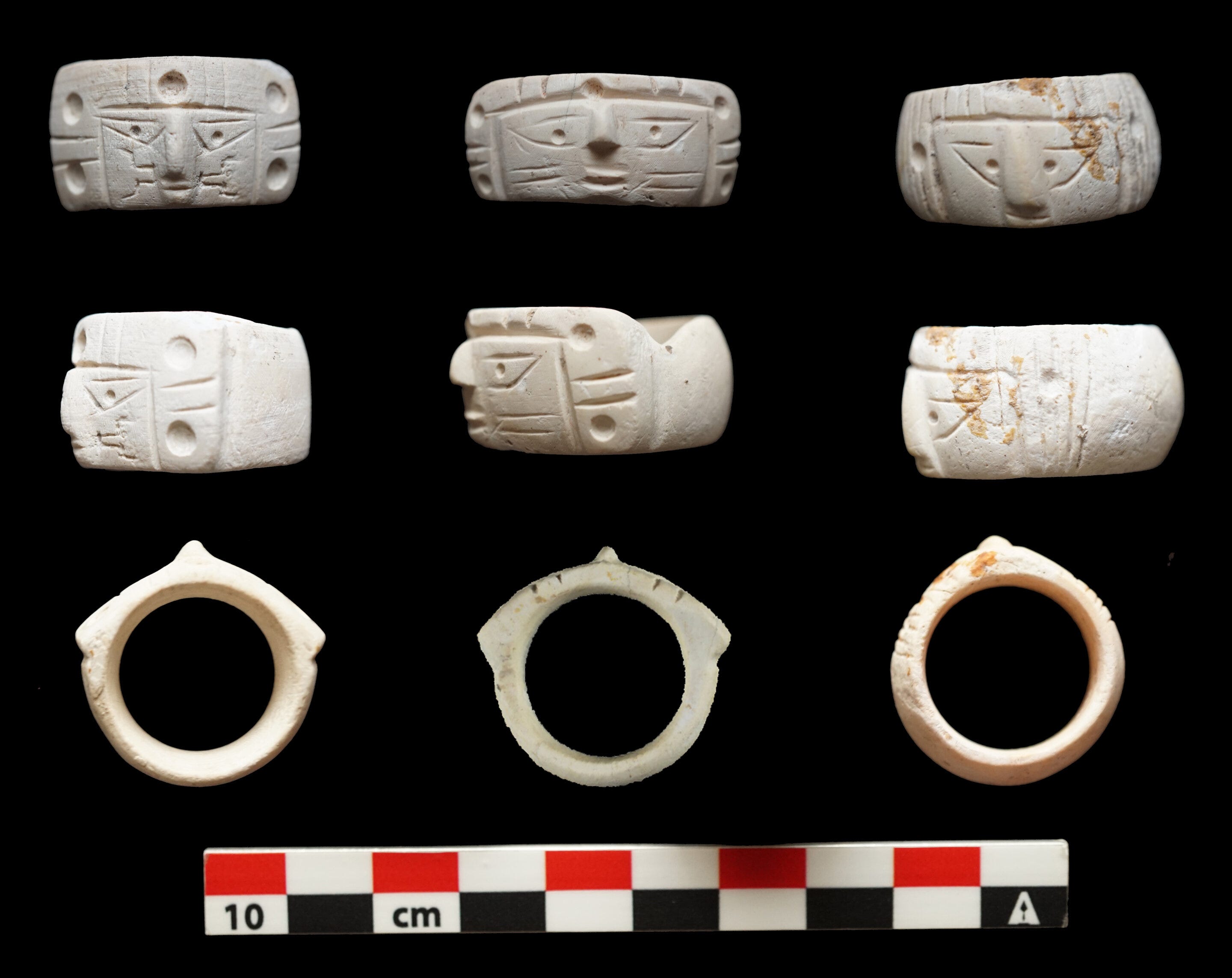
The iconographic record aligns with this. Across the Terminal Classic, a new visual trope appears in multiple media: figures seated or standing side by side, facing each other, roughly equal in size. These so-called conference scenes show up on Fine Orange molded-carved ceramics, on incised marine shell pendants, and on stone monuments like Caracol Altar 12. They contrast sharply with the Classic iconographic grammar in which the divine king towered over all others. The shift in how power was depicted and the shift in how political space was organized appear to be tracking each other.
None of this means the Terminal Classic transition to more collective governance was smooth, ideologically coherent, or universal. Kingship did not disappear. The institutions changed, not the category. What Halperin and colleagues are describing is something more gradual and contested: a series of architectural, iconographic, and material changes that, taken together, suggest that political legitimacy was being renegotiated, and that ordinary people — as witnesses, as potential sources of consensus, as residents who benefited from new infrastructure — were part of that negotiation in ways they hadn’t been before.
Whether that public presence constituted anything like political agency in a formal sense is genuinely hard to determine from the archaeological record. What the buildings can tell us is that the spatial conditions for such influence were being deliberately constructed. Halperin puts it plainly: ancient Maya societies didn’t collapse — they reworked their institutions. One of those reinventions involved the deliberate choice to tear down the walls that had kept governance out of sight.
Further Reading
Halperin, C.T. et al. (2024). A pivot point in Maya history: fire-burning event at K’anwitznal (Ucanal) and the making of a new era of political rule. Antiquity 98: 758–76. https://doi.org/10.15184/aqy.2024.38
Inomata, T. (2006). Plazas, performers, and spectators: political theaters of the Classic Maya. Current Anthropology 47: 805–42. https://doi.org/10.1086/506279
Bey III, G.J. & May Ciau, R. (2014). The role and realities of popol nahs in northern Maya archaeology, in G.E. Braswell (ed.) The Maya and their Central American neighbors: 335–55. New York: Routledge. [VERIFY full page range]
Fash, B. et al. (1992). Investigations of a Classic Maya council house at Copán, Honduras. Journal of Field Archaeology 19: 419–42. https://doi.org/10.2307/530426
Martin, S. (2020). Ancient Maya politics: a political anthropology of the Classic Period 150–900 CE. Cambridge: Cambridge University Press.
Halperin, C.T., Ramos Hernandez, C., & Gauthier, L. (2026). Council houses and new systems of governance in the Terminal Classic Southern Maya Lowlands. Antiquity. https://doi.org/10.15184/aqy.2026.10329


