

On the ceiling of a rock shelter catalogued as AW5, a serpent stretches 6.1 metres in a straight line, 6.88 if you measure along the curve of its body. The head is a crocodile’s, jaws open, ten teeth along the top and eight along the bottom, tongue extended between them. Fish fins sit behind the head. About a third of the way toward the tail, something like an arm or a flipper hangs off the body. Inside the white form, painted in red, is a backbone with vertebrae and ribs, surrounded by hatching. Photographs of the shelter show people sitting beneath it who look like they have been added for scale.
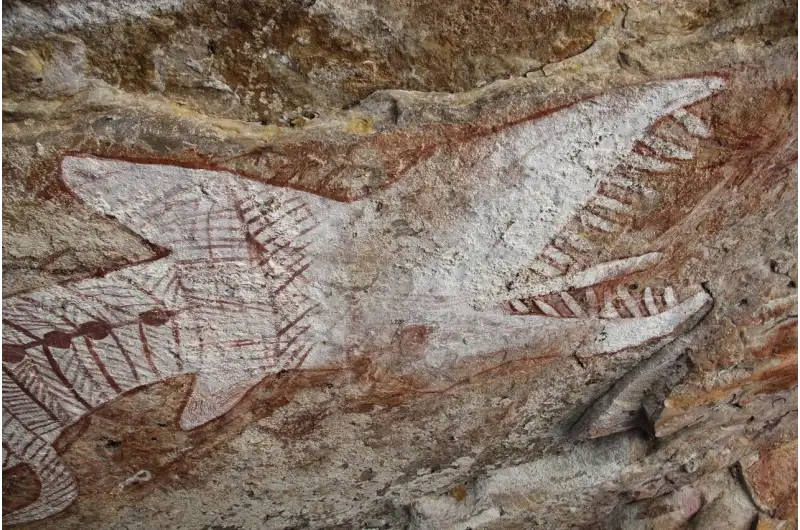
It is the largest of 29 Rainbow Serpent paintings that Paul Taçon, Sally May, Andrea Jalandoni and Charlie Mungulda recorded across 21 sites at Awunbarna, also known as Mount Borradaile, in northwest Arnhem Land. Their study appeared in Australian Archaeology1 in August 2026. Awunbarna sits in Amurdak Country, south of the Cobourg Peninsula, and its shelters hold paintings made over at least the past 15,000 years. Since 2018 the team has recorded and analysed 165 sites there, with a deliberate focus on what was painted after outsiders arrived.
The density is the first strange thing. Rainbow Serpents turn up at 12.6 percent of the 167 known Awunbarna sites. At Namunidjbuk to the northeast, two paintings across 352 sites. At Injalak Hill to the south, two across 232 sites, and one of those depicts Yingarna in human form rather than as a serpent. Outside Awunbarna, the region’s Rainbow Serpent paintings are scattered across seven separate zones of roughly 1,000 square kilometres each. At Awunbarna they are packed into an area of about 27 square kilometres, four and a half kilometres by six. Counting everything now known from western Arnhem Land, Awunbarna holds a fifth of all Rainbow Serpent rock paintings and 38.5 percent of the ones classed as recent.
The dating is where the argument has to do its work, and it is worth being clear about what kind of dating this is. Almost none of these paintings can be radiocarbon dated. The team’s case for a post-contact age rests on three things stacked together. The serpents belong to the most recent Arnhem Land painting style. They sit in the uppermost layers at sites with superimposed art. And seven of them were made mainly with white pipe clay, or kaolin, which sits on the rock surface instead of penetrating and staining it the way red ochre does. Kaolin paintings usually survive a few hundred years and sometimes erode away within decades. Add the colour combinations and infill types, which match the sequence tracked with radiocarbon dates at Nawarla Gabarnmang in central-western Arnhem Land between about 1640 and 1930, and the team concludes that 20 of the 29 Awunbarna serpents postdate contact. The paper treats roughly 1640 as the threshold for post-contact art in the region, drawing on earlier chronological work, though the cultural upheaval the study invokes belongs to the 1800s and early 1900s. This is relative dating carrying an argument about a fairly specific historical moment, and the paper is upfront that the window is wide.


