
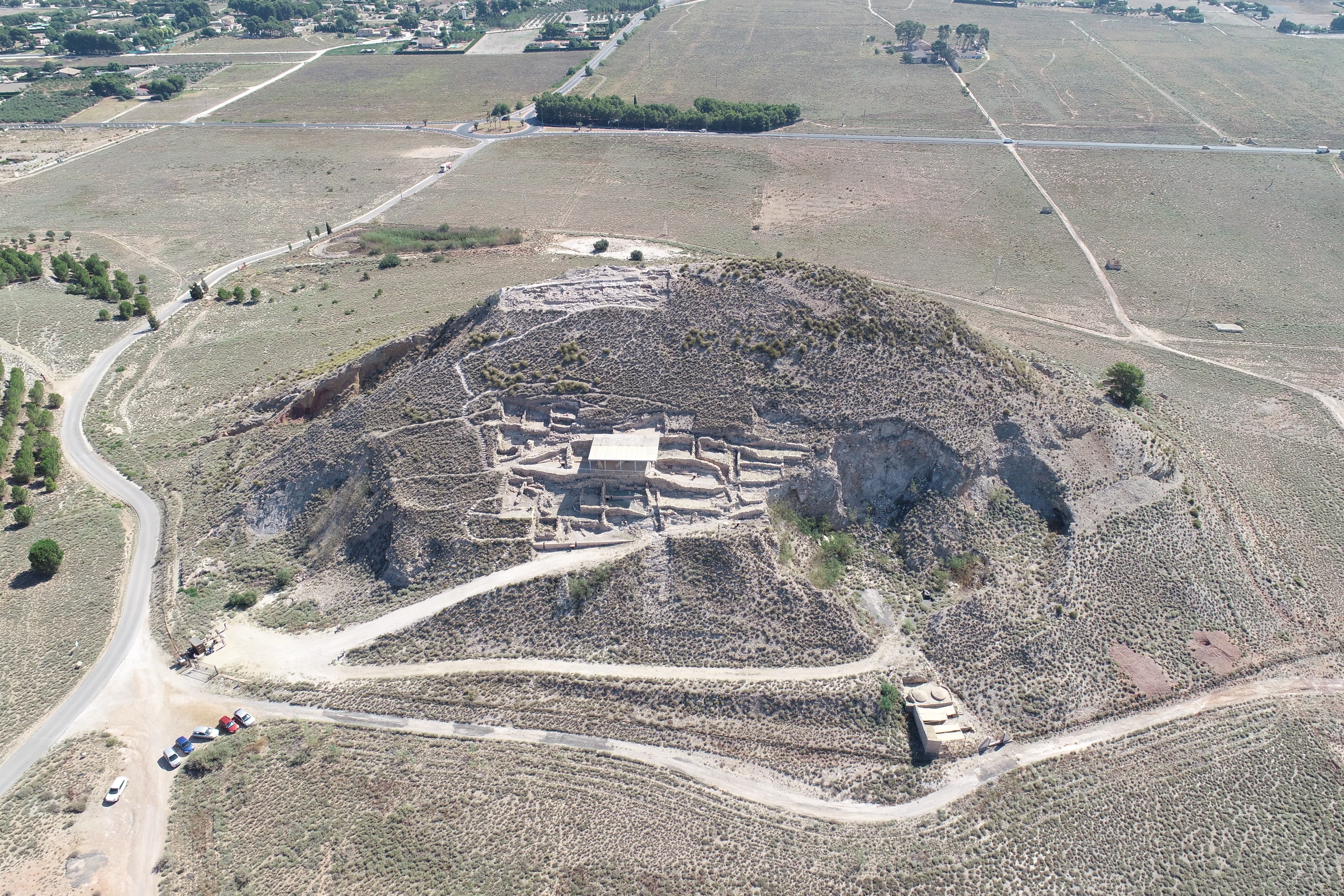
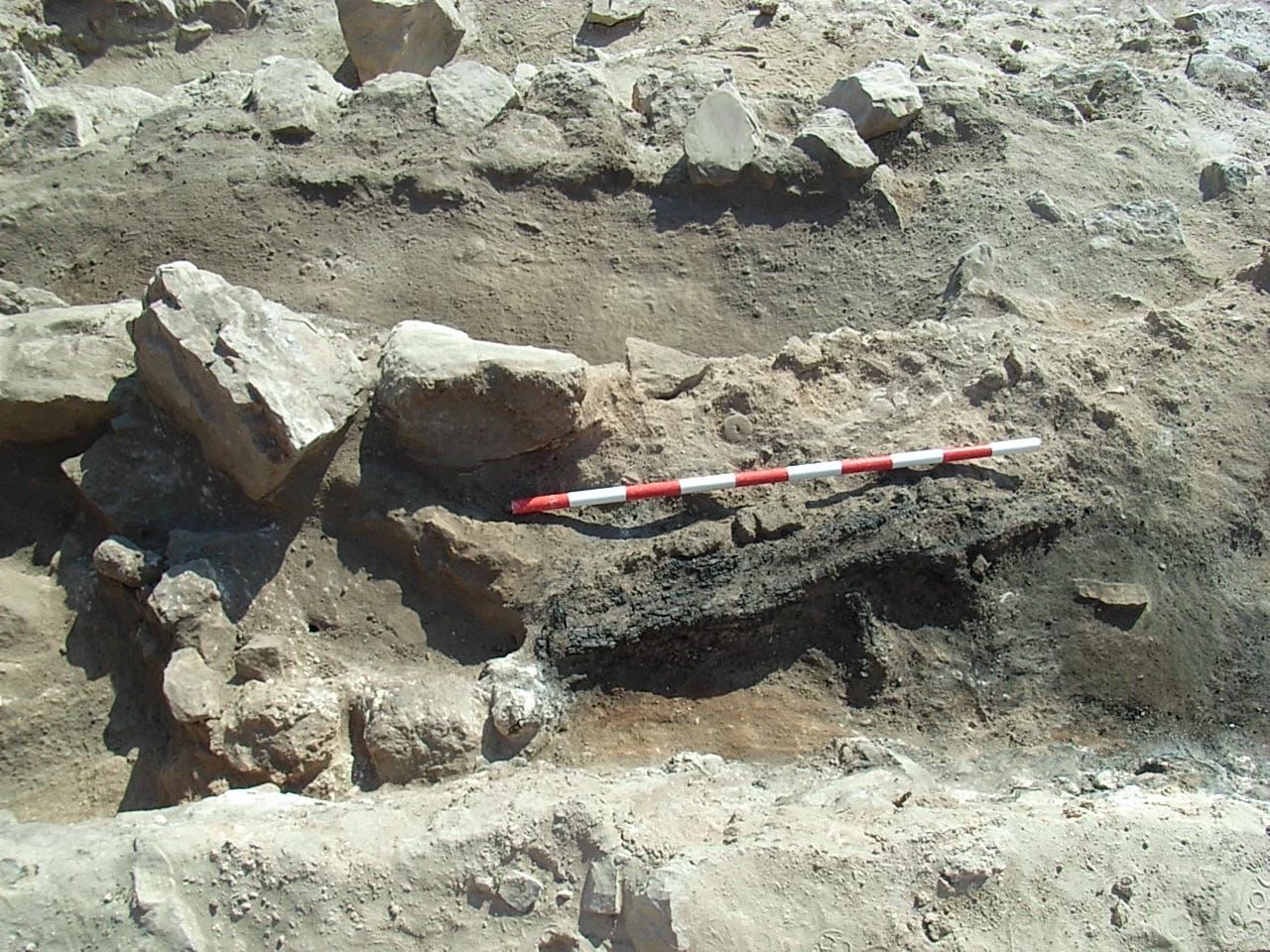
The fire that destroyed part of Cabezo Redondo around 1450 BC was, archaeologically speaking, a piece of luck. The settlement sits on a hill in the Alto Vinalopó region of southeastern Spain, a few kilometers west of present-day Villena. When flames swept through the circulation area — an outdoor platform and street connecting several houses — they sealed everything beneath carbonized debris. Wheat seeds on the floor. Esparto ropes. Charred timbers. Clay weights still clustered where they had fallen.
Together, those remains constitute one of the best-preserved Bronze Age warp-weighted looms found anywhere in the western Mediterranean.
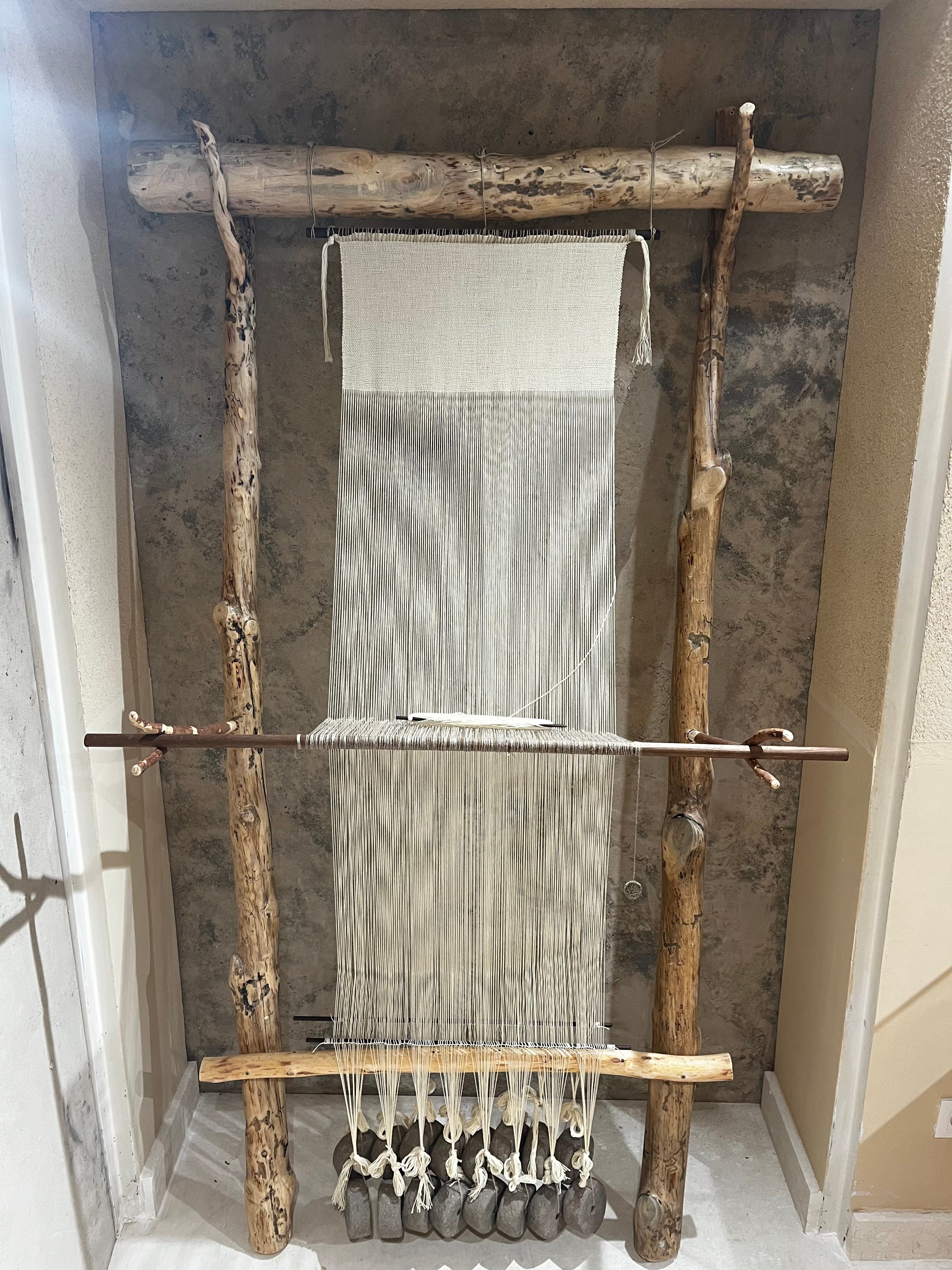
A warp-weighted loom is a vertical frame. Threads hang freely from a horizontal beam at the top, held taut by weights tied to their lower ends. A weaver passes the weft thread — the horizontal one — back and forth across the hanging warp to build up the fabric. The design is simple and has proven extraordinarily durable as a concept: versions of it appear in Neolithic Europe, in Greek vase paintings, in ethnographic records from recent centuries. What rarely survives is the physical object. Wood rots. Organic fibers decay. Archaeologists working on prehistoric textile production have long been reduced to reading loom weights in isolation — the clay or stone anchors at the bottom of the threads — and inferring the rest.
At Cabezo Redondo, that is no longer entirely the case.
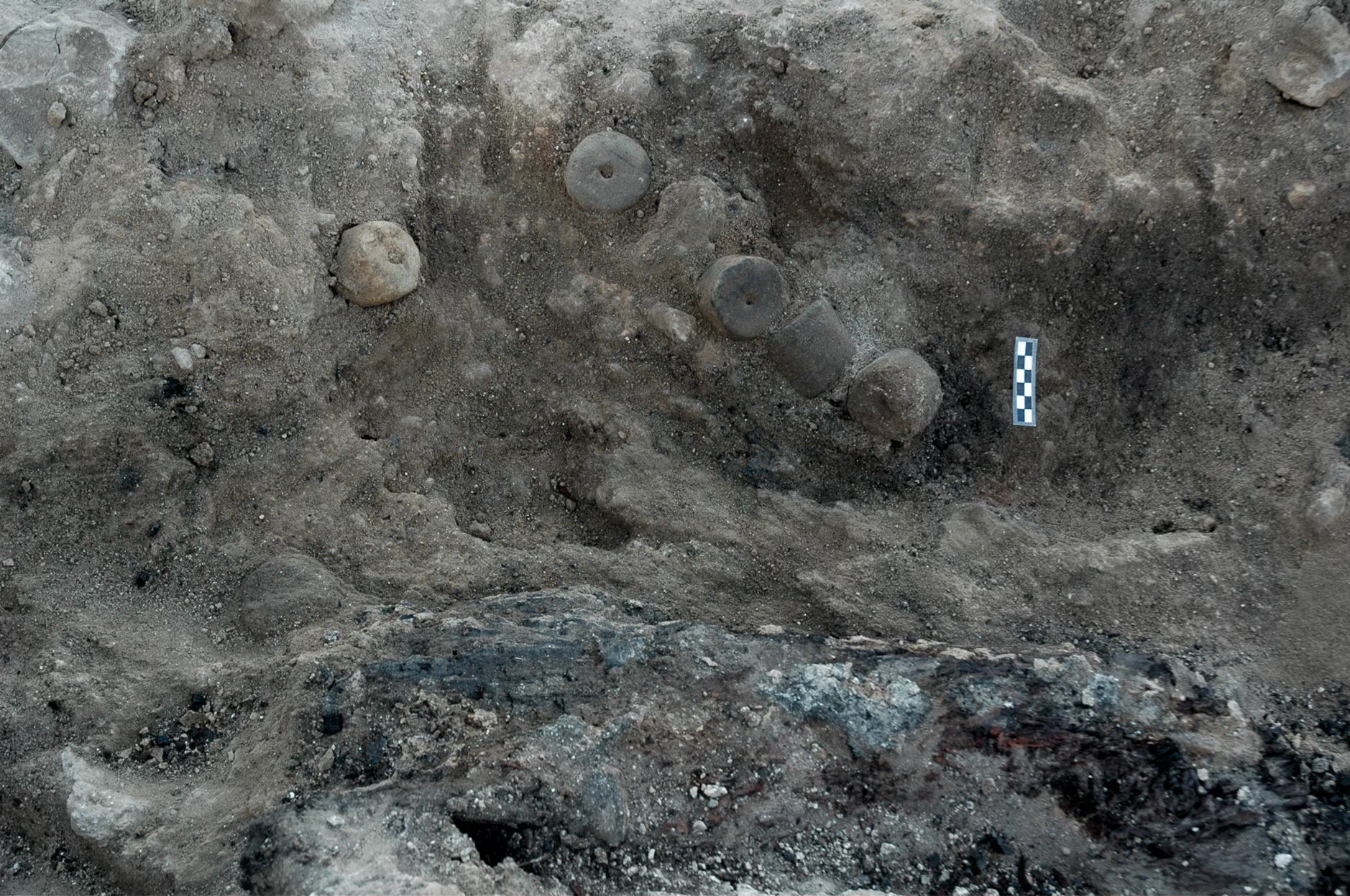
The team, led by Dr. Ricardo E. Basso Rial of the University of Granada, documented1 five charred timbers on a raised stone platform, all from locally sourced Aleppo pine (Pinus halepensis). Wood anatomy analysis, conducted with scanning electron microscopy and optical microscopy, confirmed the species and suggested the builders selected mature wood from the outer trunks of large trees — the kind of grain structure that provides stability over time. Esparto grass (Macrochloa tenacissima) ropes, braided and knotted, lay in direct contact with the timbers, likely used to lash structural elements together. Small cords of the same material were found still threaded through the central perforations of several loom weights, the physical remnant of how warp threads were tied on.
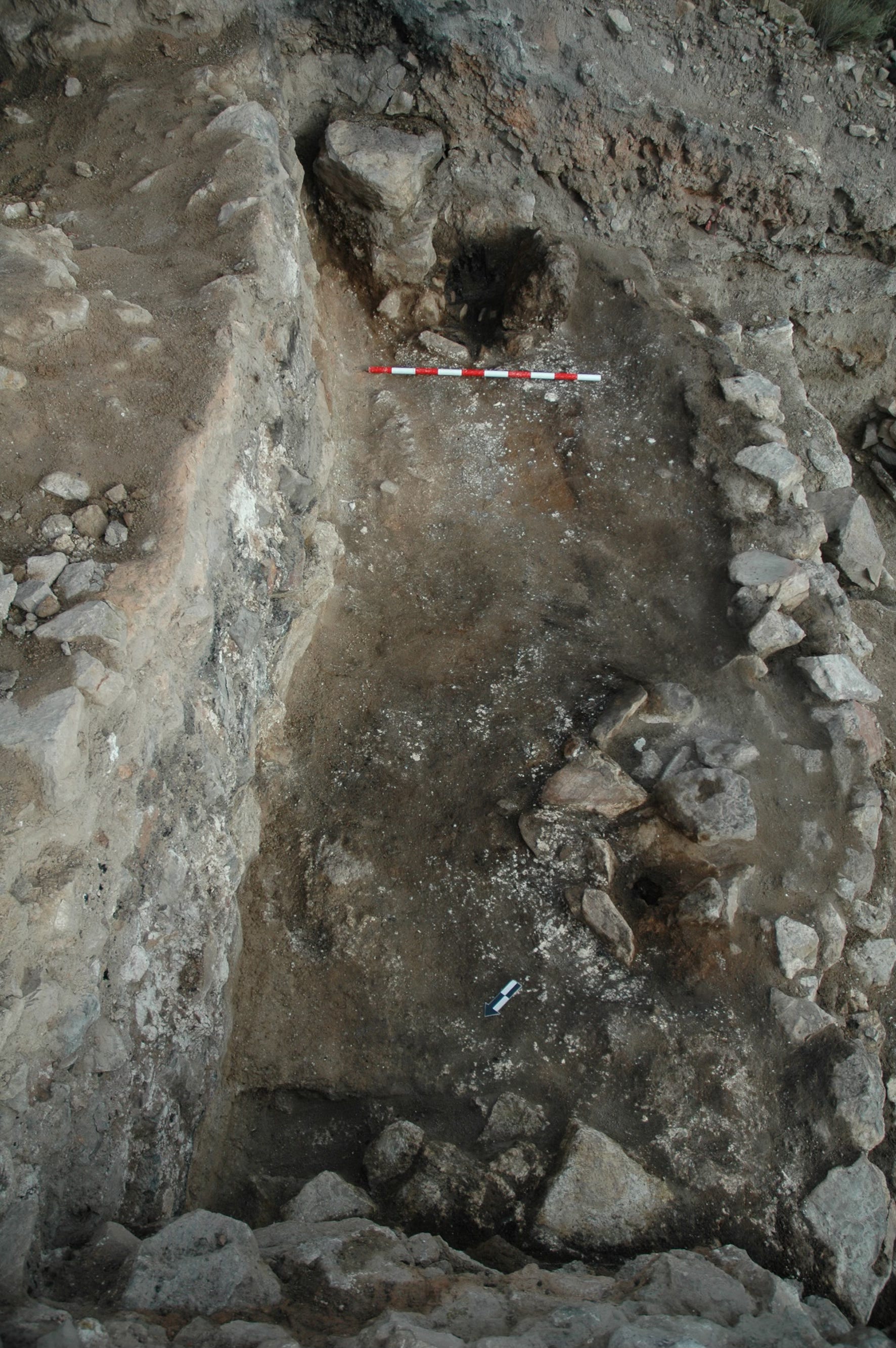
Two of the timbers, roughly a meter long with rectangular cross-sections, are most plausibly the upright posts of the loom. Three shorter, more slender pieces would have served as crossbeams. One upright preserves a branching fork at one end, possibly adapted to cradle the upper cloth beam. Estimating the loom’s full height is difficult — the timbers are incomplete — but enough survives to partially reconstruct its form.
Forty-nine clay weights were found on the platform. Forty-six lay clustered directly beside the timbers. Three others were found nearby, in the same context, their esparto cords still attached.
Reading the Weights
What makes those weights interesting is not their number but their size. Most Bronze Age loom weights from southeastern Iberia fall in the range of 400 to 900 grams. The main group at Cabezo Redondo averages around 200 grams — small, cylindrical, with a single central perforation. Their thinness is notable too. In a warp-weighted loom, the thickness of a weight determines how much space the attached threads occupy on the loom, and the sum of all weights’ thicknesses determines the total fabric width.
Using methodology developed by the Centre for Textile Research at the University of Copenhagen — an experimental approach grounded in the physical mechanics of weaving — the team modeled what this assemblage could produce.
Two configurations emerge. In the first, 44 weights arranged in two rows of 22 would produce a tabby weave roughly a meter wide. Tabby is the simplest weave structure: each horizontal weft thread passes over and under each vertical warp thread in alternation. The resulting fabric would be open and lightweight, similar to gauze, with a thread count of around 5 to 10 threads per centimeter. Thread diameter was probably under half a millimeter. That kind of textile — thin, made from plant fibers like flax — dominates the preserved Bronze Age record across Iberia.
The second configuration is where things get more interesting. The same 44 weights, rearranged into four rows of 11, would produce a twill weave. In a twill, the weft passes over and under pairs of warp threads rather than individual ones, creating a diagonal interlocking structure. The fabric that results is denser, more flexible, more durable — and thread density in this configuration would range from 10 to 19 threads per centimeter. Twill fabrics didn’t become widespread in Europe until the early first millennium BC. The earliest known examples from Central Europe date to roughly 1500 to 1200 BC: precisely when this loom was in use.
Four larger, heavier weights were also recovered on the platform, stored nearby rather than mounted on the loom. Their presence suggests the weavers had access to multiple configurations. The platform also yielded spindle whorls — four clay examples including biconical and spherical forms not typical of earlier periods, when heavier discoid whorls associated with flax spinning dominated the record.
A Craft in the Open
The platform itself is worth pausing on. It is not a workshop. It is a raised stone surface, roughly 4.2 by 1.8 meters, partially covered by a roof supported on two timber posts, situated in the street-like space connecting several houses. Ceramic vessels, stone tools, sickle blades, and metal objects were scattered through the surrounding area. The loom sat in shared domestic space, in the middle of ordinary activity.
Weaving at Cabezo Redondo was not a specialized or segregated craft the way metalworking was — the evidence for metalworking comes from non-residential contexts. Textile production appears distributed across households, embedded in the rhythms of home and neighborhood. Concentrations of loom weights appear in at least 16 different spaces across the site. House XVIII alone contained 70. Multiple households were weaving, and the variety of weight types implies multiple loom configurations and multiple fabric types in parallel use.
Flax, almost certainly, remained the primary fiber. Preserved textile fragments from the region in this period are mostly plant-fiber tabbies. But the lighter weights, the new spindle whorl forms, and the possibility of twill production all suggest something was changing.
That shift is what researchers call the “textile revolution”: the gradual adoption of wool as a weaving fiber, and with it a new technical vocabulary. Wool accepts dye more readily than flax. It produces denser, warmer, more patterned fabrics. Twill weaves, which emerged in parallel with wool’s adoption, enable designs using threads of different colors. The trajectory can be traced across Bronze Age Europe — from the Terramare settlements of northern Italy to the funerary textiles of Scandinavia — though it unfolds at different times in different regions. In Iberia, direct evidence for wool is still sparse. The only confirmed find so far is from Tomb 121 at the Argaric site of Castellón Alto in Granada, dated to 1800–1700 BC, and the full analysis of those textile fragments has not yet been published.
Cabezo Redondo doesn’t confirm that these particular weavers were making twill fabrics from wool. No textile fragments survived the fire. What it shows is that the equipment for twill production was present, that someone at this settlement understood what four rows of weights could do that two rows could not. In the words of Dr. Basso Rial, the discovery allows us to see the loom itself — frozen at the moment of use — rather than just the partial tools that typically survive.
The same fire that ended the weaving preserved the evidence of it. A meter of cloth, or the ghost of one, can still be reconstructed from the distribution of weights on a stone platform, 3,500 years after the last thread was passed.
Further Reading
Mårtensson, L., Nosch, M.-L., & Andersson Strand, E. (2009). Shape of things: understanding a loom weight. Oxford Journal of Archaeology, 28, 373–398. https://doi.org/10.1111/j.1468-0092.2009.00334.x
Molina González, F. et al. (2003). La sepultura 121 del yacimiento argárico de El Castellón Alto (Galera, Granada). Trabajos de Prehistoria, 60(1), 153–158. https://doi.org/10.3989/tp.2003.v60.i1.127
Gleba, M. (2008). Textile production in pre-Roman Italy (Ancient Textiles Series 4). Oxford: Oxbow.
Grömer, K. (2016). The art of prehistoric textile making: the development of craft traditions and clothing in Central Europe. Vienna: Natural History Museum Vienna.
Basso Rial, R.E., García Atiénzar, G., Carrión Marco, Y., Martín de la Sierra Pareja, P., Barciela González, V., & Hernández Pérez, M.S. (2026). Evidence of a warp-weighted loom in the Bronze Age settlement of Cabezo Redondo (south-east Spain). Antiquity. https://doi.org/10.15184/aqy.2026.10312


