

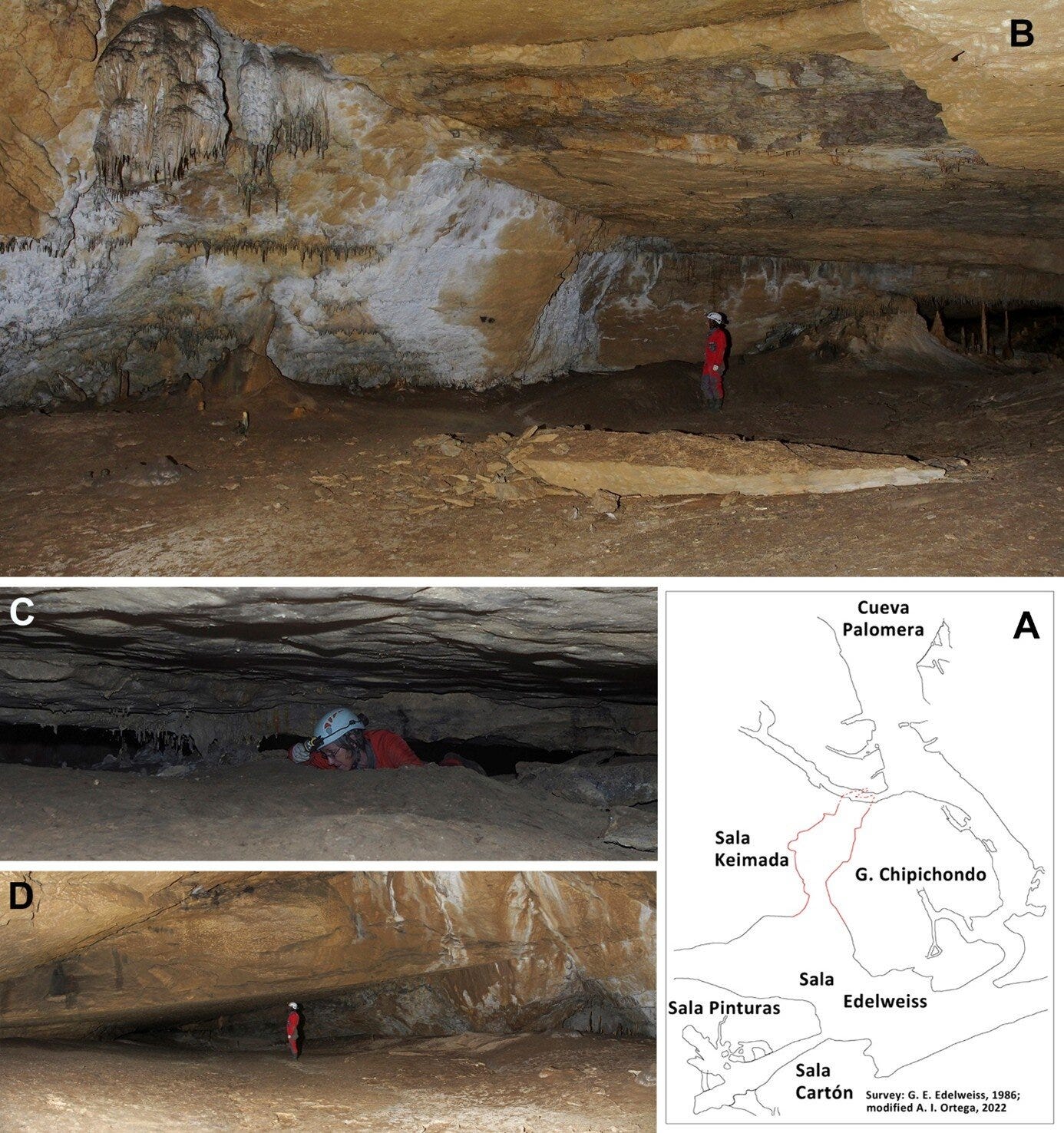
To reach Sala Keimada, you have to want to be there. The chamber sits roughly 290 meters from the entrance of Cueva Palomera, in the Ojo Guareña Karst Complex of northern Spain, and the only way in is through a crawl passage 13 meters long and, in places, just 20 centimeters high. That is not a typo. You flatten yourself against the rock and drag yourself through. You do this in complete darkness, carrying light that has to be kept alive by reviving torches against the ceiling at the junction with the chamber. Charcoal smears at that spot preserve the residue of countless people doing exactly that.
On the other side of the crawl is a chamber roughly 20 meters long. Its west wall bears a panel of black geometric figures drawn in charcoal: triangles, trapezoids, lines. They are striking not because of any naturalistic detail but because of what they share with the nearby Sala de las Pinturas, a more famous and more accessible chamber that researchers have been studying for decades. The stylistic resemblance was noticed before anyone had a date for either site. What was missing, for Sala Keimada, was chronology. That changed with a study published in 2026 in the Journal of Archaeological Science: Reports,1 led by Ana Isabel Ortega-Martínez of the Royal Burgos Academy of History and Fine Arts, presenting 18 new AMS radiocarbon dates for the chamber. The results confirmed what stylistic analysis had long suggested, and then pushed the story much further forward in time.
The oldest date in the dataset, sample SK-1, comes from a small piece of charcoal found on top of one of the finger-fluting engravings at the transition between the entrance crawl and the chamber. It calibrates to approximately 13,500 to 13,700 years before present, placing it squarely in the late Upper Paleolithic. A second sample, SK-2, taken from the charcoal paint forming one of the main black trapezoidal motifs in the chamber itself, calibrates to around 12,750 to 13,200 years before present. The two dates bracket the primary paintings in chronological terms, and they align closely with dates previously obtained for the geometric figures in the Sala de las Pinturas. The two chambers, separated in space and radically different in access difficulty, appear to have been created by the same cultural tradition at roughly the same moment.
This is the rock art tradition scholars classify as Style V, sometimes called Final Paleolithic or Late Paleolithic art, characterized by geometric and semi-abstract forms rather than the grand figurative animals more commonly associated with cave art in the public imagination. Its range spans multiple sites across the Iberian Peninsula and beyond, appearing at La Peña de Estebanvela, Fariseu, Molí del Salt, and Siega Verde, among others.


