
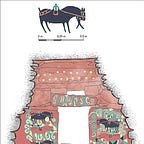
At the Ōzuka tomb, five horses parade across the stone gateway leading into the burial chamber. Their eyes are large and deliberate. Their harnesses are picked out in careful color. You can tell, from the way the artist rendered their bodies, which animals are male and which are female. Riding them are six human figures, and every one of them is a stick. No faces. No sex. One rider is drawn at roughly a quarter the size of his own horse.
This wasn’t a failure of skill. The same hands that gave the horses anatomical precision chose, apparently on purpose, to leave the people blank. A new study by Claudia Zancan, published in Antiquity,1 argues that this wasn’t an isolated quirk of one tomb but a consistent regional pattern across the decorated tombs of Kyushu, Japan’s southernmost island, and that the pattern tells us something specific about how these communities thought about death.
A Regional Style That Refused to Individualize
Kyushu sits closest to the Korean Peninsula of any part of Japan, and during the sixth and seventh centuries it absorbed plenty of continental influence. Across the water, Koguryŏ tombs painted the dead as dominant, detailed figures towering over their servants and animals, exactly the kind of imagery you’d expect from an elite burial tradition that wanted to broadcast the status of the person inside. Kyushu had access to that visual vocabulary. It didn’t use it.
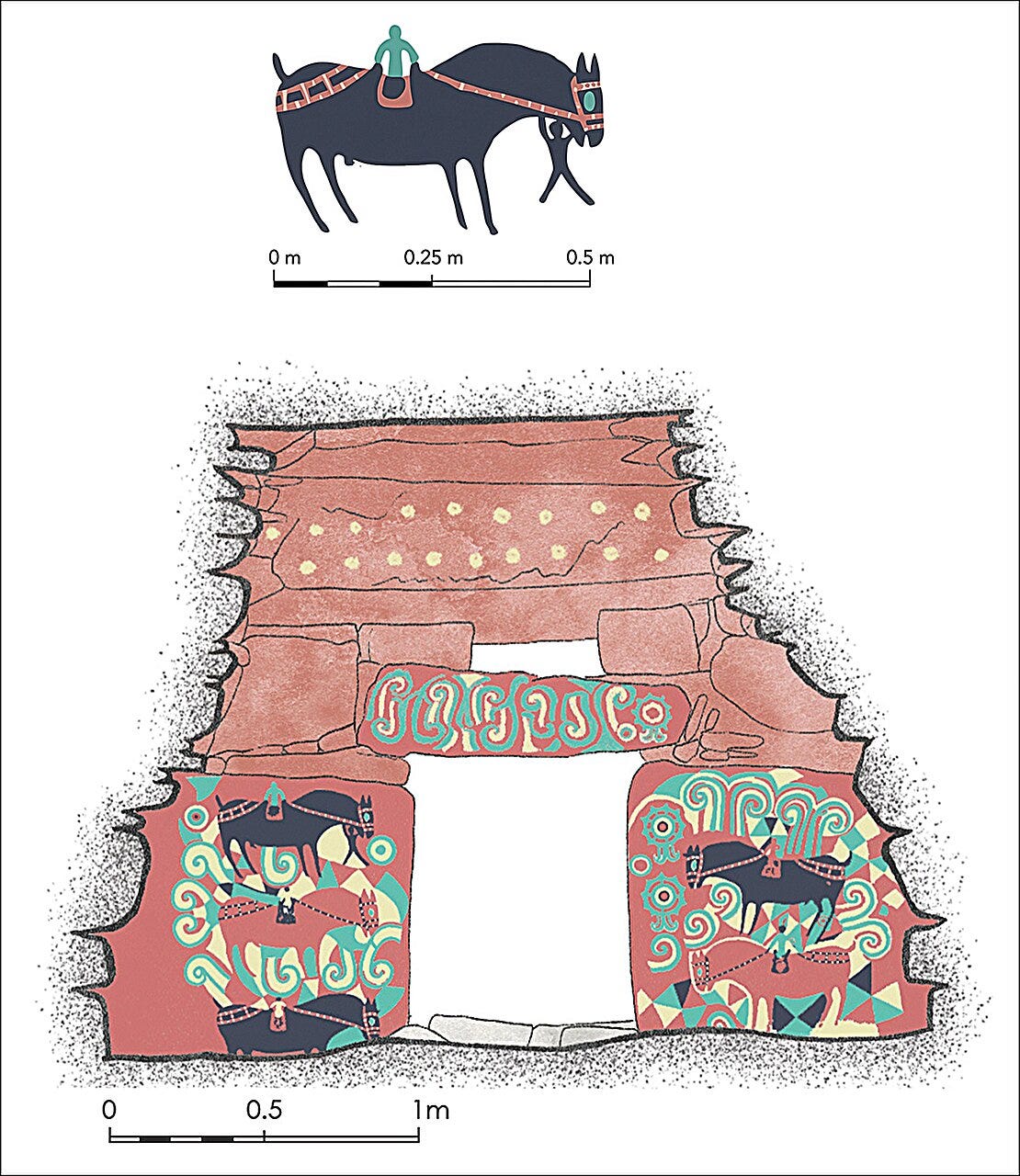
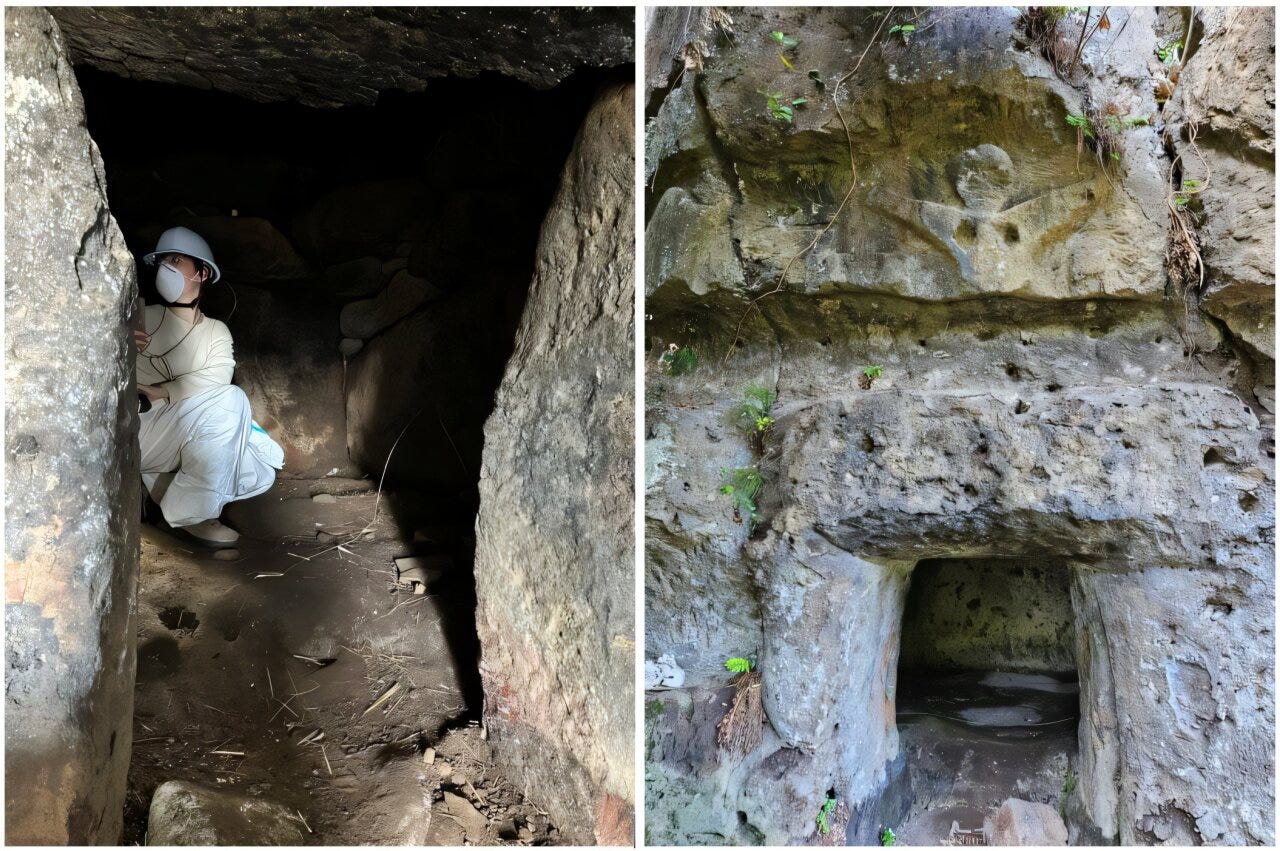
Zancan’s study systematically catalogued anthropomorphic figures across 38 decorated tombs, 20 painted and 18 rock-cut, and found the same thing again and again: human figures rendered smaller than the objects around them, stripped of individualizing detail, and, in every single case in the sample, impossible to sex. Not one figure across the entire corpus shows primary or secondary sexual characteristics, even in tombs where the artists were clearly capable of that level of detail. Compare that to contemporary Kyushu funerary sculpture like sekijin stone figures or the haniwa of the Kanto region, both of which do occasionally mark sex and social role. The anonymity in the tomb paintings looks like a choice, not a limitation.
This matters because the period itself was a moment of real transformation in Japanese mortuary practice. Older Kofun-period burials were sealed pits, built once and closed for good. The horizontal stone chambers that appear in the Late Kofun period could be reopened, over and over, for successive interments. A tomb stopped being a monument to one death and became a space for ongoing ritual. Zancan’s argument is that the imagery inside these chambers reflects that shift. If a tomb is going to be reopened for generations, its decoration doesn’t need to commemorate the specific person laid to rest last. It needs to do something else.
Borrowing a classification system originally built for Iberian rock art, Zancan mapped where the human figures actually sit within the architecture of each tomb, and three locations kept recurring. On the exterior façades of rock-cut tombs, figures appear holding weapons, facing outward, and these are the only figures in the entire corpus with anything resembling faces. They read as guardians, warding off whatever might approach from outside. Inside, at the entrance to the burial chamber, a second set of figures marks the threshold itself, the physical and symbolic boundary between the world of the living and the world of the dead. This is architecturally and mythologically loaded ground in Japanese tradition. It’s the same threshold where the god Izanagi, in the origin myth, searches for his dead wife Izanami and finds her transformed by the underworld. And at the very back of the chamber, on the rear wall closest to where the body would be laid, the human figures shrink to their smallest scale of all.
None of these three positions functions as a portrait spot. Read together, they sketch a route: guarded threshold, liminal crossing, final resting place. The figures aren’t depicting who died. They’re depicting the passage every dead person takes to become an ancestor.
What the Human Figure Was Actually For
There’s a reflex, when looking at a burial, to go looking for the individual. Sex, rank, personal effects, some marker of who this specific person was in life. Zancan’s study is essentially an argument against applying that reflex here. The tombs of Kyushu weren’t organized around commemorating a particular Homo sapiens life. They were organized around a process, a transition from person to ancestor, and the human figures in the paintings were symbolic participants in that process rather than likenesses of anyone in particular.
That reframes what the small size and blank faces are actually doing. They aren’t evidence of an underdeveloped visual tradition sitting in the shadow of more sophisticated continental art. They’re evidence of a community using abstraction on purpose, choosing anonymity as a way of expressing something collective rather than personal. Scale, in these tombs, seems to track ritual importance rather than realism. The horses at Ōzuka are large because horses carried real symbolic weight in the funerary procession being depicted. The riders are small because whoever they represent doesn’t matter as an individual. What matters is that someone is making the journey.
Zancan notes that this pattern has never been systematically tested outside Kyushu, and much of the physical evidence needed to test it is disappearing. Pigment degrades. Stone erodes. Some of these tombs have already lost the imagery that would let anyone verify whether the same rules of anonymity and placement hold elsewhere in Japan. Whatever answer that question eventually gets, it’s going to depend on how much of this material survives long enough to be looked at again.
Zancan, C. (2026). The anonymous protagonist? Agency and abstraction in Kyushu decorated tombs of the Japanese Late Kofun period. Antiquity. DOI: 10.15184/aqy.2026.10377


