
Sometime around 3700 BCE, a group of Eneolithic steppe-dwellers did something deliberate and labor-intensive at a spot along the Velykyi Kuialnyk River in what is now southern Ukraine. They scraped the topsoil off a platform down to bare yellow loam. They dug a semi-circular ditch, leaving a causeway oriented toward the southwest. They arranged stones in an elongated east-west axis around the mound they raised. At the center, they dug a pit and placed disarticulated human remains inside it — bones that appear to have been deposited in some kind of organic container, a bag or wrapping that left no trace. Then, possibly, they left the pit open for a while before filling it in.
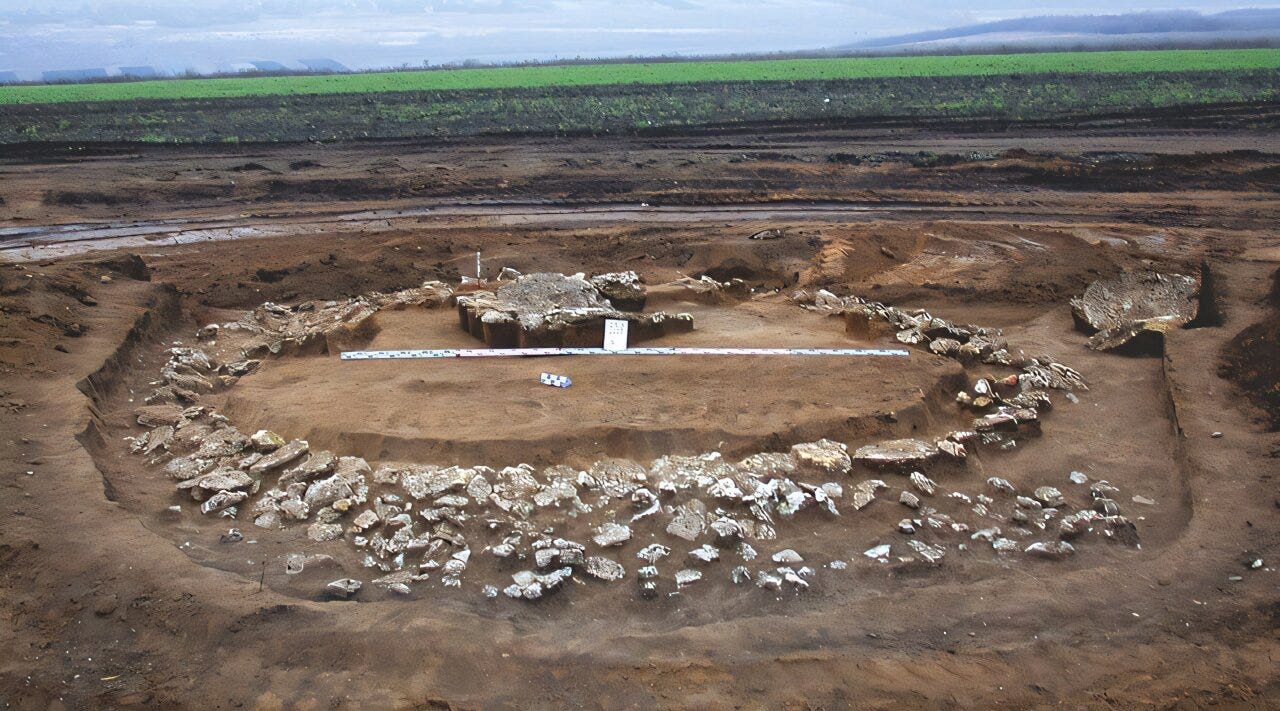
The result was not quite a tomb. The mound wasn’t built over the burial — it was already there when the burial happened. Researchers interpret1 this as a sanctuary first, a burial site second. Evidence of fires in the ditches resembles what we find at causewayed enclosures elsewhere, including Eneolithic enclosures scattered across the Pontic Steppe. Whatever this place was, it mattered to the people who made it.
Then several centuries passed. And someone else came.
The Yamna Knew What They Were Standing On
The Early Bronze Age Yamna culture — mobile pastoralists who would eventually contribute significantly to the genetic makeup of Copper and Bronze Age Europe — had a habit of burying their dead in the mounds of the people who came before them. This is well-documented enough to be a pattern rather than a coincidence. At sites across the region, Yamna people interred their dead inside pre-existing structures, modified rock art to fit their own worldview, and routinely destroyed or repurposed Eneolithic anthropomorphic stelae in their ritual practices.
Revova Kurgan 3 fits this pattern, but with an unusual level of precision. The Yamna burial at the center of the mound — burial 3, covered by two large stone slabs — was dug directly into the underlying Eneolithic layer. And the person who dug it was careful. The pit cut into the loam of the original mound without disturbing the adjacent Eneolithic burial 19. Two pits, separated by centuries, sitting side by side without touching.
That kind of precision is hard to explain as accident. The research team behind the new Antiquity study, led by Svitlana Ivanova and co-authored with Alexey Nikitin, Simon Radchenko, and Dmytro Kiosak, frames this as what they call a “continuity of sacred spaces” — a deliberate ritual reuse of a predecessor’s sacred site. Kiosak acknowledges the interpretive tightrope. A prominent hilltop with good sightlines could attract any number of unrelated groups across centuries. Landscape utility is always a plausible explanation. But the central placement of the new burial, in a mound that could have been built almost anywhere nearby, suggests something more intentional than convenience.
After burial 3, the Yamna kept using Revova 3. Three more burials were added at the edges of the same mound layer, dated to roughly 2885–2204 cal BCE. Then a new mound layer was added, containing burial 15. Then another layer with further Bronze Age burials. The site accumulated depth over nearly two millennia — 3711 to 1748 cal BCE, spanning four overlapping mound sequences — each generation adding its dead to the same patch of ground.
What the DNA Adds
The palaeogenetic data from burial 19, the earliest individual at Revova 3, introduces a complication to any clean narrative of discontinuity. Whole genome analysis shows that this Eneolithic individual carried Usatove ancestry, linking them to people buried at nearby sites like Mayaky and Usatove. That much is not surprising. What’s interesting is the genetic overlap between the Usatove and the Yamna: approximately half of Usatove genetic ancestry is shared with the Yamna gene pool originating in the Caucasus-Lower Volga area. The individual in burial 19 also carries a Y-chromosome lineage tracing back to the Near East highlands, while their mitochondrial DNA likely came from the local steppe — the same mtDNA lineage found in Yamna individuals in the northwestern Pontic.
None of this proves the Yamna people who reused Revova 3 were conscious of any genetic connection to whoever built it. But it does mean the genetic distance between the two groups was not as vast as earlier population models sometimes implied. The people are not neatly separate; the cultures were not hermetically sealed. The Yamna expansion out of the North Pontic Steppe was one of the most consequential demographic events of the prehistoric world — but it appears to have been more entangled with prior populations than the straightforward replacement model suggests.
The broader interpretive framework the authors propose connects this particular mound to a wider phenomenon. Yamna and Corded Ware groups, both steppe-derived, seem to have operated with a shared symbolic toolkit — what Ivanova and colleagues describe as a kind of “Steppe-originated religion” spreading across vast territories. For mobile pastoralists covering enormous distances, religion and ritual landscape probably served practical functions: marking territory, cementing communal identity, claiming belonging in places you couldn’t physically occupy at all times. Reusing someone else’s sacred mound is not just an act of appropriation — it’s a statement of continuity, whether that continuity was remembered, invented, or simply felt.
The kurgan at Revova 3 stands only 1.1 meters high. From it, a person could see 25 kilometers down the river valley. The Eneolithic people who built it chose that spot for reasons that were probably both practical and meaningful. The Yamna people who came after them chose the same spot. Whether they came because they knew something sacred had happened there, or because the landscape made it obvious, or because their own traditions pointed them toward mounds that already existed — the result was the same. A place that mattered to one group kept mattering, through cultures and centuries and significant genetic change, in ways the archaeology is only now making visible.
Future work could extend this picture. Ground-penetrating radar surveys of other kurgan groups in the region might reveal buried stone structures similar to those at Revova 3, suggesting the pattern of reuse was even more widespread. For now, that work is largely suspended. Fieldwork in Ukraine is severely restricted by the ongoing war, and the research project that supported this study has concluded. Kiosak mentions the possibility of continuing related work in Moldova with local colleagues, but funding and access remain open questions.
The mound is there. The layers are there. The questions are accumulating.
Further Reading
Nikitin, A.G. et al. 2025. A genomic history of the North Pontic Region from the Neolithic to the Bronze Age. Nature639: 124–31. https://doi.org/10.1038/s41586-024-08372-2
Lazaridis, I. et al. 2025. The genetic origin of the Indo-Europeans. Nature 639: 132–42. https://doi.org/10.1038/s41586-024-08531-5
Penske, S. et al. 2023. Early contact between late farming and pastoralist societies in southeastern Europe. Nature 620: 358–65. https://doi.org/10.1038/s41586-023-06334-8
Ahola, M. 2020. Creating a sense of belonging: religion and migration in the context of the 3rd millennium BC Corded Ware Complex in the eastern and northern Baltic Sea Region. Norwegian Archaeological Review 53: 114–34. https://doi.org/10.1080/00293652.2020.1852305
Radchenko, S. & Tuboltsev, O. 2019. Causewayed enclosures in Ukraine? A new look at an Early Bronze Age site on the Ukrainian Steppe. Antiquity 93. https://doi.org/10.15184/aqy.2019.53
Vierzig, A. 2020. Anthropomorphic stelae of the 4th and 3rd millennia between the Caucasus and the Atlantic Ocean. Proceedings of the Prehistoric Society 86: 111–37. https://doi.org/10.1017/ppr.2020.12
Rassamakin, Y.Y. 2012. Eneolithic burial mounds in the Black Sea Steppe: from the first burial symbols to monumental ritual architecture, in S. Muller-Celka (ed.) Ancestral Landscapes (Travaux de la Maison de l’Orient 58): 293–306. Lyon: Maison de l’Orient et la Méditerranée.
Ivanova, S. et al. 2005. Kurgany drevneishykh skotovodov mezhdurechia Iuzhnogo Buga i Dnestra [Kurgans of the ancient cattle breeders between the Southern Bug and Dniester rivers]. Odesa: Institute of Archaeology, National Academy of Sciences of Ukraine.
Ivanova, S., Nikitin, A.G., Radchenko, S. & Kiosak, D. 2026. The continuity of sacred spaces in the North Pontic Steppe: a case study of the Revova Kurgan 3 (Ukraine). Antiquity. https://doi.org/10.15184/aqy.2026.10292


