The full episode is only available to paid subscribers of Anthropology.net
A Tooth From a Different World
What a 200,000 year old Denisovan genome reveals about deep human entanglements
∙ Paid
The Cave That Keeps Speaking
Denisova Cave sits in the Altai Mountains of southern Siberia, an unassuming opening in limestone that has become one of the most important places in human evolutionary research. Over the past fifteen years, it has produced evidence of Neanderthals, Denisovans, and even a child whose parents came from both groups.
Now the cave has offered something rarer still. From a single tooth, researchers have reconstructed1 a Denisovan genome that is more than twice as old as any previously sequenced from this group.
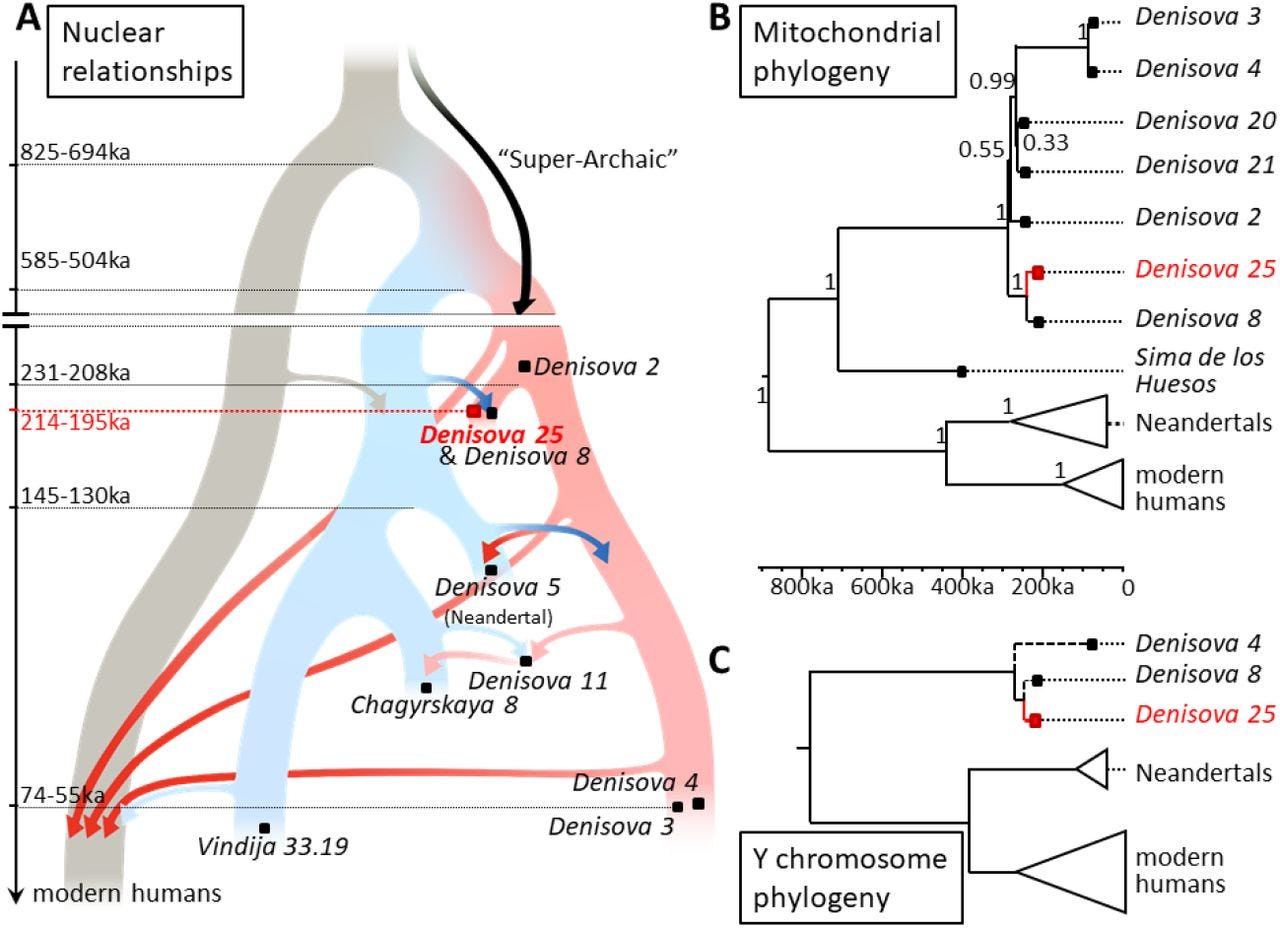
Relationships of Denisova 25 to archaic and modern humans. (A) Tree representing average population relationships inferred from nuclear genomes. Arrows indicate gene flow between populations, with darker arrows denoting those identified or examined in this study. Age estimates for high-coverage genomes are inferred from branch shortening (i.e., missing mutations in archaic genomes), with intervals corresponding to two standard deviations from the estimate as computed with a block jackknife. Population split time estimates are indicated by dotted lines. The split between the populations of Denisova 3 and Denisova 25 is estimated at 15,000 years (±2,000 years) before Denisova 25lived, adjusted for the uncertainty in the age of Denisova 25. Neandertal-Denisovan and modern-archaic split times correspond to the range of estimates obtained with calibrations of the divergence in genomic regions that presumably evolve neutrally. The split between the population of the Denisova 5 Neandertal and other Neandertals was previously estimated33. The tree is not to scale. (B) Bayesian phylogenetic tree of mitochondrial genomes of 7 Denisovans, 27 Neandertals, 64 modern humans and a hominin from Sima de los Huesos. The numbers at the nodes correspond to the posterior probabilities of the depicted branching orders. The Denisovan mitochondrial sequence of Denisova 19 is not included because it is identical to that of Denisova 218. (C) Bayesian phylogenetic tree of the Y chromosomes of 3 Denisovans, 2 Neandertals, and 32 modern humans. The Y chromosomes of Denisova 4 and Denisova 8 were excluded from the analysis due to the lower coverage available, but positioned on the tree based on the sharing of derived alleles with the Y chromosome of Denisova 25. The length of the branches for Denisova 4 and Denisova 8is inferred from the age of these individuals on the mitochondrial tree. The scale for the mitochondrial and Y chromosome phylogenies is indicated. Throughout the figure, Denisovans, Neandertals and modern humans are highlighted in light red, light blue, and light yellow, respectively.
The tooth, known as Denisova 25, belonged to a Denisovan man who lived around 200,000 years ago. At that time, Homo sapiens were still confined to Africa. Eurasia was a landscape shared by other kinds of humans.
As the authors write:
“Denisovans, an extinct human group, were first identified based on ancient DNA extracted from Denisova 3, a finger phalanx discovered at Denisova Cave in the Altai Mountains of Siberia.”
Until now, Denisova 3 was the only individual to yield a high quality genome. Denisova 25 changes that.
Continue reading this post for free, courtesy of Anthropology & Primatology.