
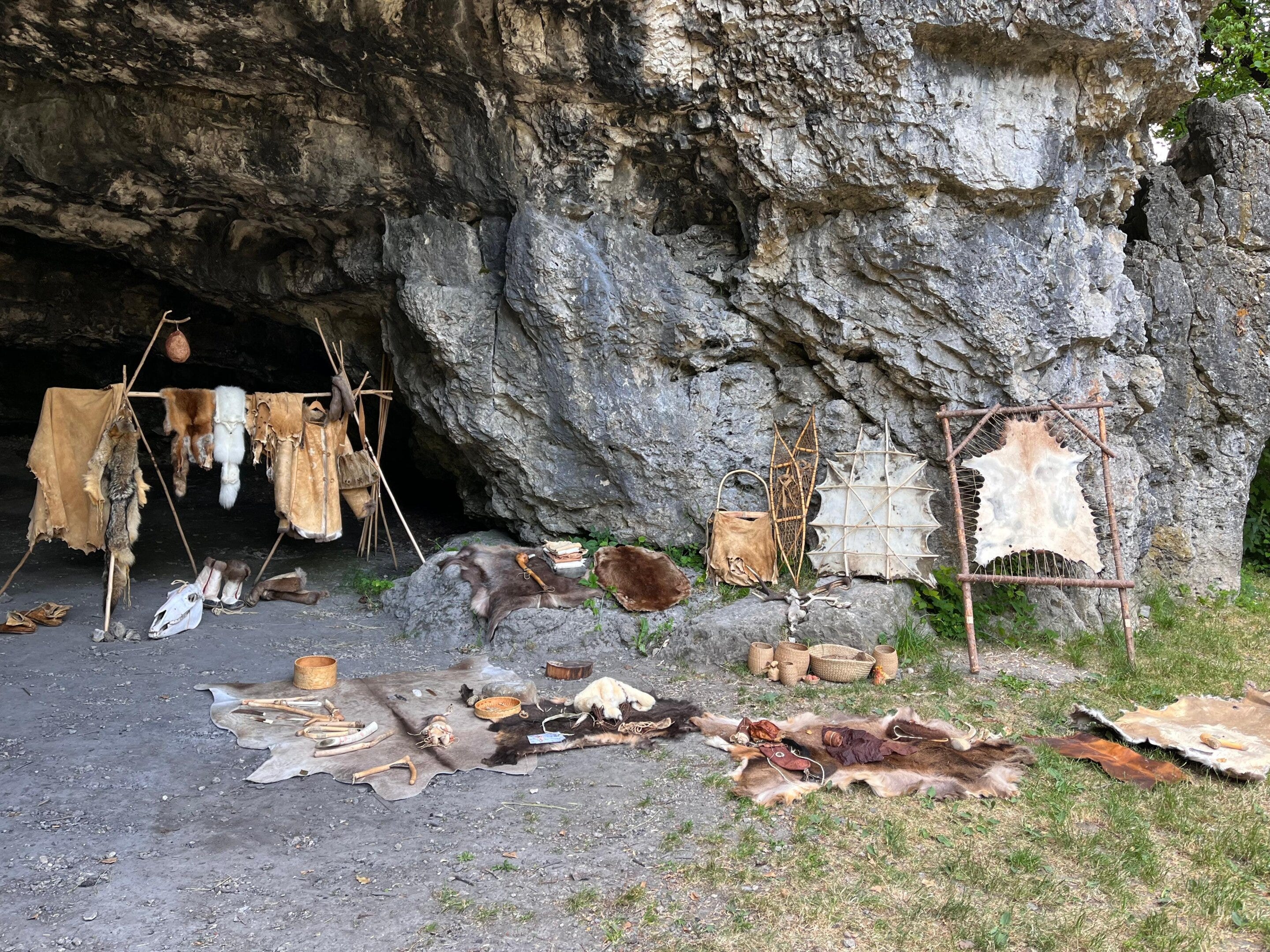
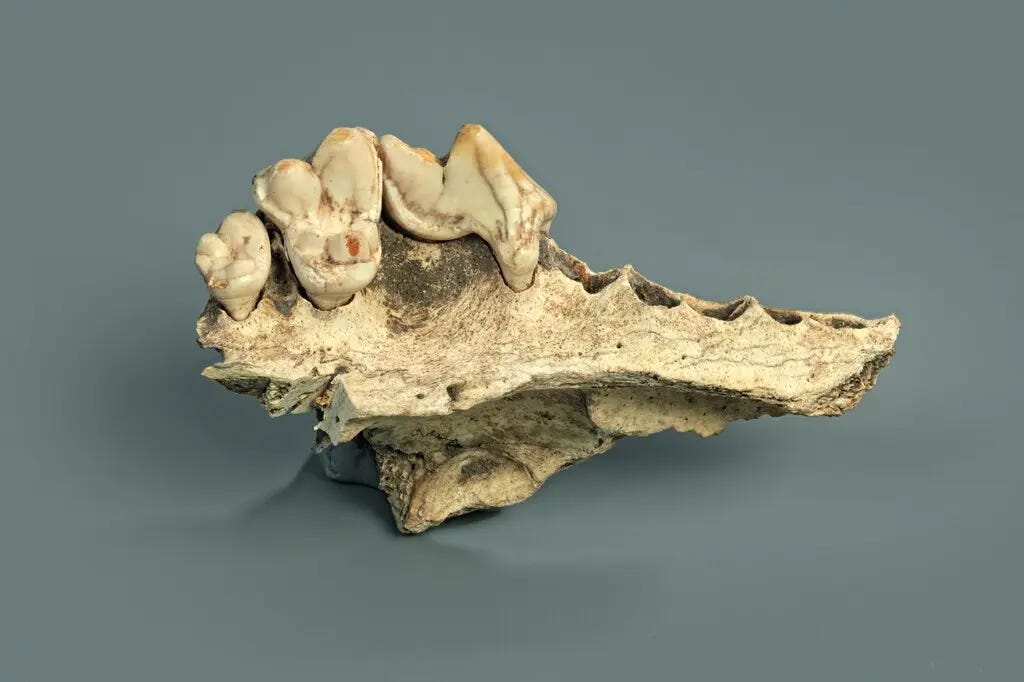
The caves of Ice Age Europe were not quiet places. People lived in them, killed animals inside them, made art on their walls, and sometimes processed their dead in them. At Gough’s Cave in Somerset, around 14,300 years ago, a group of humans associated with the Magdalenian technocomplex left behind something strange: human skulls reshaped into cups, human bones engraved, the clear signature of funerary cannibalism. Alongside those remains, among the same depositional layers, were the bones of a dog.
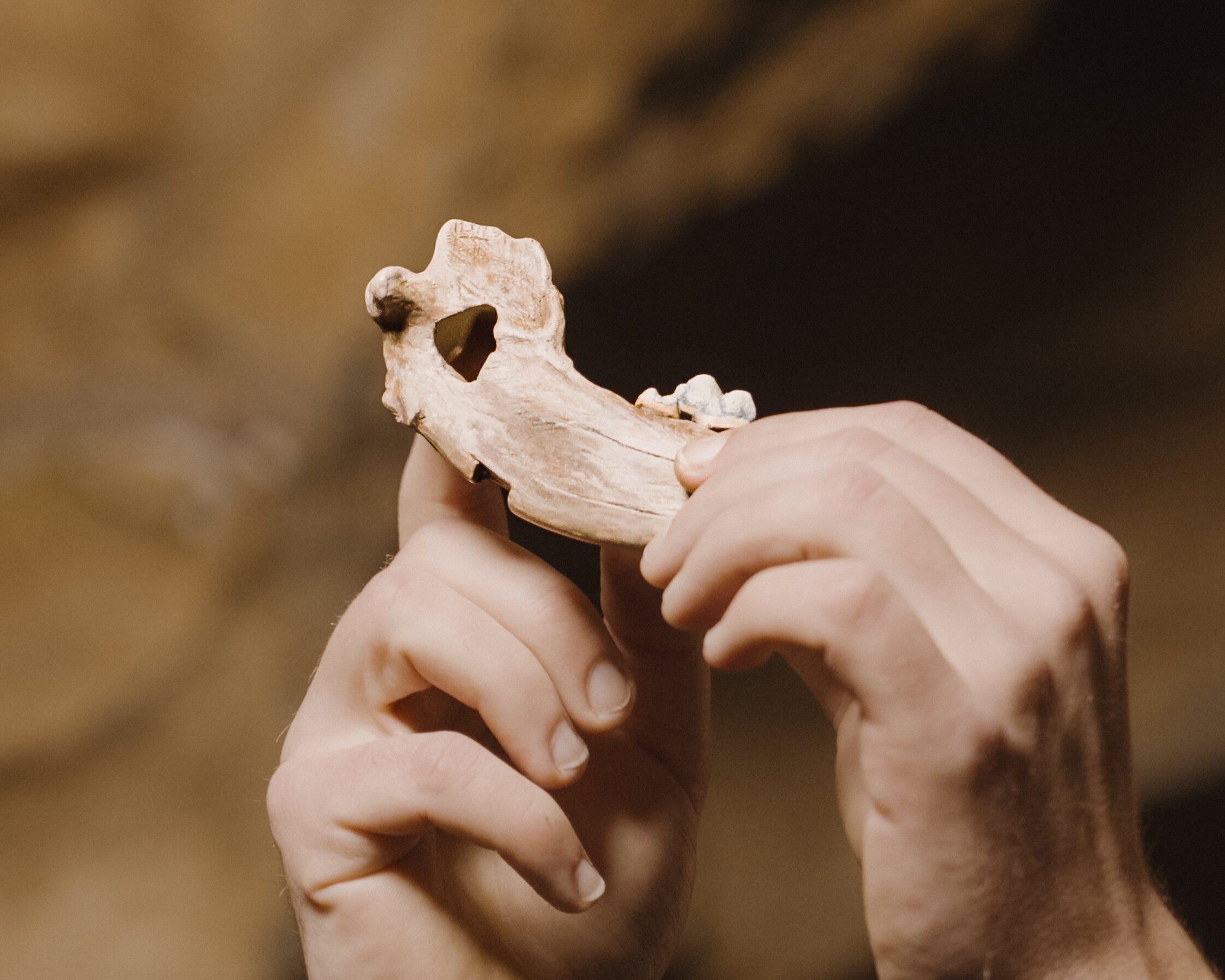
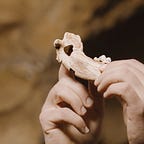
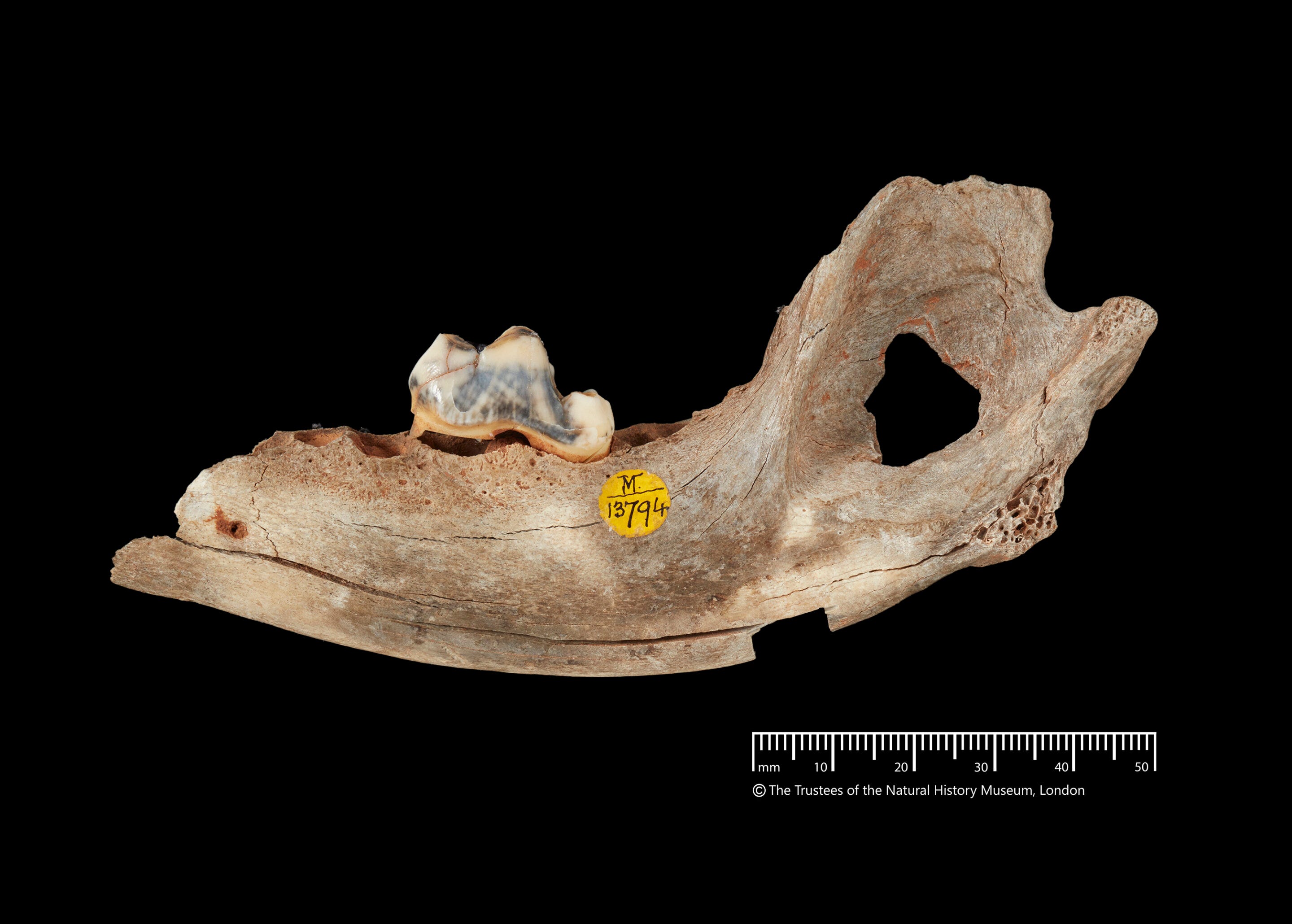
That dog’s mandible has a perforation drilled through the masseteric fossa. The same kind of postmortem anthropic modification visible on the human bones.
Whatever the precise meaning of that treatment, it says something about the relationship. These people were not keeping a wolf they had recently caught. The dog at Gough’s Cave, as confirmed by nuclear genomic data published this week in Nature, was a fully domesticated member of Canis lupus familiaris, genetically closer to a dog from central Anatolia than to any wolf living in late glacial Europe.
The oldest dogs, confirmed by genome
Two companion papers appeared simultaneously in Nature1 2 on March 25, 2026, both addressing the same problem from different directions: when did dogs first appear in Europe, and how do we actually know?
The problem with earlier attempts to answer that question is that bones lie, or at least they mislead. Wolf morphology and early dog morphology overlap in ways that make confident separation difficult, especially for remains from 14,000 to 17,000 years ago when dogs were fresh out of the wolf lineage and may not yet have accumulated the skeletal changes we now associate with domestication. Previous claims for Paleolithic dogs in Belgium, the Czech Republic, and Siberia — some dated to 33,000 years ago or older — have repeatedly failed under genetic scrutiny. The animals turned out to be wolves, some of them from extinct lineages.
The oldest definitive dog DNA, before these studies, dated to about 10,900 years ago from the Mesolithic site of Veretye in Karelia. That was the floor. The new papers blow through it.
One team, led by researchers at the Natural History Museum London, Ludwig Maximilian University Munich, and the University of Oxford, generated nuclear and mitochondrial genomes from canid remains at Pınarbaşı in central Anatolia (15,800 years old) and Gough’s Cave (14,300 years old). The other team, led by researchers at the Francis Crick Institute, the University of East Anglia, and the Max Planck Institute for Evolutionary Anthropology, analyzed DNA from 216 canid skeletal remains — 181 from pre-Neolithic contexts — across Europe and its margins, using a hybridization capture approach that enriched endogenous canid DNA by 10 to 100-fold from material where less than 1% of the total DNA was even host-derived.
Together they confirmed dogs at five sites spanning from Britain to Turkey during the late Upper Paleolithic: Pınarbaşı, Gough’s Cave, Bonn-Oberkassel in Germany, Kesslerloch in Switzerland, and Grotta Paglicci in Italy. The Kesslerloch dog, which had been proposed as a dog on morphological grounds in earlier work and dates to 14,200 years ago, was confirmed genetically by the Crick-led team. It is the oldest dog in their dataset confirmed by genome-wide analysis.
The 13,700-year-old canid from Goyet cave in Belgium, by contrast, had long been considered a probable dog. Small size, traces of human modification, red-colored stains. The genetic data says wolf.
This is not a minor methodological caveat. It goes to the heart of how the field has been working and how often it has been wrong.
A single population, spread across cultures
Here is where it gets strange. The five confirmed Paleolithic dogs are associated with three genetically and culturally distinct human populations: the Magdalenian (Gough’s Cave), the Epigravettian (Bonn-Oberkassel, Kesslerloch, Grotta Paglicci), and Anatolian hunter-gatherers (Pınarbaşı). These groups had diverged long before the dogs appear in the record. The Magdalenian and Epigravettian splits probably predate the Last Glacial Maximum, around 24,000 to 21,000 years ago.
The dogs don’t reflect this divergence. Dogs from Gough’s Cave and Pınarbaşı are more genetically similar to each other than to any other dog in the dataset. Their most recent common ancestor is estimated at roughly 16,900 years ago — which means their ancestral population was already diverging from other dog populations well before either of these individual animals was born. They cluster together in a distinct mitochondrial clade, C5, a sister group to all other C haplogroup dogs, that also includes Bonn-Oberkassel, Kesslerloch, and Grotta Paglicci.
Greger Larson, a paleogeneticist at Oxford and an author on both studies, framed the oddity directly in a press context: the people are very different, but the dogs are very much the same. Across the five sites, the dogs were more genetically similar to each other than the humans at the same sites were to each other.
One interpretation, favored by the Marsh et al. team, is that dogs spread westward with the expansion of Epigravettian-associated ancestry and material culture roughly 16,000 years ago, and people carrying Magdalenian ancestry in Britain and perhaps Spain acquired dogs through interactions with Epigravettians — without that interaction leaving any detectable trace of Epigravettian ancestry in the Magdalenian humans. The dog was exchanged; the genes were not.
Whether Magdalenian people at Gough’s Cave acquired their dog from Epigravettians or through some other network remains genuinely open. The paucity of Paleolithic dog remains makes the data thin. But the pattern is real: a relatively genetically homogeneous dog population spread across populations of people who were quite distinct from one another. Greger Larson compared it to the spread of a new technology or art form — something people found useful and interesting enough to pass around.
Where the dogs came from, and what they were not
The larger question of dog domestication — where, when, by whom — remains unsettled. These papers narrow parts of it without resolving the whole.
The Kesslerloch dog, at 14,200 years old, already shows more genetic affinity to later European dogs than to Asian dogs. Population structure in dogs, the data suggest, is at least 14,200 years old. For that differentiation to have already been in place by then, domestication must have occurred considerably earlier. The authors reason, cautiously, that domestication likely predates Kesslerloch by several millennia, to allow enough time for the genetic gap between European and Asian dogs to have opened up.
On the question of which wolves were involved, both papers point away from European wolves. The Bergström et al. analysis finds that all the pre-Neolithic European dogs in their dataset are consistent with deriving from an eastern progenitor, the same source population that produced dogs in Siberia, East Asia, and Australasia. European Late Glacial wolves — the wolves that actually lived alongside these dogs — contributed detectably to dog ancestry in none of them. This is not new, but the Kesslerloch confirmation extends the result back several thousand years.
One canid from Belgium that illustrates this point neatly: the Goyet cave specimen, genetically a wolf, has fully wolf-like ancestry. Its small size and human modifications were real, but those features, it turns out, don’t tell you what you think they do. A wolf can be small. A wolf can be associated with humans in ways that leave marks on bone. That doesn’t make it a dog.
At the same time, the dogs at Gough’s Cave showed similar dietary stable isotope signatures to the humans there, consistent with the dogs eating what the people were eating, or at least food from the same trophic level. At Pınarbaşı, the isotope data for neonatal dogs and their mothers suggests an aquatic dietary component that matches the human diet at the site, where small freshwater fish are common in the occupied layers. The dogs were being provisioned. They were inside the system, not just following it from a distance.
What farming did, and didn’t do, to European dogs
The other major finding concerns what happened when agriculture arrived in Europe, roughly 9,000 years ago, carried by people migrating from Southwest Asia.
In humans, the Neolithic transition in Europe involved a near-complete replacement of hunter-gatherer ancestry in many regions. Neolithic farmers typically had 70 to 80 percent Southwest Asian ancestry. Ancient DNA from these farmers shows they arrived with their own animals — sheep, goats, cattle, pigs — and largely displaced the wild progenitors of those animals in Europe.
Dogs were the only domestic animal already present in Europe before farming arrived. The question was whether they experienced the same kind of replacement.
They did not. The Bergström et al. analysis, using formal ancestry modeling, shows that Southwest Asian dog ancestry did enter Europe with Neolithic farmers — but at much lower proportions than in the humans. Neolithic dogs in Scotland showed 21 to 25 percent Southwest Asian ancestry. Dogs in southern Europe showed higher values, up to 66 percent in Greece. But the local Mesolithic dogs persisted in the gene pool, and they persist there still. Modern European dogs fall roughly halfway between Mesolithic European and Neolithic Southwest Asian dogs in ancestry cline analyses, which implies they trace approximately half their ancestry to the pre-agricultural dogs of Europe.
The contrast with what happened to dogs when Europeans arrived in the Americas is stark. In the Americas, European dogs rapidly and almost completely replaced the pre-contact native American dog population. The Neolithic transition in Europe was softer. Incoming farmers incorporated local hunter-gatherer dogs to a substantial degree, rather than replacing them.
One plausible reading is that hunter-gatherer dogs and farmer dogs were doing overlapping jobs, or at minimum that the social relationships between arriving farmers and existing populations allowed for the mixing of dog populations in ways that colonial-era encounters did not. The genetic data can’t tell you which, but the pattern is clear enough.
The Marsh et al. paper adds another layer: eastern Eurasian dog ancestry also entered Europe during the Mesolithic, not just during the later Bronze Age steppe migrations as had been proposed. Balkan Mesolithic dogs from the Iron Gates sites in Serbia (Padina and Vlasac) and from Veretye in northwest Russia carried substantial eastern Eurasian dog ancestry — around 44 percent on average. Human genomes from the same contexts show those people also carried eastern hunter-gatherer ancestry. The dogs followed the people east to west, it seems, just as they had crossed western Eurasia at an earlier moment.
This eastern component persisted. Roughly 30 percent eastern Eurasian dog ancestry is present in Neolithic dogs, 33 percent in the Bronze Age, around 20 percent in medieval and modern breed dogs. The fundamental ancestry architecture of European dogs — a mix of western and eastern Eurasian lineages — was in place by at least 10,900 years ago and has not been fully erased since.
The question of exactly where dogs first emerged, and from which human group, the data cannot yet answer. The Kesslerloch dog’s genomic profile is divergent enough that it sits off the main cline of global dog diversity in some analyses — more distantly related to later Eurasian dogs than the Mesolithic Scandinavian dogs are. Whether that reflects a basal position in dog phylogeny, or admixture from some earlier dog lineage, or something else, requires more sampling from the gap between 14,000 and 10,000 years ago that currently has almost no coverage. Anders Bergström, the first author of the Crick-led paper, put it plainly: we’re still trying to find out where dogs come from and who were the people who first built this bond.
Further Reading
Bergström, A. et al. Grey wolf genomic history reveals a dual ancestry of dogs. Nature 607, 313–320 (2022).
Bergström, A. et al. Origins and genetic legacy of prehistoric dogs. Science 370, 557–564 (2020).
Feuerborn, T.R. et al. Modern Siberian dog ancestry was shaped by several thousand years of Eurasian-wide trade and human dispersal. Proceedings of the National Academy of Sciences 118, e2100338118 (2021).
Posth, C. et al. Palaeogenomics of Upper Palaeolithic to Neolithic European hunter-gatherers. Nature 615, 117–126 (2023).
Janssens, L. et al. A new look at an old dog: Bonn-Oberkassel reconsidered. Journal of Archaeological Science 92, 126–138 (2018).
Sinding, M.-H.S. et al. Arctic-adapted dogs emerged at the Pleistocene-Holocene transition. Science 368, 1495–1499 (2020). Botigué, L.R. et al. Ancient European dog genomes reveal continuity since the Early Neolithic. Nature Communications8, 16082 (2017).
Charlton, S. et al. Dual ancestries and ecologies of the Late Glacial Palaeolithic in Britain. Nature Ecology & Evolution 6, 1658–1668 (2022).
Bello, S.M. et al. Upper Palaeolithic ritualistic cannibalism at Gough’s Cave (Somerset, UK): the human remains from head to toe. Journal of Human Evolution 82, 170–189 (2015).
Bergström, A. et al. Genomic history of early dogs in Europe. Nature 651, 986–994 (2026). DOI: 10.1038/s41586-026-10112-7
Marsh, W.A. et al. Dogs were widely distributed across western Eurasia during the Palaeolithic. Nature 651, 995–1003 (2026). DOI: 10.1038/s41586-026-10170-x


