

On a panel deep inside the cave of Lumentxa, two bison face left. A few feet away, a horse head turns right. This is not a coincidence of who happened to be standing where sixteen thousand years ago. It is, according to a new statistical analysis of nine Basque Magdalenian caves, part of a pattern so consistent it shows up across an entire regional tradition.
Iñaki Intxaurbe, a researcher affiliated with the University of the Basque Country and the University of Bordeaux, built1 a dataset of 500 painted and engraved figures drawn from Santimamiñe, Lumentxa, Atxurra, Ekain, Altxerri, Aitzbitarte IV, Aitzbitarte V, Alkerdi 1, and Etxeberri, sites strung along the Bay of Biscay corridor that links the Iberian Peninsula to the rest of continental Europe. Rather than asking what the animals meant, he asked something narrower and, it turns out, more answerable: do they cluster together in predictable ways, and do they face in predictable directions? He treated the corpus the way a linguist might treat a body of text in an unknown grammar, building co-occurrence networks that track which motifs keep showing up together on the same painted surfaces, or “panels,” and running those networks through community detection, minimum spanning trees, and chi-square tests for orientation and inclination.
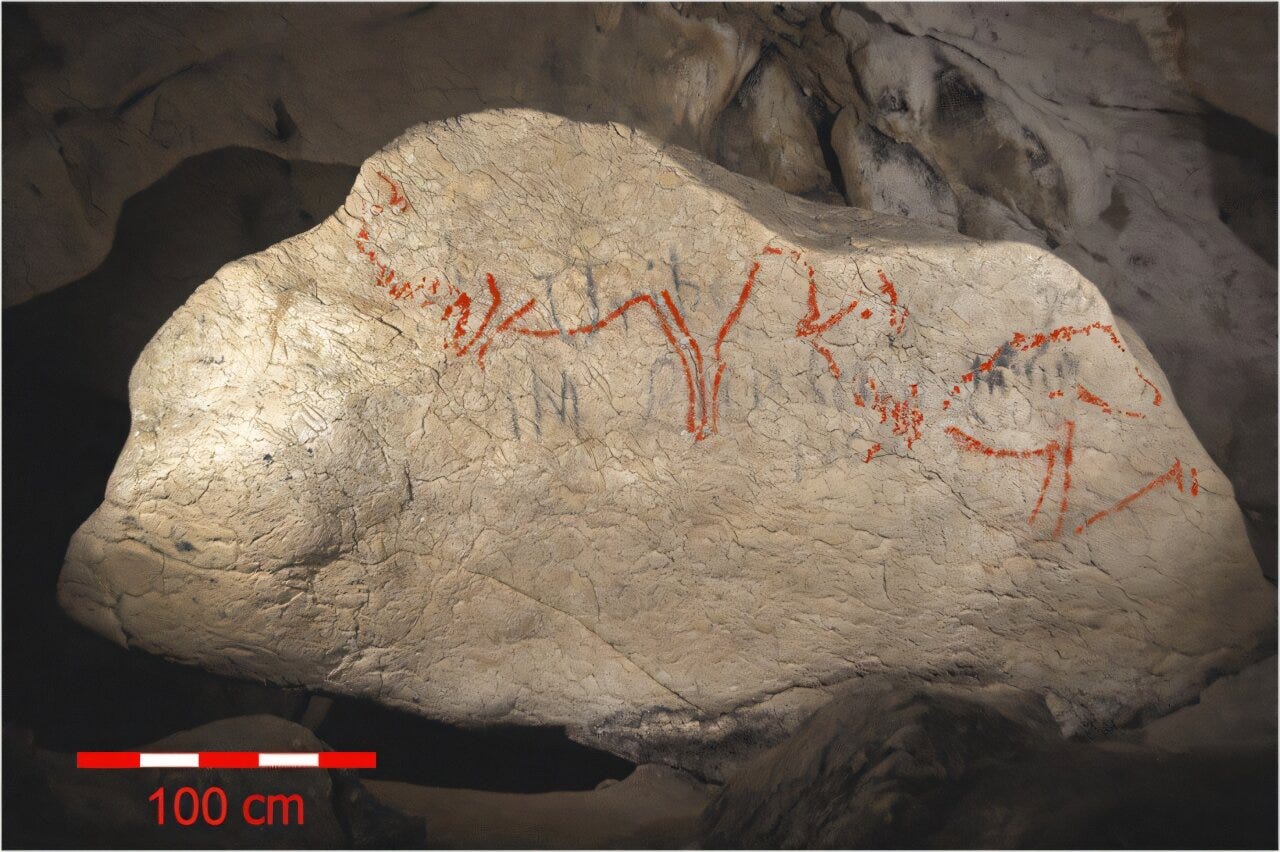
The results converge on something structural. Bison, horse, and ibex behave as compositional hubs, forming a dense, interconnected core that other motifs orbit rather than join as equals. Deer, hind, and reindeer form a looser secondary cluster tethered to that core. Fish, birds, and non-figurative signs sit further out still, contributing to compositions without organizing them. When Intxaurbe strips the network down to a minimum spanning tree, removing the redundant connections to expose the skeleton of the system, bison rises to the top as the single most structurally dominant node, with ibex and horse branching off it in turn.
The orientation data is where the pattern gets genuinely strange. Bison and ibex face left more often than chance would predict. Horses face right. A chi-square test across the whole corpus confirms that theme and orientation are not independent (p = 0.016), and the effect holds up, though more weakly at the level of individual species, even after correcting for multiple comparisons. Horses also tend to lie horizontally on the cave wall, while bison show up more often in inclined or vertical positions, and anthropomorphic figures cluster strongly toward vertical arrangement. None of this reads as decorative variation. It reads as a set of conventions applied with enough consistency that a computer running blind statistical tests, with no knowledge of what a bison or a horse is supposed to symbolize, can detect it from the numbers alone.


