

A Monument Beneath the Monuments
The plains surrounding Stonehenge are often treated as an old story. A place so thoroughly investigated that only incremental refinements remain. Yet the landscape continues to alter its own narrative, especially when new technologies force archaeologists to widen their expectations.
The latest revision comes in the form of a massive ring of deep, wide pits arranged around Durrington Walls, a monument already notable for its scale. What began as curious geophysical anomalies has now solidified into one of the most ambitious examples of Neolithic landscape engineering in Britain.
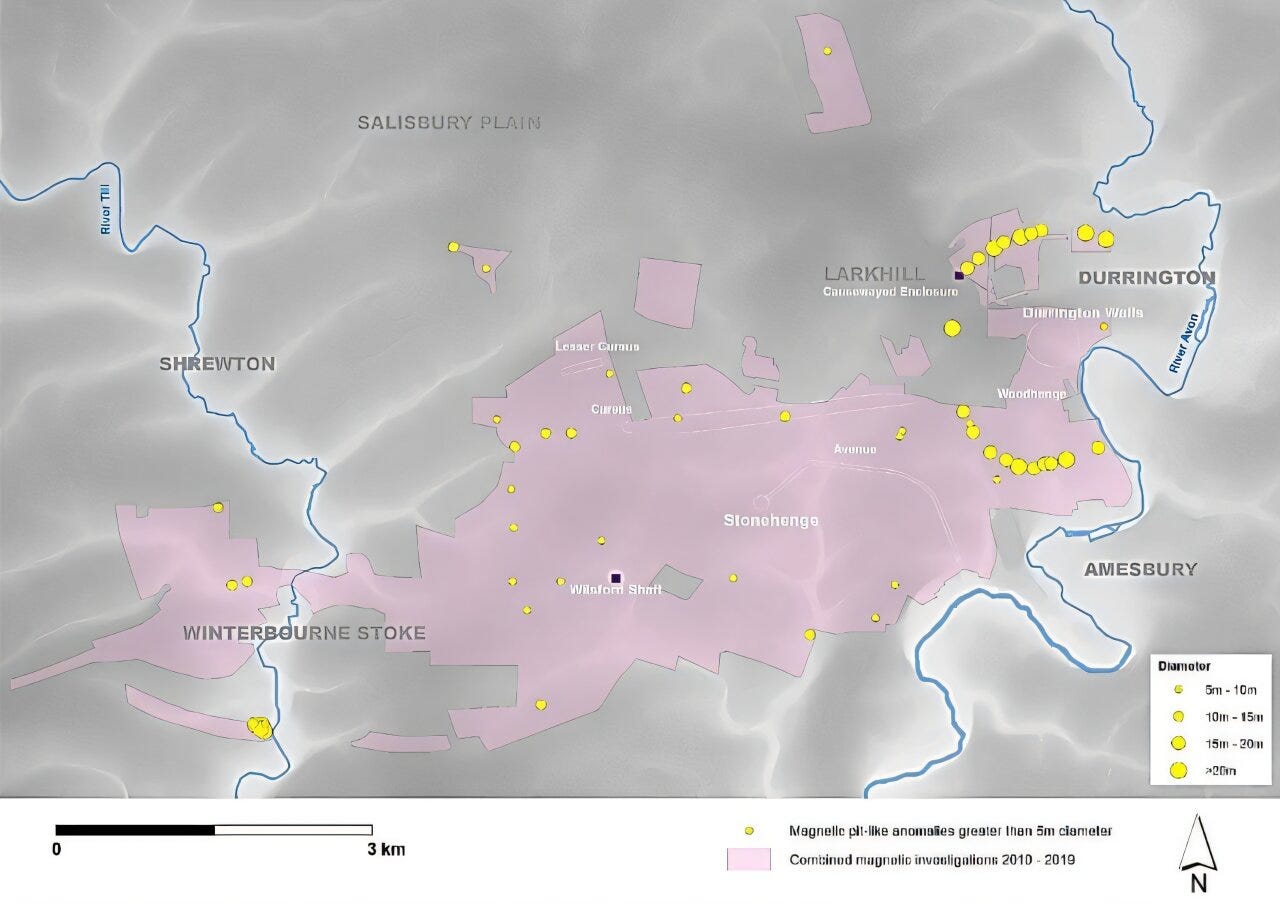
A team led by the University of Bradford, working with collaborators across the United Kingdom and beyond, has spent the last four years confirming the reality of this structure. Their findings, published in Internet Archaeology,1 argue that the pit ring is neither geological trickery nor an accidental cluster of depressions. It is a planned construction, dug within a narrow window of time, and positioned with startling precision.
“The architecture of these pits demonstrates an understanding of space that operated at a landscape scale rather than simply around a monument,” says Dr. Helena Rourke, a landscape archaeologist at the University of Exeter.
In other words, the pits matter not because they lie near Durrington Walls, but because they change how we understand the perimeter of ceremonial life in the late Neolithic.
Animation of ERT profiles across 7A, 5A, 4A, 3A and 2A. Backdrop © Google Earth. Credit: Internet Archaeology (2025). DOI: 10.11141/ia.69.19


