
There’s a stretch of your genome that’s almost entirely free of Neanderthal DNA. Not just sparse — nearly empty. The X chromosome, in person after person, population after population, looks like something scrubbed it clean of whatever contributions our Neanderthal relatives might have made. Geneticists have known about this for years. They called the gaps “Neanderthal deserts,” and most assumed the explanation was straightforward: natural selection. The Neanderthal variants that ended up on the X chromosome were probably harmful, so they got weeded out over generations. Case closed.
It wasn’t closed.
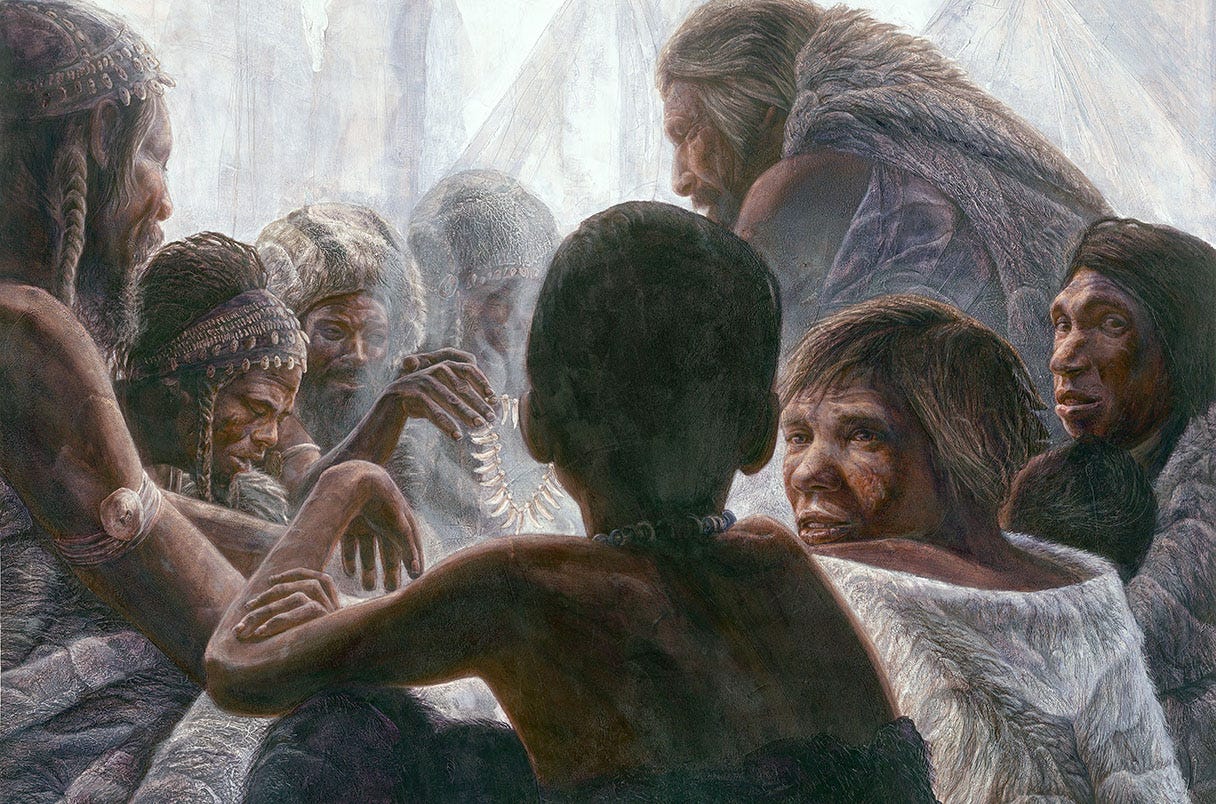
A paper published in Science1 on February 26, 2026, by Alexander Platt, Daniel Harris, and Sarah Tishkoff at the University of Pennsylvania has reopened the question — and the answer they’ve arrived at is stranger and more interesting than genetic incompatibility. The Neanderthal desert on our X chromosome, they argue, wasn’t created by bad genes. It was created by who was sleeping with whom.
To understand why this matters, you need to know one thing about sex chromosomes and inheritance. Females carry two X chromosomes; males carry one X and one Y. A father can pass his X chromosome to daughters only — never to sons. A mother always passes an X chromosome, to daughters and sons alike. This asymmetry means that when two populations interbreed, the direction of the mating matters enormously for what ends up in the X chromosome pool. If the males doing the reproducing across groups come from one population and the females from another, the X chromosomes of each group will reflect that imbalance in a predictable, traceable way.
The team’s insight was to look at the problem from both ends. The Neanderthal DNA present in modern human genomes had been studied extensively. But Platt and his colleagues realized this was only half the picture. The other half — the modern human DNA that made its way into Neanderthal genomes — had received much less attention. If you could look at both sides of the exchange, you might be able to determine which direction it mostly flowed.
What the Neanderthal Chromosomes Actually Show
Three high-quality Neanderthal genomes exist: specimens from the Altai Mountains in Siberia, from Chagyrskaya Cave, and from Vindija Cave in Croatia. These individuals lived at different times, ranging from roughly 122,000 to 52,000 years ago. All of them contain traces of earlier contact with Homo sapiens, the result of an interbreeding event that the researchers estimate occurred around 250,000 years ago — well before the better-known episode roughly 46,000 to 50,000 years ago that left Neanderthal DNA in the genomes of people alive today.
When the team examined the autosomes — the 22 pairs of non-sex chromosomes — of these three Neanderthals, they found modern human DNA scattered across them, as expected. Then they looked at the X chromosomes. And what they found inverted every assumption.
The Neanderthal X chromosomes didn’t have less modern human DNA. They had significantly more. About 62% more, relative to the autosomes. Where modern humans had a Neanderthal desert on their X chromosomes, Neanderthals had the opposite: a modern human surplus.
This is the kind of mirror-image pattern that makes a hypothesis snap into focus. If the explanation for the depletion in modern humans were purely genetic toxicity — Neanderthal variants causing harm and getting selected against — then the same logic should apply in reverse. Harmful modern human variants on the Neanderthal X should also have been purged. But they weren’t. They were overrepresented. Whatever drove the pattern, it wasn’t simply bad genes on the X chromosome making hybrid offspring less fit.
The team then ran simulations to test alternative explanations. Could the surplus have resulted from biased migration — say, if the Homo sapiens groups that moved into Neanderthal territory were mostly female? Even in the most extreme version of that scenario, with an entirely female migrant group, the math only produced a 1.3-fold excess of modern human DNA on the Neanderthal X. The observed excess was 1.6-fold. Something more was needed.
What fit best was a mating preference. Specifically: Neanderthal males disproportionately mating with modern human females, and their offspring being preferred as partners in subsequent generations as well. The bias wasn’t a one-time event. It appears to have been persistent, operating across multiple generations, possibly across both of the major interbreeding episodes separated by roughly 200,000 years.
“You need a strikingly strong phenomenon to get us there,” Platt told the New York Times.
The team also checked whether the modern human DNA enriched on Neanderthal X chromosomes might be there because it conferred some advantage — i.e., whether this was positive selection for good modern human variants rather than a signature of mating patterns. The sequences in question turned out to have lower-than-average concentrations of functional elements: protein-coding regions, regulatory sequences, that sort of thing. That doesn’t rule out selection as a partial factor, but it does make a purely adaptive story less convincing.
Mate preference, the team concluded, was the most parsimonious explanation.
What We Can’t Know From Here
The finding raises a question that the genetics cannot answer: why?
The study doesn’t resolve whether the preference was mutual, one-sided, or coerced. Sarah Tishkoff has said the team deliberately didn’t speculate about consent. Steven Churchill, a paleoanthropologist at Duke University who wasn’t involved in the research, was less restrained. If males from one species systematically paired with females from another to this degree, he told Science, it’s hard to square that with anything other than competitive, unfriendly interaction between the groups.
April Nowell, a paleoanthropologist at the University of Victoria, pushed back on that framing. There’s no archaeological evidence of violence between human groups at the relevant time periods, she noted. And from the perspective of evolutionary biology, females are typically the more selective sex in mate choice. It’s at least as plausible that Homo sapiens women were choosing Neanderthal partners as that they were being taken by force.
Benjamin Peter at the Max Planck Institute for Evolutionary Anthropology praised the analysis while flagging a technical concern: the observed pattern on the X chromosome might, in principle, be an artifact of the statistical methods used. He’s also pointed out that the interbreeding event the study modeled directly — 250,000 years ago — predates the episode that actually left Neanderthal DNA in people living today. Whether the same mating bias held during both episodes is an inference, not a direct observation.
Rebecca Wragg Sykes, an archaeologist at the University of Cambridge, noted that the fossil and archaeological record from 250,000 years ago is too sparse to offer independent corroboration.
“We still do not have a cultural signature for a hybrid social population,” she said.
A skeleton in the right place, or ancient DNA from a previously unstudied site, could change the picture significantly.
What we’re left with is a pattern in the genome that points clearly toward sex-biased interbreeding and toward mate preference as the likeliest cause. It’s an answer that’s also a door. It opens onto questions about Neanderthal social structure — who stayed, who moved, who chose whom — that the researchers are already beginning to investigate by looking at the ratio of X chromosome diversity to autosomal diversity in Neanderthal populations. That ratio can hint at whether females or males were the ones dispersing between groups, which has its own implications for how Neanderthal societies were organized.
The genome, read carefully enough, turns out to hold not just a record of biology but something closer to a social history. What Homo sapiens and Neanderthals did when they met — who approached whom, whose children stayed, whose left — left traces that are still legible today, embedded in the DNA of everyone reading this.
Platt, A., Harris, D.N., & Tishkoff, S.A. (2026). Interbreeding between Neanderthals and modern humans was strongly sex biased. Science, 391(6788). DOI: 10.1126/science.aea6774


