
When French Catholic missionaries arrived in the Mangareva Islands in 1834, they came with tools, building expertise, and an agenda. Within a few years, the frères bâtisseurs — lay builder-brothers attached to the mission — had transformed the volcanic archipelago at the southeastern edge of French Polynesia. They raised a massive cathedral in Rikitea, the main village. They put up churches on the neighboring islands of Aukena, Akamaru, and Taravai. Schools, a dormitory, a workshop for the weaver-brothers, communal bread ovens, a royal palace for the converted chief Maputeoa, and a watch tower along the coast. The missionaries were thorough record-keepers and left detailed documentation of everything they built.
They wrote almost nothing about the homes their converts lived in.
Those homes still exist, or what’s left of them does. Across four islands, 69 ruined stone cottages survive in varying states of collapse, their walls made from blocks of coral cut out of the surrounding reef. Known in Mangarevan as ‘are po’atu, they account for more than half of all the colonial-era structures archaeologists have recorded in the islands. The missionaries taught local people to build this way — Polynesian converts learning European masonry techniques, cutting Acropora branch coral from near-shore reefs and from beach rock formations on the motu, the narrow coral islets that fringe the lagoon. The technique spread. The construction materials were local. The buildings were everywhere. And European sources, predictably, were mostly silent about who built them and when.
The problem with recovering that history is partly chronological. Radiocarbon dating, the default method for establishing age in archaeological contexts, becomes unreliable for organic materials less than about 400 years old. The Mangarevan cottages were built mostly in the 1830s to 1860s. Radiocarbon can’t resolve that timeframe with useful precision. Dating by artifact typology is possible — imported ceramics and glassware have known production date ranges — but this requires excavation, adds interpretive noise, and still only narrows things down to multi-decade spans.
Coral is a different material. A new study by James Flexner of the University of Sydney, published in Antiquity,1 demonstrates that uranium-thorium (U-Th) dating can be applied directly to the coral blocks in the walls of these buildings, producing construction dates accurate to within a few years.
How the Method Works, and Where It Gets Complicated
Coral skeletons incorporate uranium from seawater as they grow. Once the coral dies, uranium slowly decays to thorium. Because fresh coral contains essentially no thorium at death, the ratio of uranium to thorium in a sample is a measure of time elapsed since death. For the past 500 years or so, lower concentrations of decay products make this technically demanding, but it works if samples are carefully selected and processed under ultra-clean conditions. Flexner had 10 branch coral samples analyzed at the University of Queensland Radiogenic Isotope Facility.
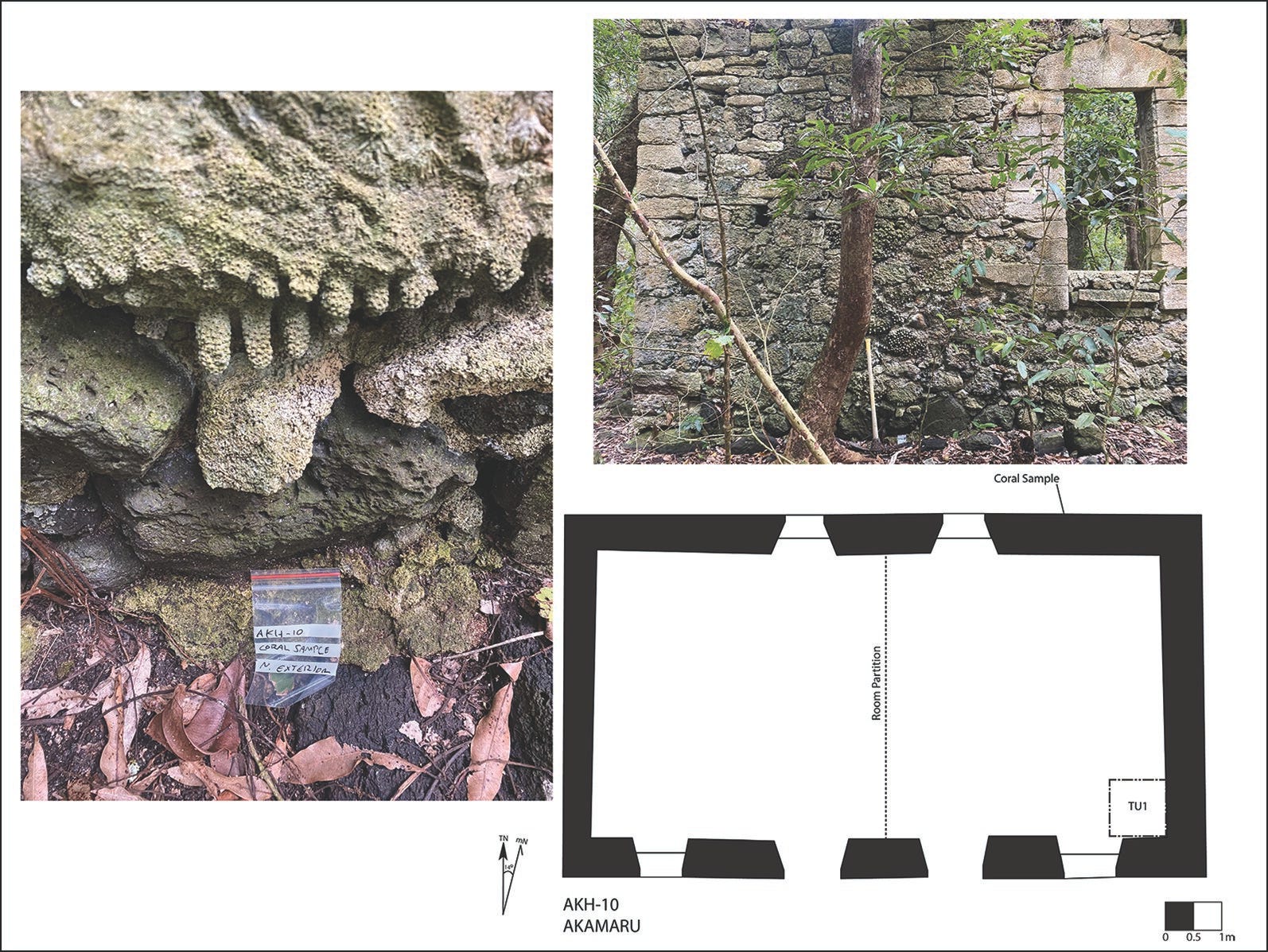
The samples came from unweathered or minimally weathered branch corals embedded in Acropora sp. limestone blocks — either pulled from walls still standing or recovered from blocks that had clearly fallen from adjacent ruins. This is important: heavily weathered coral becomes chemically compromised, and a few of the samples in this study illustrate what that looks like. The watch tower at Mata-Kuiti point returned a date predating European contact with Mangareva by half a century. The sample was notably weathered. The boys’ school at Aukena — the Collège d’Anaotiki, whose construction dates are known from missionary documents as 1853 to 1858 CE — returned 1831 ± 2 CE from a more weathered sample where better material wasn’t accessible.
So sample quality matters. But the more interesting complication lies in what the dates actually measure. U-Th dating on coral tells you when the coral died, not when it was placed in a wall. There can be a gap. Coral harvested from the seaward edge of a living reef would have died shortly before it was cut and used. But builders also drew material from the shoreward limestone, where coral might have been dead for years or decades before it was quarried. Some blocks may have been reused from older structures — the archaeological literature on Mangareva has long suggested that pre-contact sacred sites called marae were cannibalized for building material during the missionary construction period.
Flexner’s team treats this as analogous to the “old wood” problem in radiocarbon dating of timber buildings: the tree whose ring you’re dating may have died long before it was incorporated into a structure. The U-Th date is best understood as a terminus post quem — a “no earlier than” marker — rather than a direct construction date. The building can’t be older than the coral in its walls; it can only be the same age or younger.
With those caveats in place, the dates from the seven undated Polynesian cottages are coherent and informative. Most cluster in the first decade or so of missionary presence: AKH-7 at 1834 ± 3, AKH-10 at 1840 ± 3, AKH-1 at 1841 ± 2, AKH-35 at 1844 ± 2, AKH-20 at 1846 ± 2. One outlier, AKH-11, returned a pre-contact date of 1779 ± 2, which Flexner interprets as probable reuse of coral from a pre-European structure — possibly a marae. The gap between that date and the known period of cottage construction is decades long, but not centuries. No sample showed the kind of age gap that would suggest systematic large-scale looting of ancient reef formations. The reuse, where it occurred, was modest.
The Pit Beneath the House
The most vivid result in the study involves a house on Akamaru called AKH-20 and a pit feature found beneath its floor.
When excavators opened a test unit in the southwest corner of the building, they found a pit — PN-318 — filled with an unusually high concentration of material: bone fragments, shell, glass, and iron artifacts. Food and drink, including what appears to be alcohol-related debris. Compared with the other houses sampled on the island, this pit was exceptional for the density and variety of its contents.
The initial hypothesis was that this represented the waste from a single feasting event, perhaps connected to the construction of the house itself. A garbage pit inside a tropical household would be impractical, which made it unlikely that the material accumulated over the course of normal daily life. More plausible was a one-time deposit, sealed beneath the foundation when the building went up.
The two U-Th dates support this interpretation. A coral block from the wall of AKH-20 returned 1846 ± 2 CE. A branch coral recovered from inside pit PN-318 returned 1848 ± 4 CE. The dates overlap within their error ranges. Flexner suggests that the coral from the pit probably fell off during the trimming of blocks ahead of construction — builders cutting and shaping coral on site, trimmings falling into the pit, the pit then sealed as the walls went up.
If that reading is right, the dates bracket a moment: a feast, a construction event, and a household coming into existence. The feast debris sealed beneath the floor of a Polynesian Catholic home in the 1840s. None of that appears in any missionary document.
The objects inside the walls of these buildings add to the picture. Glassware, cooking pots, and ceramics found in excavated contexts indicate how families organized their domestic lives under the mission system — how meals were prepared, how interior space was structured, how religious practice shaped household routines. The architecture and its contents together tell a story about what it meant to be a Polynesian convert in the mid-nineteenth century: a life partly reshaped by European Catholicism and partly continuous with older ways of being that the documentary record treats as invisible.
What Flexner’s study opens up is the ability to put those buildings in sequence, to understand which came first and how quickly the construction spread across the islands. The boys’ school on Aukena was a control site with known dates; the Polynesian cottages had none. Now several of them do. Applied more broadly across the 69 surviving structures, U-Th dating could produce a construction timeline detailed enough to ask new questions about how the mission built its community of converts — which households appeared earliest, which came later, whether there are spatial or social patterns embedded in the sequence.
The same technique could work well beyond Mangareva. Coral limestone buildings survive across the tropical Pacific, across the Caribbean, along the East African coast. Much of that architecture was built by people who left no written record, documented by Europeans who saw no reason to write about the domestic lives of colonized populations. In those places too, the coral in the walls keeps a chemical record of time. It just needed a method capable of reading it.
Further Reading
Kirch, P.V. et al. (2021). Coordinated ¹⁴C and ²³⁰Th dating of Kitchen Cave rockshelter, Gambier (Mangareva) Islands, French Polynesia. Journal of Archaeological Science: Reports 35. https://doi.org/10.1016/j.jasrep.2020.102724
Kirch, P.V. & Sharp, W. (2005). Coral ²³⁰Th dating of the imposition of a ritual control hierarchy in precontact Hawaii. Science 307: 102–104. https://doi.org/10.1126/science.1105432
Sharp, W.D. et al. (2010). Rapid evolution of ritual architecture in Central Polynesia indicated by precise ²³⁰Th/U coral dating. Proceedings of the National Academy of Sciences USA 107: 13234–39. https://doi.org/10.1073/pnas.1005063107
Schiffer, M.B. (1986). Radiocarbon dating and the “old wood” problem: the case of the Hohokam chronology. Journal of Archaeological Science 13: 13–30. https://doi.org/10.1016/0305-4403(86)90024-5
Emory, K.P. (1939). Archaeology of Mangareva and neighbouring atolls. Honolulu: B.P. Bishop Museum.
Laval, H. (1968). Mémoires pour servir à l’histoire de Mangareva: ère chrétienne, 1834–1871. Paris: Musée de l’Homme.
Flexner, J. (2026). Direct dating of colonial-era coral building materials using the U-Th method in the Mangareva Islands, French Polynesia. Antiquity. https://doi.org/10.15184/aqy.2026.10325


